
Six Private Citizens File Federal First Amendment Suit Against Trump Administration Over White House Press Access Restrictions
Why it matters
The dispute tests a structural legal theory that could transform media credentials from discretionary executive privileges into legally protected information pipelines for global markets.
What happened (in 30 seconds)
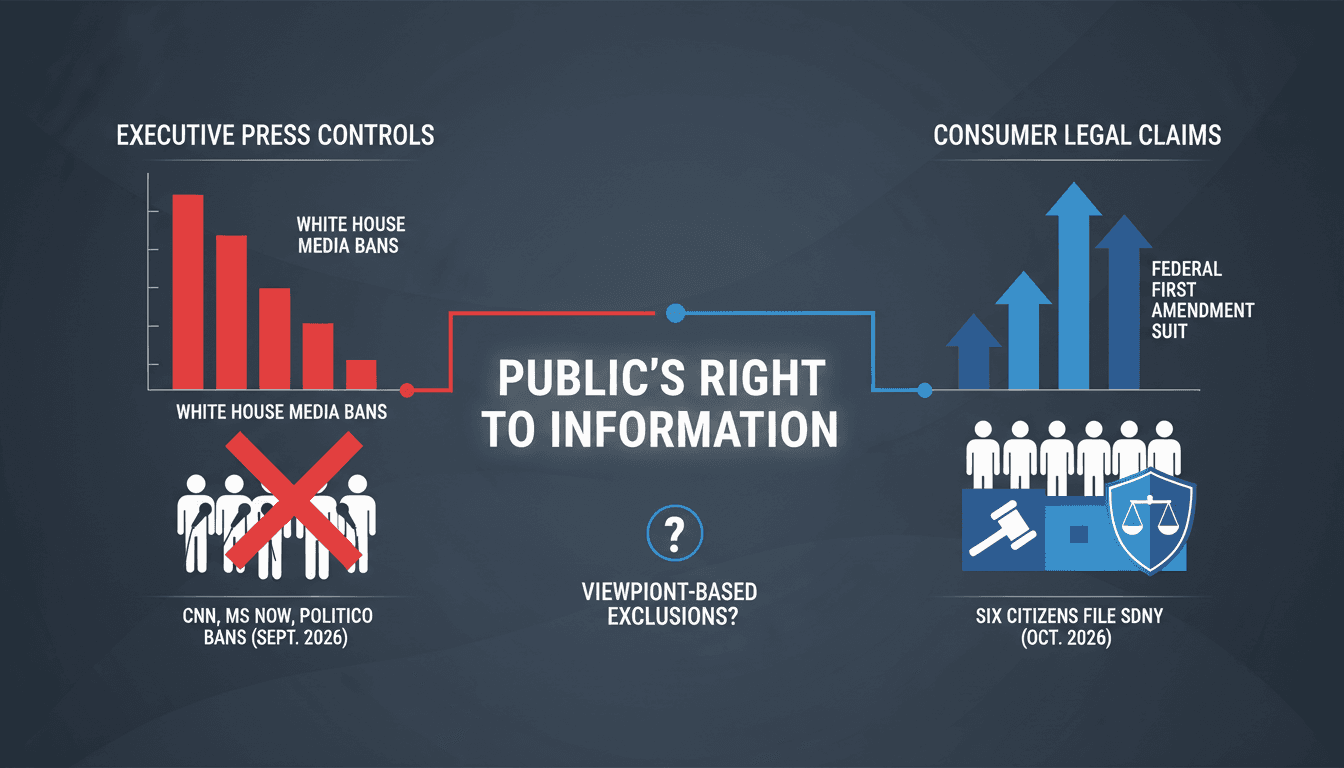
* A novel legal challenge emerged: On October 26, 2026, six private citizens filed a federal lawsuit in the U.S. District Court for the Southern District of New York against Donald Trump and senior administration officials over White House press restrictions. * The legal strategy shifted to the audience: Represented by the Knight First Amendment Institute and Yale Law School's Media Freedom and Information Access Clinic, the plaintiffs—including scholars, educators, advocates, and journalists—assert a constitutional right as information consumers to receive independent executive branch coverage. * The targets are administrative gatekeepers: Alongside Trump, the complaint names White House Chief of Staff Susie Wiles, Communications Director Steven Cheung, and Secret Service Director Sean M. Curran, seeking declaratory and injunctive relief against viewpoint-based media exclusions.
The context you actually need
* Earlier credentials were systematically altered: In September 2026, the administration revoked White House access for journalists from CNN, MS NOW, and Politico, which resulted in a separate lawsuit where a federal judge issued a preliminary injunction restoring limited access. * Secondary restrictions expanded across logistics: Operational constraints extended beyond the briefing room, including access restrictions on the Associated Press, barring a reporter from The Independent from Air Force One, and active administrative proposals to relocate the press corps out of the James S. Brady Press Briefing Room. * The audience is asserting standing: Unlike typical First Amendment disputes led by commercial publishers defending operational access, this action relies entirely on six end-users arguing that selective exclusions directly impair their professional research, teaching, and analysis.
What's really happening
The lawsuit reframes executive credentialing disputes around an audience-centered economic model. Historically, when an administration limits press passes, the institutional publishers bear the litigation costs. In this case, six private individuals—comprising academic scholars, an advocacy director, a Yale professor, and a University of Pennsylvania student journalist—are arguing that the primary constitutional harm falls on the downstream consumer.
The underlying structural tension rests on how information flows from executive power centers to global operators. When administrative offices limit access based on coverage tone, they replace competitive, multi-outlet verification with curated distribution channels. For global professionals who track regulatory shifts, monetary policies, and geopolitical posture, this mechanism alters the clarity of primary data.
The legal mechanism deployed by the Knight First Amendment Institute and Yale Law School challenges the administration's treatment of press access as discretionary hospitality. The plaintiffs argue that the White House press area functions as a limited public forum where viewpoint discrimination is constitutionally impermissible. If the executive branch can select which outlets access direct questioning during official proceedings, the total pool of public information shrinks to match the editorial comfort of the executive.
The litigation also highlights an institutional incentive loop. For executive officials, narrowing access reduces the operational friction of unscripted briefings, limits hostile real-time inquiry, and channels critical narratives into peripheral positions. For news organizations, navigating pass revocations consumes balance sheets and legal bandwidth. By inserting the consumer directly into the legal equation, this lawsuit bypasses the commercial risk calculations of individual publishers.
If this audience-rights doctrine gains judicial traction, it creates a binding precedent where government agencies cannot insulate themselves from critical inquiry without answering to the public reliant on those inquiries. Conversely, if the Southern District of New York dismisses the claim on standing grounds, it confirms that executive credentialing remains an internal administrative prerogative, leaving global observers dependent on whichever news outlets maintain official favor.
Who feels it first (and how)
* Global macro and regulatory analysts: Professionals in cross-border hubs like Dubai, London, and Singapore who rely on unmediated White House reporting to assess trade policy, sanction regimes, and geopolitical developments. * Institutional media companies: Commercial news networks that risk pass revocations during administrative disputes, who may gain legal insulation if audience rights establish a broader shield. * Corporate risk officers: Strategy leaders managing cross-border trade who depend on fast, verifiable institutional intelligence rather than secondary state communications. * Constitutional and appellate legal teams: Litigators tracking whether the Southern District of New York expands public forum doctrines to executive credentialing procedures.
What to watch next
* The jurisdictional motion to dismiss: Watch for the Department of Justice to challenge the six plaintiffs' legal standing, testing whether individual news consumers have concrete, redressable injuries under Article III. * The physical press room relocation plans: Track whether the administration advances formal plans to relocate the press corps out of the West Wing's James S. Brady Press Briefing Room. * Appellate rulings on earlier outlet injunctions: Monitor how the federal courts handle the parallel litigation initiated by CNN, MS NOW, and Politico following their September 2026 preliminary injunction.
Six private citizens filed a First Amendment complaint on October 26, 2026, targeting Donald Trump, Susie Wiles, Steven Cheung, and Sean M. Curran in the Southern District of New York.
The administration will argue that White House credentialing is a discretionary executive function outside the scope of third-party consumer lawsuits.
Whether federal courts will recognize audience information deprivation as an actionable constitutional injury sufficient to halt executive credential revocations.
Frequently Asked Questions
- Why it matters?
- The dispute tests a structural legal theory that could transform media credentials from discretionary executive privileges into legally protected information pipelines for global markets.
- What happened (in 30 seconds)?
- A novel legal challenge emerged: On October 26, 2026, six private citizens filed a federal lawsuit in the U.S. District Court for the Southern District of New York against Donald Trump and senior administration officials over White House press restrictions. The legal strategy shifted to the audience: Represented by the Knight First Amendment Institute and Yale Law School's Media Freedom and Information Access Clinic, the plaintiffs—including scholars, educators, advocates, and journalists—assert
- What's really happening?
- The lawsuit reframes executive credentialing disputes around an audience-centered economic model. Historically, when an administration limits press passes, the institutional publishers bear the litigation costs. In this case, six private individuals—comprising academic scholars, an advocacy director, a Yale professor, and a University of Pennsylvania student journalist—are arguing that the primary constitutional harm falls on the downstream consumer. The underlying structural tension rests on h
- Who feels it first (and how)?
- Global macro and regulatory analysts: Professionals in cross-border hubs like Dubai, London, and Singapore who rely on unmediated White House reporting to assess trade policy, sanction regimes, and geopolitical developments. Institutional media companies: Commercial news networks that risk pass revocations during administrative disputes, who may gain legal insulation if audience rights establish a broader shield. Corporate risk officers: Strategy leaders managing cross-border trade who depend on
- What to watch next?
- The jurisdictional motion to dismiss: Watch for the Department of Justice to challenge the six plaintiffs' legal standing, testing whether individual news consumers have concrete, redressable injuries under Article III. The physical press room relocation plans: Track whether the administration advances formal plans to relocate the press corps out of the West Wing's James S. Brady Press Briefing Room. Appellate rulings on earlier outlet injunctions: Monitor how the federal courts handle the paral
Global news coverage with extensive reporting on Middle Eastern conflicts and geopolitics.
"Al Jazeera is a Qatar-based broadcaster known for wide regional coverage and alternative perspectives."
— A47 Editor
Trump faces private citizens lawsuit over limiting White House media access
A private citizens' lawsuit has been filed against President Trump over restrictions limiting White House media access, with the plaintiffs arguing they are losing access to vital information that media outlets covering Trump previously provided. The...
Comprehensive coverage of Middle Eastern and global issues.
"Al Jazeera is a prominent voice from the Global South, especially the Middle East, with an emphasis on underreported stories."
— A47 Editor
Trump faces private citizens lawsuit over limiting White House media access
A private citizens' lawsuit has been filed against President Trump over restrictions limiting White House media access, with the plaintiffs arguing they are losing access to vital information that media outlets covering Trump previously provided. The...
Capitol Hill news, legislation, and policy insight.
"The Hill specializes in U.S. politics and policy, with a focus on Capitol Hill developments and a reputation for insider reporting."
— A47 Editor
6 citizens sue Trump over White House bans on news outlets
Six individual citizens, including a civics teacher, a legal journalist, a student journalist, a human rights advocate, a historian and a media watchdog, have sued President Donald Trump and administration officials over White House bans and restrict...
Right-of-center views on political news.
"The Washington Times is a conservative-leaning newspaper known for its political coverage and advocacy of right-of-center viewpoints."
— A47 Editor
6 citizens sue Trump, saying media ban deprives them of news as audience stakeholders
Six individual citizens, including a civics teacher, a legal journalist, a student journalist, a human rights advocate, a historian and a media watchdog, have sued President Donald Trump and administration officials over White House bans and restrict...