
Israel Holds Pivotal Knesset Election on October 27 as Netanyahu's Political Future Hangs in Balance
Why it matters
The arithmetic of the 120-seat Knesset directly shapes regional stability, determining whether cross-border commercial frameworks accelerate or stall under prolonged interim governance.
What happened (in 30 seconds)
- National polls concluded: Approximately 7.3 million eligible citizens voted across 12,018 polling stations on October 27, 2026, marking the first national parliamentary vote since the multi-front conflicts that began in October 2023.
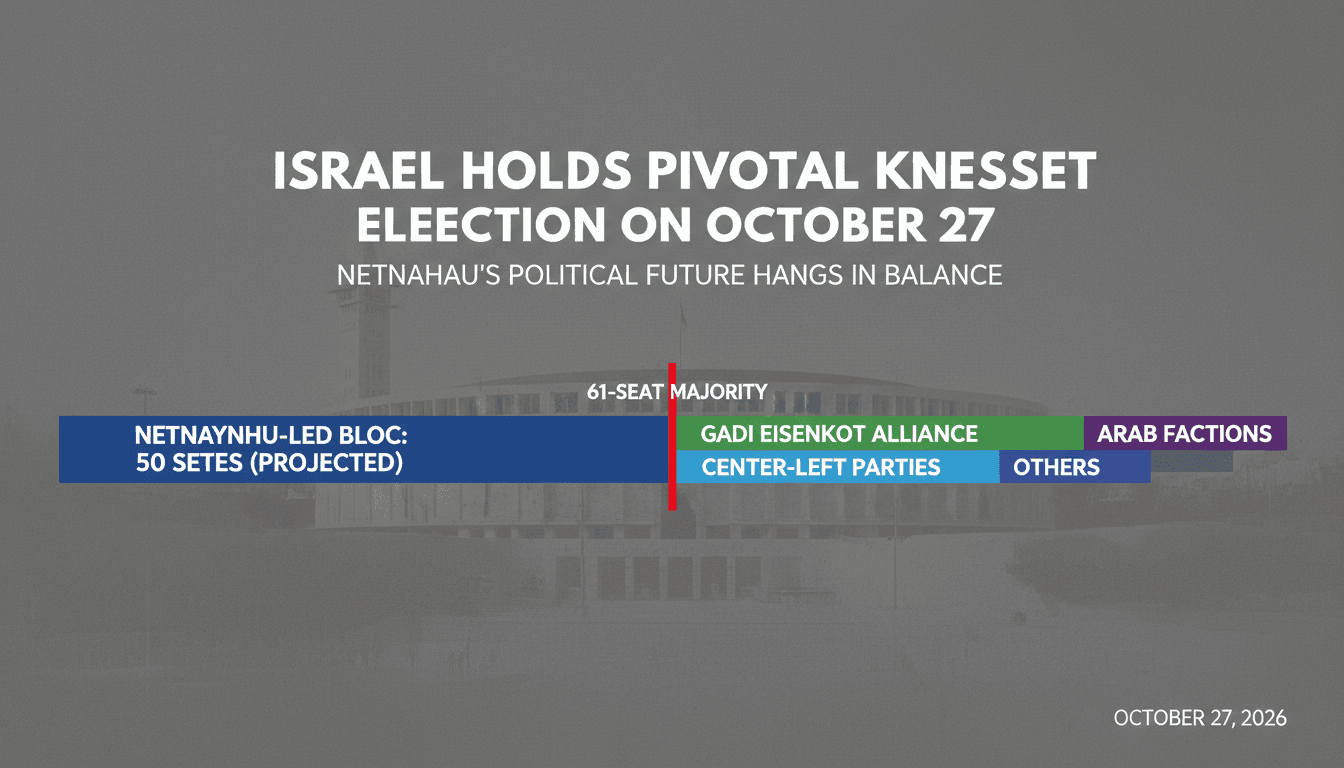
- No decisive victor emerged: Pre-election projections placed Benjamin Netanyahu’s right-wing bloc at roughly 50 seats, while the opposition alliance led by Gadi Eisenkot led slightly, leaving both sides short of the 61-seat threshold required for a governing majority.
- Transition to coalition bargaining: With polls closed as of 10 p.m. local time, formal seat distributions will hand over the political process to weeks of multi-party negotiation, during which the incumbent leadership remains in an interim caretaker capacity.
The context you actually need
- A rare full legislative term: The 25th Knesset completed its statutory term before this vote—the first parliament to do so in several decades—establishing a baseline of structural resilience despite severe regional stress.
- Post-conflict institutional pressures: The election followed extended operations across Gaza, Lebanon, and strategic friction with Iran, bringing domestic security doctrine, military conscription standards, and judicial frameworks to the center of voter turnout.
- The mathematical reality of 120 seats: Israeli governance relies strictly on proportional representation; without 61 aligned lawmakers, executive power cannot pass binding annual budgets or enact structural economic policy, requiring concessions across smaller faction leaders like Itamar Ben-Gvir, Bezalel Smotrich, Naftali Bennett, and Yair Lapid.
What's really happening
The core mechanism shaping Israel's immediate future is not the top-line vote count, but the structural challenge of building a viable governing coalition. Under the parliamentary architecture of the Knesset, reaching the 61-seat threshold requires ideological factions with divergent fiscal and regulatory agendas to sign binding coalition agreements. When pre-election models project the incumbent bloc near 50 seats, the balance of power shifts toward secondary factions holding five to ten seats. These kingmakers extract heavy concessions on fiscal allocations, cabinet portfolios, and legislative programs before agreeing to endorse a Prime Minister.
Because the electorate remains evenly split, executive governance faces an extended phase of caretaker management. Under Israeli law, an outgoing prime minister retains operational authority while formal talks proceed. However, a caretaker government operates under significant statutory constraints: it cannot easily restructure long-term fiscal frameworks, execute major structural reforms, or push controversial statutory measures through a divided parliament. For institutional capital and multinational operators, this means statutory decision-making decelerates. Sovereign initiatives require stable legislative majorities to sustain funding and regulatory continuity, both of which remain paused during negotiations.
The international dimension adds external pressures to these internal calculations. Endorsements such as the public backing from U.S. President Donald Trump underscore that external allies seek a predictable counterparty for regional security accords and trade architectures. The core policy friction involves deciding whether to prioritize the policy agendas of traditional religious and right-wing partners or to construct an alternative centrist bloc around security figures like Gadi Eisenkot. The former route secures cohesive voting discipline on select domestic issues but risks persistent policy friction with external partners. The latter path offers broader baseline stability but requires compromise among rival leaders including Bennett, Lapid, and Eisenkot. Until one bloc secures signatures representing 61 lawmakers, sovereign administration remains transactional, reactive, and defined by short-term political preservation.
Who feels it first (and how)
- Regional corporate strategists in Dubai and the Gulf: Commercial entities managing bilateral trade, aviation links, and tech ventures face a holding pattern on bilateral agreements until a confirmed cabinet clarifies trade priorities.
- Energy and infrastructure developers: Cross-border natural gas pipelines, regional power-grid connectivity plans, and Mediterranean offshore exploration face administrative slowdowns while statutory energy portfolios remain tied to coalition talks.
- Venture capital and tech founders: Companies relying on domestic state research-and-development grants or clarity on military conscription exemptions must navigate operational uncertainty regarding human capital and tax policy.
- Cross-border logistics operators: Supply chains navigating regional transit corridors operate under heightened border protocols and security closures without clarity on when standard border operations will normalize.
What to watch next
- The formal recommendation tally: The state president will consult with all party delegations to tally recommendations; whichever candidate gathers the initial mandate to form a government establishes the operational baseline for executive policy.
- Caretaker cabinet duration: Track whether coalition discussions exceed the standard initial four-week window; an extended impasse prolongs caretaker rule, freezing non-essential regulatory updates and fiscal disbursements.
- Secondary faction demands: Monitor platform announcements from middle-tier party leaders including Smotrich, Ben-Gvir, Bennett, and Lapid, which signal the policy concessions required to close the gap to 61 seats.
The election for the 26th Knesset was completed on October 27, 2026, across 12,018 voting stations with 7.3 million eligible citizens, following a full parliamentary term by the 25th Knesset.
Formal coalition negotiations will span multiple weeks, leaving Benjamin Netanyahu in place as head of an interim caretaker administration while neither bloc holds a clear majority.
Whether the centrist opposition factions can reconcile internal leadership ambitions to assemble 61 seats, or whether a prolonged deadlock forces a return to the ballot box.
Frequently Asked Questions
- Why it matters?
- The arithmetic of the 120-seat Knesset directly shapes regional stability, determining whether cross-border commercial frameworks accelerate or stall under prolonged interim governance.
- What happened (in 30 seconds)?
- National polls concluded: Approximately 7.3 million eligible citizens voted across 12,018 polling stations on October 27, 2026, marking the first national parliamentary vote since the multi-front conflicts that began in October 2023. No decisive victor emerged: Pre-election projections placed Benjamin Netanyahu’s right-wing bloc at roughly 50 seats, while the opposition alliance led by Gadi Eisenkot led slightly, leaving both sides short of the 61-seat threshold required for a governing majority
- What's really happening?
- The core mechanism shaping Israel's immediate future is not the top-line vote count, but the structural challenge of building a viable governing coalition. Under the parliamentary architecture of the Knesset, reaching the 61-seat threshold requires ideological factions with divergent fiscal and regulatory agendas to sign binding coalition agreements. When pre-election models project the incumbent bloc near 50 seats, the balance of power shifts toward secondary factions holding five to ten seats.
- Who feels it first (and how)?
- Regional corporate strategists in Dubai and the Gulf: Commercial entities managing bilateral trade, aviation links, and tech ventures face a holding pattern on bilateral agreements until a confirmed cabinet clarifies trade priorities. Energy and infrastructure developers: Cross-border natural gas pipelines, regional power-grid connectivity plans, and Mediterranean offshore exploration face administrative slowdowns while statutory energy portfolios remain tied to coalition talks. Venture capital
- What to watch next?
- The formal recommendation tally: The state president will consult with all party delegations to tally recommendations; whichever candidate gathers the initial mandate to form a government establishes the operational baseline for executive policy. Caretaker cabinet duration: Track whether coalition discussions exceed the standard initial four-week window; an extended impasse prolongs caretaker rule, freezing non-essential regulatory updates and fiscal disbursements. Secondary faction demands: Mon
Arabic-language coverage of international news and geopolitics.
"RT Arabic is a Russian state-funded outlet often criticized for promoting Kremlin-aligned narratives."
— A47 Editor
الانتخابات الإسرائيلية اليوم.. اقتراع مفصلي بلا حسم مضمون ومستقبل نتنياهو على المحك
Israelis head to the polls today, Tuesday, to elect the 26th Knesset, in a vote that analysts describe as pivotal for the political future of Benjamin Netanyahu and for the direction of Israel's political and security policy, with no certain outcome ...
Pan-Arab political news and analysis.
"Al-Quds Al-Arabi is a London-based Arabic newspaper known for political coverage."
— A47 Editor
فايننشال تايمز: عودة نتنياهو وتحالفه إلى السلطة ستقود المنطقة إلى مزيد من الكوارث
The Financial Times published an editorial stating that the return to power of Israeli Prime Minister Benjamin Netanyahu and his coalition after winning a new term will lead the region toward further catastrophe. The article recalls that three years ...
Arabic-language coverage of political affairs and current events.
"Okaz political coverage typically follows mainstream Saudi framing on national and regional affairs."
— A47 Editor
الإسرائيليون ينتخبون غداً.. هل يرحل نتنياهو وتبقى السياسات المتطرفة؟
Israelis are heading to the polls on Tuesday in a general election marked by deep political and social division, following the October 7 attack and the war in Gaza. The vote pits incumbent Benjamin Netanyahu against challenger Gadi Eisenkot, with the...
Arabic-language coverage of international news and geopolitics.
"RT Arabic is a Russian state-funded outlet often criticized for promoting Kremlin-aligned narratives."
— A47 Editor
حتى بلا فوز.. الجمود الانتخابي يمنح نتنياهو أشهرا لتوجيه ضربة إلى إيران
Rhe Wall Street Journal reported that Israel's scheduled election on Tuesday may not end Benjamin Netanyahu's tenure, even without a clear victory for his bloc, as electoral deadlock could give him several months to pursue a strike on Iran.