
Gadi Eisenkot Leads Polls as Principal Challenger to Netanyahu Ahead of October 27 Israeli Election
Why it matters
Leadership rotation in Jerusalem tests the durability of regional economic ties against new defense timelines, signaling how security mandates will govern cross-border capital flows.
What happened (in 30 seconds)
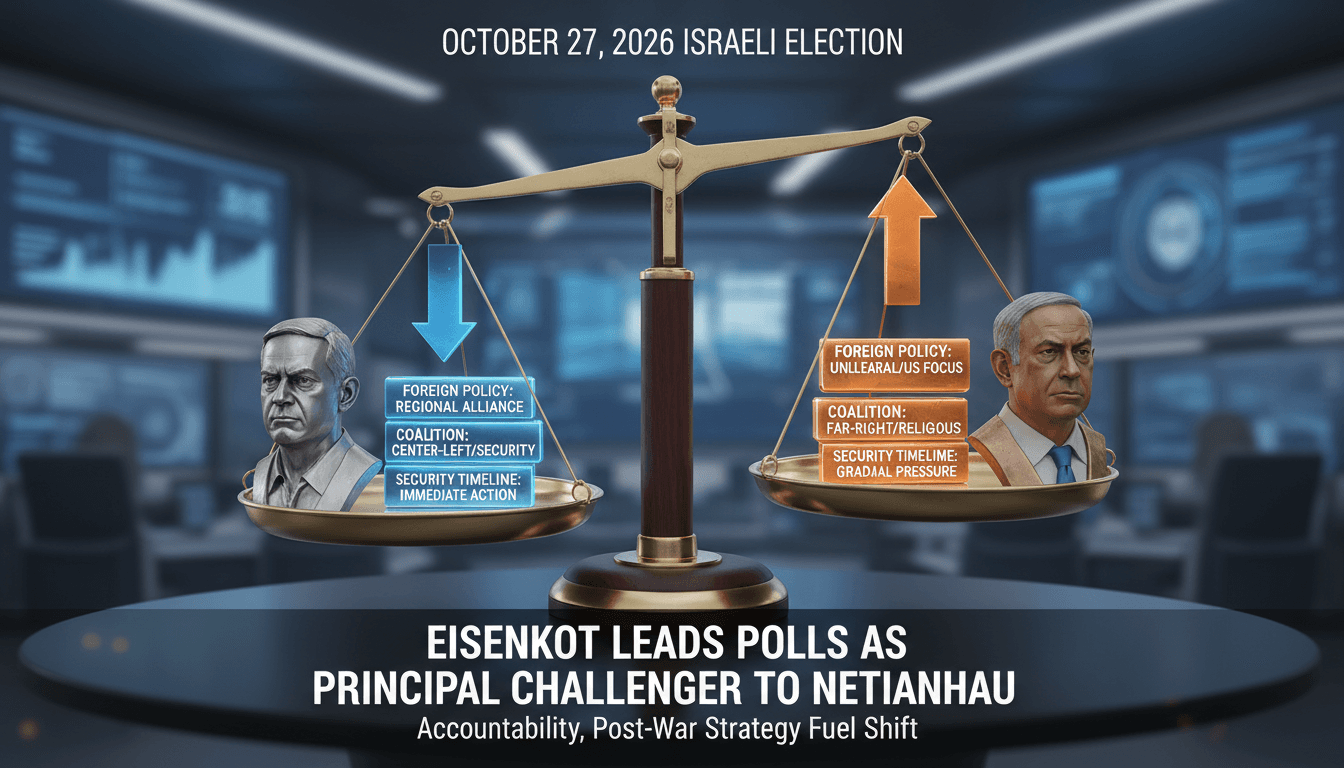
- A new challenger leads the polls: Former IDF Chief of Staff Gadi Eisenkot and his centrist Yashar party entered the October 27, 2026 legislative election leading Prime Minister Benjamin Netanyahu’s Likud party in public surveys.
- The campaign centers on security accountability: Eisenkot built his platform on establishing a state commission of inquiry into the October 7, 2023 failures and concluding the operation to dismantle Hamas's military capabilities within an 18-month window.
- The incumbent faces a fragmented coalition landscape: Netanyahu countered by securing backing from U.S. President Donald Trump and framing the race around Iranian deterrence, while Eisenkot ruled out serving in any future Netanyahu-led cabinet.
The context you actually need
- A war cabinet departure shaped the current field: Eisenkot joined Netanyahu’s emergency war cabinet in late 2023 following the October 7 attacks, but resigned in June 2024 over disagreements regarding post-war strategy and political interference.
- A party vehicle was built for this cycle: After leaving military service and entering formal politics in 2022, Eisenkot launched the Yashar ("Straight") party in 2025 to organize defense-minded voters dissatisfied with prolonged governance and far-right alliances.
- Regional frameworks provide structural continuity: For international hubs like Dubai, cross-border diplomatic and commercial normalization under the Abraham Accords framework is structured to persist independent of cabinet transitions in Jerusalem.
What's really happening
The electoral contest between Benjamin Netanyahu and Gadi Eisenkot reflects structural pressures within Israel’s security apparatus rather than an ideological swing toward the traditional political left. Eisenkot’s Yashar party is not offering a conciliatory foreign policy platform. Instead, it offers a managerial realignment of defense strategy. Eisenkot maintains conservative security positions—including explicit opposition to Palestinian statehood and long-standing support for disproportionate force doctrines—while challenging the administrative efficacy and political alliances of the incumbent administration.
For international operators and regional markets, the central variable is coalition mechanics within the Knesset. While polling in late October 2026 placed Yashar ahead of Likud, Israel’s proportional representation system requires 61 seats to form an executive governing bloc. A plurality of votes does not guarantee an immediate mandate. If Yashar secures the lead, Eisenkot must assemble a coalition across center-left, centrist, and anti-Netanyahu right-wing factions. These factions share little ideological cohesion beyond their opposition to the incumbent and their demand for a state commission of inquiry into the events of October 7, 2023.
Netanyahu’s incentive structure focuses on consolidating right-wing support by positioning the race as a binary choice on foreign policy firmness, specifically regarding Iran. Endorsements from U.S. President Donald Trump reinforce this defense-first posture, attempting to neutralize Eisenkot’s military credentials. Conversely, Eisenkot’s platform introduces a specific execution target: dismantling Hamas’s military infrastructure within an 18-month timeline alongside a mandatory administrative inquiry.
Despite heated domestic campaign messaging, the external economic architecture of the Middle East demonstrates institutional insulation. Trade corridors, bilateral investments, and diplomatic channels established under the Abraham Accords remain insulated from domestic parliamentary turnover. Regional capitals, including Dubai, view the election through the lens of contract continuity and regional predictability. The fundamental calculus for regional enterprise remains unchanged: commercial normalization is anchored to state-level agreements and sovereign trade structures that outlast parliamentary cycles.
Who feels it first (and how)
- Israeli capital markets: Domestic bond and equity desks experience immediate volatility as pricing models adjust for potential shifts in coalition stability and security timelines.
- Cross-border trade desks in the UAE: Corporate entities managing logistics and financial corridors operate without disruption, as trade mechanisms under the Abraham Accords remain protected by institutional treaties.
- Regional defense planners: Military and intelligence analysts recalibrate planning around Eisenkot’s explicit 18-month operational window versus the incumbent’s open-ended deterrence strategy.
- Centrist and right-leaning Knesset factions: Coalition negotiators face high-stakes bargaining as they balance participating in an Eisenkot unity bloc against the risk of renewed parliamentary deadlock.
What to watch next
- Final coalition mathematics: The specific seat distribution in the Knesset will determine whether Eisenkot can form a viable working majority without incorporating conflicting political extremes.
- Implementation of the 18-month defense mandate: If elected, the speed at which an Eisenkot administration initiates the October 7 inquiry will signal how quickly defense leadership pivots to strategic conclusion.
- Bilateral policy alignment with Washington: Monitor how the incoming Israeli executive interacts with U.S. President Donald Trump's administration regarding joint defense postures on Iran.
Yashar entered the October 27, 2026 election holding a polling lead over Likud; Eisenkot has categorically refused to join any government led by Netanyahu; both candidates maintain hawkish defense platforms.
The Abraham Accords framework will maintain steady operational continuity, preserving economic and diplomatic stability between Israel and the UAE regardless of the final prime ministerial appointment.
Whether Yashar’s polling lead translates into a stable 61-seat Knesset governing majority, or if fragmented party returns will trigger prolonged coalition deadlock.
Frequently Asked Questions
- Why it matters?
- Leadership rotation in Jerusalem tests the durability of regional economic ties against new defense timelines, signaling how security mandates will govern cross-border capital flows.
- What happened (in 30 seconds)?
- A new challenger leads the polls: Former IDF Chief of Staff Gadi Eisenkot and his centrist Yashar party entered the October 27, 2026 legislative election leading Prime Minister Benjamin Netanyahu’s Likud party in public surveys. The campaign centers on security accountability: Eisenkot built his platform on establishing a state commission of inquiry into the October 7, 2023 failures and concluding the operation to dismantle Hamas's military capabilities within an 18-month window. The incumbent f
- What's really happening?
- The electoral contest between Benjamin Netanyahu and Gadi Eisenkot reflects structural pressures within Israel’s security apparatus rather than an ideological swing toward the traditional political left. Eisenkot’s Yashar party is not offering a conciliatory foreign policy platform. Instead, it offers a managerial realignment of defense strategy. Eisenkot maintains conservative security positions—including explicit opposition to Palestinian statehood and long-standing support for disproportionat
- Who feels it first (and how)?
- Israeli capital markets: Domestic bond and equity desks experience immediate volatility as pricing models adjust for potential shifts in coalition stability and security timelines. Cross-border trade desks in the UAE: Corporate entities managing logistics and financial corridors operate without disruption, as trade mechanisms under the Abraham Accords remain protected by institutional treaties. Regional defense planners: Military and intelligence analysts recalibrate planning around Eisenkot’s e
- What to watch next?
- Final coalition mathematics: The specific seat distribution in the Knesset will determine whether Eisenkot can form a viable working majority without incorporating conflicting political extremes. Implementation of the 18-month defense mandate: If elected, the speed at which an Eisenkot administration initiates the October 7 inquiry will signal how quickly defense leadership pivots to strategic conclusion. Bilateral policy alignment with Washington: Monitor how the incoming Israeli executive inte
Conservative-leaning political and national coverage.
"The Washington Times is a conservative-leaning newspaper known for its political coverage and advocacy of right-of-center viewpoints."
— A47 Editor
Who is Gadi Eisenkot? Former top Israeli general seeking to oust Benjamin Netanyahu
Gadi Eisenkot, a retired lieutenant general and former chief of staff of the Israel Defense Forces, is widely seen as the most likely figure to replace Prime Minister Benjamin Netanyahu if he loses power in Israel's general election on October 27, 20...
European coverage of Middle East politics and security issues.
"France 24 offers international reporting with a European editorial perspective."
— A47 Editor
Israeli candidate Eisenkot pledges to unite country as Netanyahu deems him 'soft' on Iran
Israeli presidential candidate Gadi Eisenkot used his final campaign rally on Sunday to pledge to "heal" Israeli society after the divisive tenure of Prime Minister Benjamin Netanyahu, as polling begins Tuesday. Netanyahu meanwhile received fresh bac...
24/7 international news from a French perspective in multiple languages.
"France 24 is viewed as a globally focused outlet with balanced coverage and a European perspective."
— A47 Editor
Israeli candidate Eisenkot pledges to unite country as Netanyahu deems him 'soft' on Iran
Israeli presidential candidate Gadi Eisenkot used his final campaign rally on Sunday to pledge to "heal" Israeli society after the divisive tenure of Prime Minister Benjamin Netanyahu, as polling begins Tuesday. Netanyahu meanwhile received fresh bac...
Regional coverage and analysis focused on politics, diplomacy, and business across the Middle East.
"Al-Monitor is known for analytical reporting on Middle East politics and policy developments."
— A47 Editor
Israel's Eisenkot vows unity as Netanyahu paints him as soft on Iran
Israeli election contender Gadi Eisenkot held his final major rally before the October 27, 2026 vote, pledging to unite the country, while Prime Minister Benjamin Netanyahu received fresh backing from US President Donald Trump. Eisenkot has pledged a...