
US Midterm Elections 2026 Set to Decide Congressional Control for Remainder of Trump Term
Why it matters
The division of legislative power establishes the statutory framework for economic policy, federal debt ceilings, and global trade posture across the final two years of the presidential term.
What happened (in 30 seconds)
- Nationwide ballot on November 3, 2026: Approximately 210 million registered voters decide all 435 seats in the US House of Representatives, 35 seats in the US Senate, and 36 governorships.
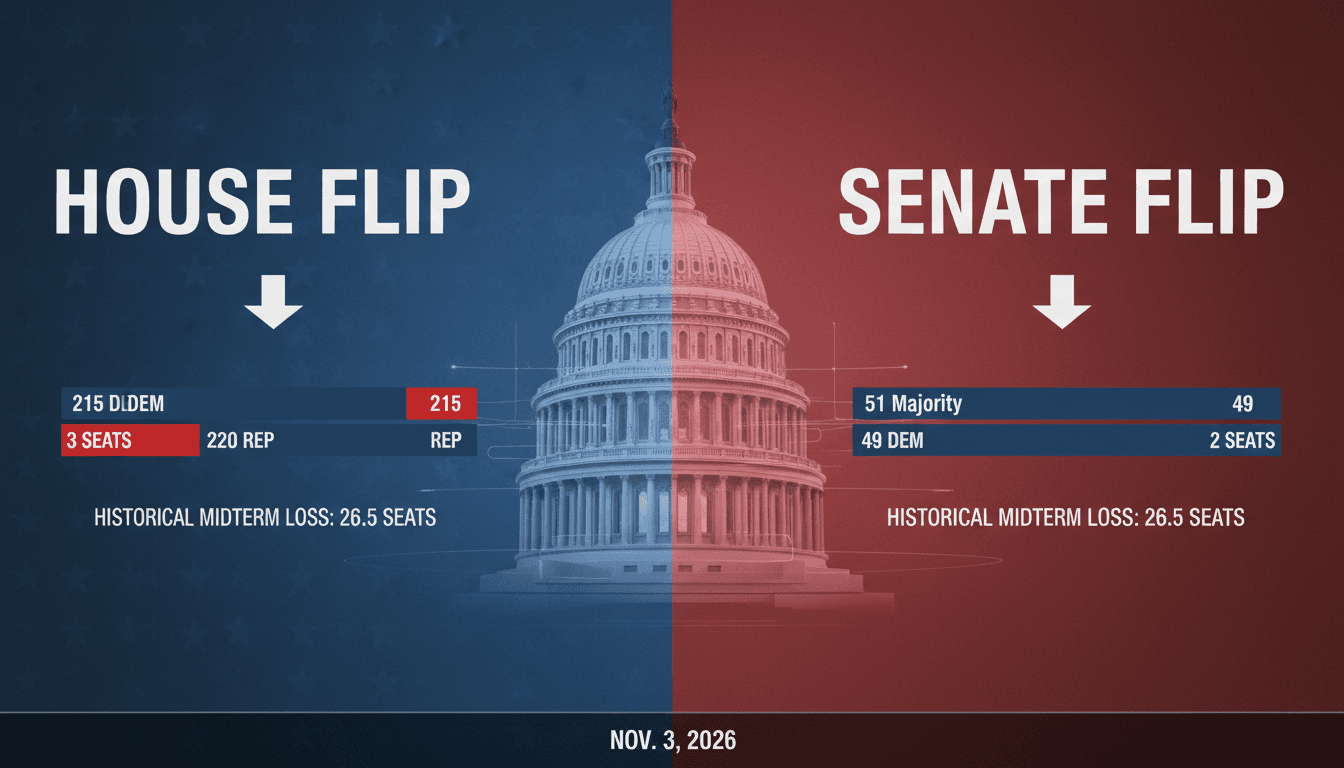
- Narrow thresholds for power: Democrats require a net gain of three seats to capture the House and four seats to flip the Senate, where Republicans currently hold majorities in both chambers.
- A defensive terrain for the majority: The Senate landscape requires the Republican Party to defend 22 out of the 35 seats contested, including competitive races in states such as Georgia, Michigan, Maine, North Carolina, and Ohio.
The context you actually need
- Historical midterm trends: Since 1946, the political party holding the White House loses an average of 26.5 House seats during midterm cycles, creating structural headwinds for the incumbent party.
- Structural baseline shifts: Post-2024 congressional redistricting provided baseline advantages to Republican districts in several states, raising the efficiency threshold Democrats need to gain seat majorities.
- Domestic economic drivers: Electorate participation tracks kitchen-table variables, with voter decision-making primarily organized around cost of living, healthcare coverage, and household budgeting.
What's really happening
The November 2026 midterms operate as a functional checkpoint on federal administrative capacity. The governance mechanics of the US system mean that single-party control versus a divided legislature fundamentally alters the flow of policy execution. When one party holds both the executive branch and both chambers of Congress, statutory change moves along party lines through budget reconciliation and routine legislative packaging. In contrast, divided government redirects administrative priorities away from expansive statutory programs toward executive orders, administrative rulemaking, and defensive oversight.
Because Democrats need a net pickup of only three seats in the House of Representatives, minor shifts in voter turnout across competitive suburban and mixed districts determine control of federal appropriations. The House holds constitutional primacy over revenue bills and committee subpoenas. A transition to Democratic control in the House immediately reorganizes committee leadership, replacing current legislative dockets with investigative oversight into executive branch operations, regulatory enforcement, and spending allocations. This shifts the executive branch's bandwidth from legislative advancement to regulatory defense.
In the Senate, the math is defined by asymmetric defense. Defending 22 of 35 seats strains campaign capital and ground resources across a wider map. While flipping the Senate requires a net four-seat swing for Democrats, the chamber's institutional duties make every seat consequential for judicial confirmations, executive appointments, and treaty ratifications. A split Congress—where one party holds the House and the other retains the Senate—creates an institutional bottleneck. Under that structure, omnibus spending measures and debt limit negotiations require strict compromise, preventing unilateral policy swings while increasing the likelihood of legislative stalemates.
For international stakeholders and markets, the core incentive structure hinges on stability versus friction. Under unified governance, policy changes arrive through statutory law, which offers baseline durability over a multi-year horizon. Under divided government, legislative action freezes, pushing presidents to rely on regulatory authority, trade tariffs, and foreign policy mechanisms where the executive holds broader autonomous authority. This dynamic channels domestic political friction straight into foreign policy and global trade directives.
Who feels it first (and how)
- Global energy markets: Potential legislative pivots affect federal energy leasing frameworks, domestic production regulations, and strategic reserve policies, driving price signals internationally.
- Dubai-based corporate operators: Expatriates and multinationals operating out of global commercial hubs like Dubai face downstream shifts in cross-border trade tariffs, financial compliance mandates, and foreign policy developments involving key regional actors like Iran.
- Institutional investors and corporate treasuries: Portfolio allocations recalibrate based on prediction market signals around legislative oversight, federal spending caps, and the likelihood of divided government.
- State-level administrative bodies: Election administrators in battleground jurisdictions encounter prolonged verification timelines, mail-in ballot processing windows, and potential runoffs.
What to watch next
- Early returns from East Coast battlegrounds: Initial results after 6:00 p.m. Eastern Time in key Eastern and Midwestern districts provide the first statistical indicators of national suburban vote margins.
- Mail-in ballot certification schedules: Extended counting windows across key western states and urban counties will determine the final composition of razor-thin House majorities over several days or weeks.
- The Georgia Senate runoff date: A potential December 1, 2026 runoff scenario in Georgia could delay the formal confirmation of Senate majority control past election night.
All 435 House seats, 35 Senate seats, and 36 governor positions are on the ballot, with 210 million registered voters eligible to participate nationwide.
The final margin of victory in both chambers will remain tight, with House control determined by fewer than ten individual district outcomes across the country.
Whether final Senate control is confirmed within 48 hours of poll closings or delayed into December by state-specific runoff thresholds and legal certification challenges.
Frequently Asked Questions
- Why it matters?
- The division of legislative power establishes the statutory framework for economic policy, federal debt ceilings, and global trade posture across the final two years of the presidential term.
- What happened (in 30 seconds)?
- Nationwide ballot on November 3, 2026: Approximately 210 million registered voters decide all 435 seats in the US House of Representatives, 35 seats in the US Senate, and 36 governorships. Narrow thresholds for power: Democrats require a net gain of three seats to capture the House and four seats to flip the Senate, where Republicans currently hold majorities in both chambers. A defensive terrain for the majority: The Senate landscape requires the Republican Party to defend 22 out of the 35 seat
- What's really happening?
- The November 2026 midterms operate as a functional checkpoint on federal administrative capacity. The governance mechanics of the US system mean that single-party control versus a divided legislature fundamentally alters the flow of policy execution. When one party holds both the executive branch and both chambers of Congress, statutory change moves along party lines through budget reconciliation and routine legislative packaging. In contrast, divided government redirects administrative prioriti
- Who feels it first (and how)?
- Global energy markets: Potential legislative pivots affect federal energy leasing frameworks, domestic production regulations, and strategic reserve policies, driving price signals internationally. Dubai-based corporate operators: Expatriates and multinationals operating out of global commercial hubs like Dubai face downstream shifts in cross-border trade tariffs, financial compliance mandates, and foreign policy developments involving key regional actors like Iran. Institutional investors and c
- What to watch next?
- Early returns from East Coast battlegrounds: Initial results after 6:00 p.m. Eastern Time in key Eastern and Midwestern districts provide the first statistical indicators of national suburban vote margins. Mail-in ballot certification schedules: Extended counting windows across key western states and urban counties will determine the final composition of razor-thin House majorities over several days or weeks. The Georgia Senate runoff date: A potential December 1, 2026 runoff scenario in Georgia
Global news coverage with extensive reporting on Middle Eastern conflicts and geopolitics.
"Al Jazeera is a Qatar-based broadcaster known for wide regional coverage and alternative perspectives."
— A47 Editor
US midterm elections 2026 in maps and charts
On November 3, Americans will decide which party controls the US Congress for the second half of Donald Trump's presidency, with all 435 House seats and a portion of the Senate at stake, according to Al Jazeera's visual guide to the 2026 midterm elec...
Comprehensive coverage of Middle Eastern and global issues.
"Al Jazeera is a prominent voice from the Global South, especially the Middle East, with an emphasis on underreported stories."
— A47 Editor
US midterm elections 2026 in maps and charts
On November 3, Americans will decide which party controls the US Congress for the second half of Donald Trump's presidency, with all 435 House seats and a portion of the Senate at stake, according to Al Jazeera's visual guide to the 2026 midterm elec...
News from the United States including domestic politics, society, and culture.
"The Guardian is known for its progressive editorial stance and in-depth analysis, often advocating for social justice, environmental issues, and liberal values."
— A47 Editor
What are the US midterm elections and why do they matter?
The 2026 US midterm elections, scheduled for 3 November, will determine whether Republicans retain control of Congress or whether Democrats gain power to check Donald Trump's agenda, with all 435 House seats and a portion of the Senate at stake. The ...
Top international stories selected by The Guardian editors.
"The Guardian is known for its progressive editorial stance and in-depth analysis."
— A47 Editor
What are the US midterm elections and why do they matter?
The 2026 US midterm elections, scheduled for 3 November, will determine whether Republicans retain control of Congress or whether Democrats gain power to check Donald Trump's agenda, with all 435 House seats and a portion of the Senate at stake. The ...
Regional coverage and analysis focused on politics, diplomacy, and business across the Middle East.
"Al-Monitor is known for analytical reporting on Middle East politics and policy developments."
— A47 Editor
Explainer-Four ways US foreign policy could change if Democrats win in November
Reuters reports, via Al-Monitor, that nonpartisan analysts see a good chance Democrats could win control of the US House and possibly the Senate in the November 3 midterm elections, which would give them a share of power in Washington after two years...