
Algeria Authorizes First Overseas Ground Deployment Since 1973 to Protect Sonatrach Energy Assets in Niger
Why it matters
The formal deployment of Algerian forces beyond national borders alters regional security doctrine to protect physical hydrocarbons, linking energy infrastructure directly to state military guarantees.
What happened (in 30 seconds)
* Official authorization granted: On October 26, 2026, Algerian President Abdelmadjid Tebboune formally authorized the deployment of People's National Army units to Niger. * Legislative foundation established: Both houses of the Algerian Parliament approved the measure unanimously in closed sessions on October 25, 2026, citing constitutional articles 30 and 91. * Infrastructure defense mandate: Following an official request from authorities in Niger, the mandate tasks units with safeguarding shared economic and energy assets, specifically Sonatrach projects in Madama near the Libyan border.
The context you actually need
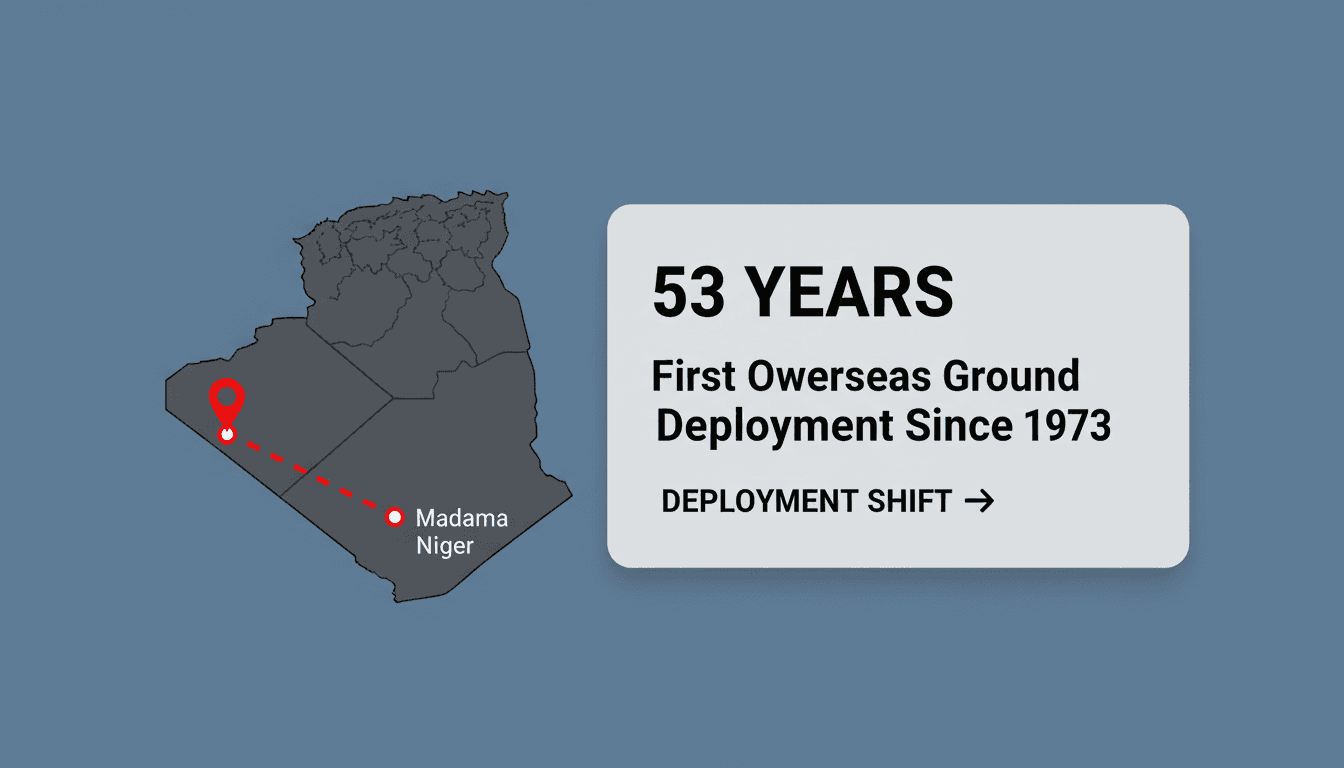
* A 53-year precedent shifted: This intervention represents Algeria's first foreign deployment of ground troops since supporting Egypt in the 1973 Arab-Israeli War. * Deepened regional coordination: Niger has operated under military rule since July 2023; Algeria previously extended air support during an August 2026 mutiny attempt and finalized a formal military cooperation protocol in October 2026. * Strategic assets at stake: Bilateral economic exposure includes upstream installations run by Algerian state firm Sonatrach and planning around the Trans-Saharan Gas Pipeline project amid broad Sahel security friction.
What's really happening
The decision to send Algerian military units to northern Niger reflects structural shifts in economic asset preservation across the Sahel. For over five decades, Algeria maintained a strict non-intervention posture, avoiding foreign ground deployments. The shift to deploying units into Niger demonstrates how sovereign energy investments dictate defensive policy when adjacent operating environments face chronic friction.
The target of this deployment is Madama, a remote area in northern Niger near the Libyan border where Algeria’s state energy producer, Sonatrach, holds significant upstream project interests. Securing extraction and transport infrastructure in border environments requires continuous static and mobile defense. Operating these assets without direct physical defense exposes critical balance sheets to disruptions from regional armed groups active across the Sahel.
The institutional process behind this decision illustrates clear strategic consensus within Algeria. A presidential notification moved to parliament on October 22, 2026, receiving unanimous backing across both chambers on October 25 under constitutional articles 30 and 91. The legal mechanics show that securing cross-border energy operations is treated not merely as corporate field security, but as an integral component of national economic continuity.
The bilateral relationship between Algiers and Niamey has undergone structural alignment since Niger’s July 2023 change in governance. While Algeria initially opposed the ouster of President Mohamed Bazoum, practical interests rapidly realigned around border stability and shared infrastructure. This alignment materialized progressively: Algerian air support during an August 2026 mutiny attempt preceded a structured bilateral military cooperation protocol signed in October 2026. The ground deployment is the operational realization of that legal and strategic architecture.
At the systemic level, the Trans-Saharan Gas Pipeline initiative demands stability over thousands of kilometers of vulnerable terrain. When states cannot guarantee physical integrity along these transport conduits, long-term capital commitments stall. By positioning conventional army units on Nigerien soil at Niamey’s explicit request, Algeria establishes an operational perimeter around its capital investments, signaling that vital export corridors will be defended through sovereign force rather than ad hoc third-party security arrangements.
Who feels it first (and how)
* Sahel Infrastructure and Energy Operators: Engineering teams, pipeline planners, and operations managers at Sonatrach and partner ventures gain direct state-backed security perimeters around Madama facilities. * Regional Security Strategists and Border Planners: Military analysts across North and West Africa must recalculate regional deterrent structures as Algeria actively deploys regular ground forces beyond sovereign borders. * Global Hydrocarbon Procurement Desks: Long-range buyers assessing prospective African gas supplies through the Trans-Saharan Gas Pipeline network observe state willingness to physically underwrite transport security.
What to watch next
* Operational deployment footprints: Monitor reports detailing troop counts, logistics hubs, and base structures established around Madama to gauge the tactical scale of the mission. * Bilateral legal protocols: Watch for follow-up agreements clarifying rules of engagement between the People's National Army and Nigerien armed forces during joint patrols. * Trans-Saharan Gas Pipeline development milestones: Track whether enhanced site security leads to renewed project financing and field surveys along the northern transit routes.
President Abdelmadjid Tebboune authorized the deployment on October 26, 2026, following unanimous parliamentary approval under constitutional articles 30 and 91, marking the first foreign ground operation since 1973 to protect Sonatrach assets in Madama.
The presence of regular Algerian forces will stabilize the immediate perimeter around designated energy facilities, reducing supply and personnel disruption risks in northern Niger.
Total troop numbers, field duration, the precise rules of engagement for combat scenarios, and whether the defensive perimeter will expand along broader pipeline routes remain undisclosed.
Frequently Asked Questions
- Why it matters?
- The formal deployment of Algerian forces beyond national borders alters regional security doctrine to protect physical hydrocarbons, linking energy infrastructure directly to state military guarantees.
- What happened (in 30 seconds)?
- Official authorization granted: On October 26, 2026, Algerian President Abdelmadjid Tebboune formally authorized the deployment of People's National Army units to Niger. Legislative foundation established: Both houses of the Algerian Parliament approved the measure unanimously in closed sessions on October 25, 2026, citing constitutional articles 30 and 91. Infrastructure defense mandate: Following an official request from authorities in Niger, the mandate tasks units with safeguarding shared ec
- What's really happening?
- The decision to send Algerian military units to northern Niger reflects structural shifts in economic asset preservation across the Sahel. For over five decades, Algeria maintained a strict non-intervention posture, avoiding foreign ground deployments. The shift to deploying units into Niger demonstrates how sovereign energy investments dictate defensive policy when adjacent operating environments face chronic friction. The target of this deployment is Madama, a remote area in northern Niger ne
- Who feels it first (and how)?
- Sahel Infrastructure and Energy Operators: Engineering teams, pipeline planners, and operations managers at Sonatrach and partner ventures gain direct state-backed security perimeters around Madama facilities. Regional Security Strategists and Border Planners: Military analysts across North and West Africa must recalculate regional deterrent structures as Algeria actively deploys regular ground forces beyond sovereign borders. Global Hydrocarbon Procurement Desks: Long-range buyers assessing pro
- What to watch next?
- Operational deployment footprints: Monitor reports detailing troop counts, logistics hubs, and base structures established around Madama to gauge the tactical scale of the mission. Bilateral legal protocols: Watch for follow-up agreements clarifying rules of engagement between the People's National Army and Nigerien armed forces during joint patrols. Trans-Saharan Gas Pipeline development milestones: Track whether enhanced site security leads to renewed project financing and field surveys along
Arabic-language coverage of international news and geopolitics.
"RT Arabic is a Russian state-funded outlet often criticized for promoting Kremlin-aligned narratives."
— A47 Editor
تبون يقرر إرسال وحدات من الجيش الجزائري إلى النيجر لحماية المصالح المشتركة
Algeria's presidency announced on Monday that President Abdelmadjid Tebboune has decided to deploy units of the National People's Army to Niger, with the stated aim of ensuring the protection of shared energy and economic interests between the two co...
Algerian news with politics, society, and sports coverage.
"Ennahar Online is a high-volume Algerian outlet."
— A47 Editor
إرسال وحدات من الجيش إلى النيجر.. دعم حزبي للقرار السيادي
Algerian political parties and national organizations have expressed support for the decision to send units of the National Popular Army to Niger, as reported by the Algerian News Agency. The move is framed as a strategic step to protect the country'...
Algerian news with politics, society, and sports coverage.
"Ennahar Online is a high-volume Algerian outlet."
— A47 Editor
الرئيس تبون يقرر إرسال وحدات من الجيش الوطني الشعبي إلى النيجر
President Abdelmadjid Tebboune has decided to send units of the National Popular Army to the Republic of Niger, aimed at protecting shared energy and economic interests between the two countries. According to a statement from the Presidency of the Re...