
US Senator Presses Musk on Starlink Speed Limits Affecting Ukrainian Drone Operations and Air Defense
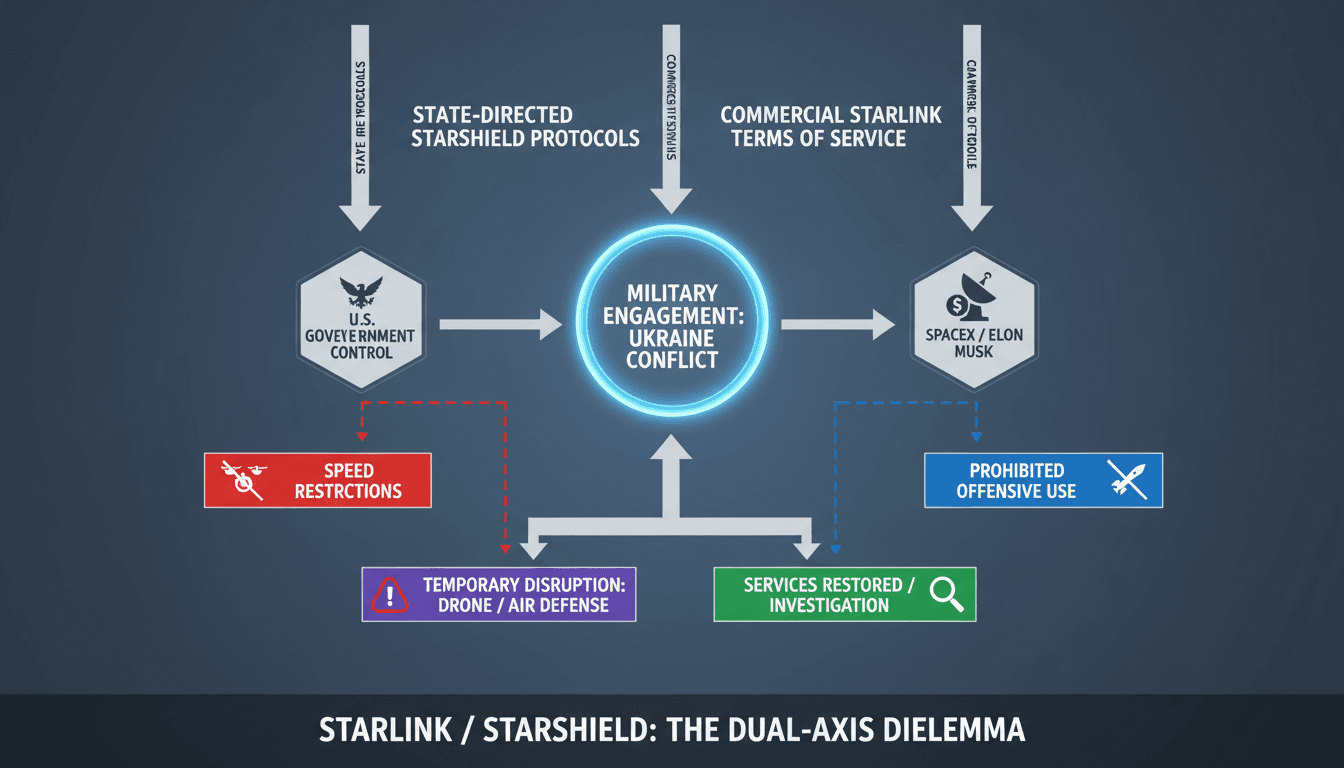
The operational boundary between commercial communications infrastructure and sovereign military command now dictates real-time risk for dual-use tech supply chains.
Why it matters
When private satellite networks become the baseline infrastructure for national defense, contractual service terms and state oversight collide directly during active crises.
What happened (in 30 seconds)
- Sudden service caps throttled defense operations: On October 14, 2026, Ukrainian defense units reported unannounced speed restrictions on military-grade Starshield and commercial Starlink terminals during coordinated Russian missile and drone strikes that killed at least six people and cut power to over 600,000 residents.
- Legislators challenged network leadership: U.S. Senator Thom Tillis publicly questioned SpaceX CEO Elon Musk regarding the operational constraints, warning that intentional limits during defensive maneuvers risked aiding adversary aggression.
- Contractual divisions emerged as the core defense: Musk stated that Starshield operations fall under direct U.S. Department of Defense oversight while reiterating that commercial Starlink terms explicitly prohibit deployment for offensive strikes, before normal terminal speeds were restored.
The context you actually need
- A multi-year operational dependency: Since the 2022 invasion of Ukraine, SpaceX connectivity has served as the foundational digital backbone for both civilian emergency response and military coordination across the country.
- The structural split between Starlink and Starshield: Starshield was established specifically as a specialized, government-controlled variant designed to separate state-directed defense requirements from commercial consumer network terms.
- Escalating political friction in Washington: The disruption aligned with broader debates regarding geopolitical alliances, resulting in a bipartisan request from U.S. senators for a formal Pentagon inspector general investigation into how dual-use satellite networks are managed.
What's really happening
The friction over Starlink terminals in Ukraine is not merely an isolated dispute over service levels; it exposes an unresolved structural tension in modern defense: state reliance on private commercial communications platforms.
For decades, sovereign military operations relied on dedicated, government-owned satellite arrays. Building and deploying those systems took decades and billions of dollars in taxpayer funding. In contrast, modern distributed low-Earth-orbit constellations deliver higher throughput, reduced latency, and greater resilience against electronic warfare at a fraction of traditional procurement cycles. The trade-off is governance. When an operator provisions connectivity, it does so within legal, commercial, and geopolitical risk envelopes that do not mirror military mandates.
The operational breakdown on October 14 highlights how these conflicting incentives clash in real time. Ukrainian officials indicated that bandwidth throttling impaired drone guidance and air defense coordination precisely while Russian missile strikes hit critical energy assets, cutting power to more than 600,000 individuals. From the perspective of local defense operators, connectivity is an uninterrupted tactical utility.
From the perspective of commercial network leadership, the incentives involve legal liability and strict export compliance. SpaceX has consistently cited its commercial terms of service, which restrict the deployment of standard Starlink hardware for offensive weapon guidance systems. While the military-grade Starshield tier was established specifically to transfer operational governance to the U.S. Department of Defense, ambiguity remains regarding where commercial network monitoring ends and state command begins. When technical adjustments happen without advance notice, military field units absorb immediate operational vulnerability.
At the legislative level, this division creates regulatory vulnerability. Senator Tillis’s public confrontation of Elon Musk, followed by bipartisan calls for a Department of Defense inspector general inquiry, marks a push to formally clarify command structures. If sovereign states outsource critical operational infrastructure to private enterprises, governments must establish whether private operators retain administrative override capacity, or whether operational command of defense contracts transfers entirely to military leadership during wartime emergencies.
Who feels it first (and how)
- Defense procurement officers: Confront immediate exposure when evaluating whether dual-use commercial contracts provide sufficient continuity guarantees compared to sovereign defense networks.
- Critical infrastructure operators: Face sudden operational delays if secondary telemetry, grid monitoring, or emergency data pipelines run on commercial satellite services subject to unilateral terms-of-service enforcement.
- Aerospace and defense contractors: Must navigate tighter regulatory scrutiny and potential Pentagon compliance audits designed to legally demarcate private platform management from sovereign operational command.
What to watch next
- The Pentagon inspector general's mandate: Whether the requested Department of Defense inquiry establishes binding service-level agreements for private orbital assets deployed in active conflict zones.
- Contract restructuring for Starshield deployments: How the U.S. military updates operational command clauses to prevent private vendor throttling during active defense engagements.
- Autonomous backup integration by foreign militaries: The rate at which international defense forces diversify their connectivity mix to avoid reliance on a single corporate-controlled satellite network.
Terminals experienced operational speed restrictions on October 14, 2026, without advance notice to Ukrainian defense forces; speeds were subsequently restored following outreach to network leadership; over 600,000 people lost electricity during the concurrent missile strikes; and bipartisan lawmakers requested a formal Pentagon investigation.
The Department of Defense will face pressure from congressional oversight committees to codify absolute operational command over military-contracted private satellite systems.
Whether the operational throttling was executed unilaterally by network engineers enforcing commercial acceptable-use terms or directed via military command channels managing Starshield protocols.
Frequently Asked Questions
- Why it matters?
- When private satellite networks become the baseline infrastructure for national defense, contractual service terms and state oversight collide directly during active crises.
- What happened (in 30 seconds)?
- Sudden service caps throttled defense operations: On October 14, 2026, Ukrainian defense units reported unannounced speed restrictions on military-grade Starshield and commercial Starlink terminals during coordinated Russian missile and drone strikes that killed at least six people and cut power to over 600,000 residents. Legislators challenged network leadership: U.S. Senator Thom Tillis publicly questioned SpaceX CEO Elon Musk regarding the operational constraints, warning that intentional lim
- What's really happening?
- The friction over Starlink terminals in Ukraine is not merely an isolated dispute over service levels; it exposes an unresolved structural tension in modern defense: state reliance on private commercial communications platforms. For decades, sovereign military operations relied on dedicated, government-owned satellite arrays. Building and deploying those systems took decades and billions of dollars in taxpayer funding. In contrast, modern distributed low-Earth-orbit constellations deliver high
- Who feels it first (and how)?
- Defense procurement officers: Confront immediate exposure when evaluating whether dual-use commercial contracts provide sufficient continuity guarantees compared to sovereign defense networks. Critical infrastructure operators: Face sudden operational delays if secondary telemetry, grid monitoring, or emergency data pipelines run on commercial satellite services subject to unilateral terms-of-service enforcement. Aerospace and defense contractors: Must navigate tighter regulatory scrutiny and po
- What to watch next?
- The Pentagon inspector general's mandate: Whether the requested Department of Defense inquiry establishes binding service-level agreements for private orbital assets deployed in active conflict zones. Contract restructuring for Starshield deployments: How the U.S. military updates operational command clauses to prevent private vendor throttling during active defense engagements. Autonomous backup integration by foreign militaries: The rate at which international defense forces diversify their co
Celebrity news, photo galleries, and Hollywood updates.
"Wonderwall covers celebrity gossip, Hollywood rumors, and pop culture photo galleries."
— A47 Editor
Republican Sen. Thom Tillis questions Elon Musk’s role in ‘aiding and abetting a mass murderer’ after Ukraine accused SpaceX of limiting Starlink internet during a Russian missile attack
Republican Sen. Thom Tillis has publicly asked SpaceX CEO Elon Musk to explain overnight disruptions to Starlink internet service in Ukraine during a Russian missile attack, questioning whether the service was intentionally restricted and warning tha...
Business, investment, entrepreneurship, leadership, and innovation.
"Forbes is known for its coverage of business leaders, market trends, and entrepreneurial ventures with a pro-business editorial stance."
— A47 Editor
Elon Musk Shouldn’t Be Able To Turn Off Ukraine’s War
Forbes reports that Elon Musk's control over Starlink's satellite internet service in Ukraine allows an unelected private executive to shape U.S. foreign policy, while government officials can avoid accountability for the arrangement. The base articl...
Capitol Hill news, legislation, and policy insight.
"The Hill specializes in U.S. politics and policy, with a focus on Capitol Hill developments and a reputation for insider reporting."
— A47 Editor
Starlink drama puts spotlight on Musk's global stature
Elon Musk's company SpaceX confirmed it was behind restrictions that slowed Starlink satellite internet and its military-grade version, Starshield, for Ukraine's military, after about ten days of confusion and finger-pointing over the cause. Musk sai...