
Arab Parties Position as Kingmakers After Inconclusive Israeli Election Threatens Netanyahu's Hold on Power
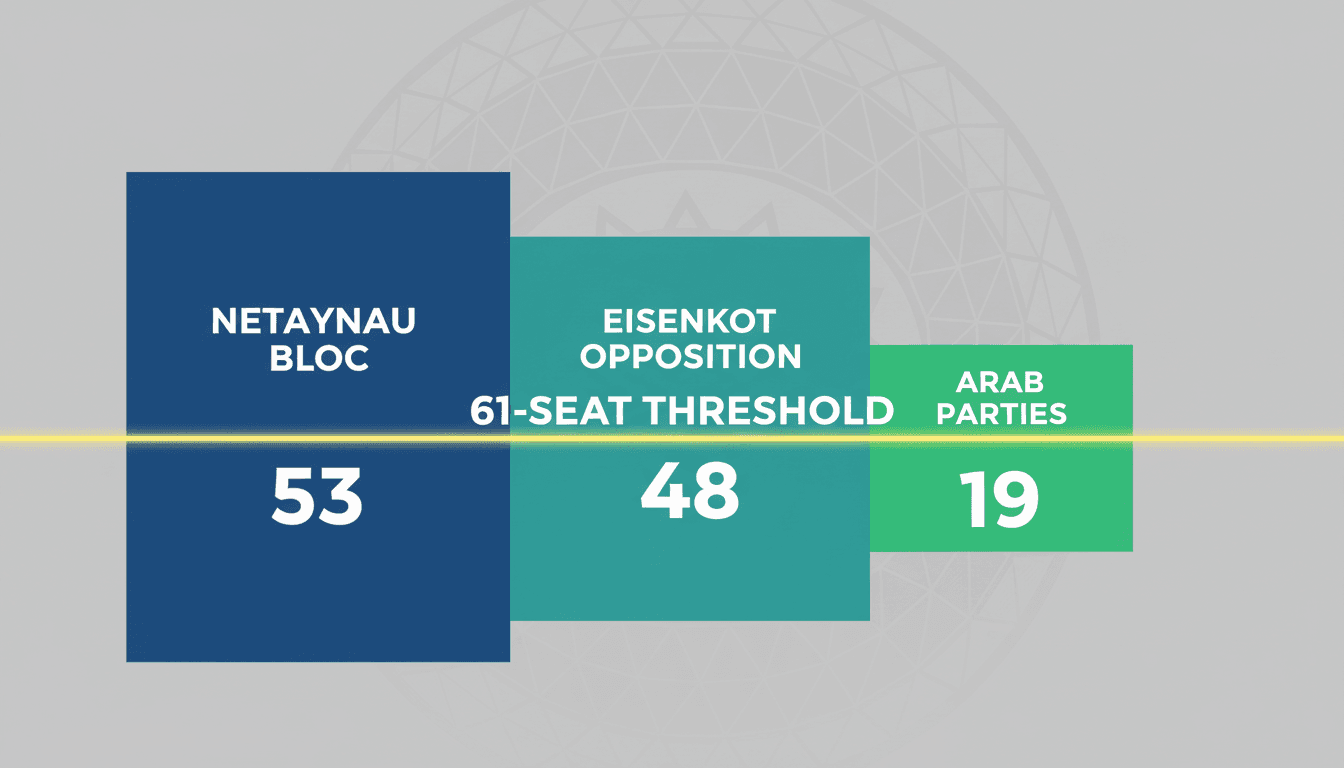
Shifts in Israeli leadership dynamics influence regional trade stability, cross-border capital flows, and the diplomatic pace of the Abraham Accords across Gulf commercial hubs.
Why it matters
A structural shift in Knesset leverage creates potential policy reassessments across regional energy, technology partnerships, and diplomatic normalization frameworks.
What happened (in 30 seconds)
- An inconclusive national tally: The October 27, 2026, legislative elections left Prime Minister Benjamin Netanyahu’s bloc short of governance with 53 seats, while Gadi Eisenkot's opposition secured 48 seats.
- A historic minority caucus: Arab parties captured a combined 19 seats in the 120-seat Knesset, with the Joint List winning 11 seats and Ra'am securing 8 seats.
- A conditional offer of leverage: Arab party leaders offered external support on October 31 to help Eisenkot reach a 67-seat threshold, opting against cabinet portfolios while setting specific governance conditions.
The context you actually need
- Record minority participation: Turnout surged across Israel’s Arab minority—representing roughly 21% of the total population—driven by opposition to previous coalition policies regarding discrimination, domestic security, and Gaza.
- The structural arithmetic: Neither conventional Zionist bloc holds an independent route to the required 61-seat governing threshold without engaging non-traditional legislative arrangements.
- Heightened legal and procedural contestation: Following the initial tallies, Likud leadership alleged electoral irregularities without presenting evidence, while street demonstrations in Tel Aviv pressed opposition leaders to accept external Arab parliamentary backing.
What's really happening
The mechanics behind this coalition deadlock reveal an incentive realignment inside Israel’s legislative apparatus. Historically, mainstream parties treated non-Zionist factions as external to coalition math. However, the distribution of the October 2026 vote altered that baseline. With Netanyahu’s coalition capturing 53 seats and Gadi Eisenkot’s opposition bloc holding 48, the 19 seats won by the Joint List and Ra'am represent the mathematical fulcrum of the 120-seat Knesset.
This numerical reality creates distinct tactical incentives for every actor involved. For Arab party leaders Ahmad Tibi, Yousef Jabareen, and Mansour Abbas, the priority centers on extracting legislative concessions without assuming executive liability. By proposing confidence-and-supply support—recommending Eisenkot to President Isaac Herzog and backing crucial floor votes rather than demanding ministerial portfolios—they retain domestic political independence while attempting to remove the incumbent administration.
Conversely, the opposition leadership faces contradictory strategic pressures. Eisenkot requires these 19 votes to cross the 61-seat operational threshold and construct a 67-seat working majority. Yet relying on external non-Zionist backing carries acute political costs among conservative voters. To manage this friction, Eisenkot has tied negotiations to strict baseline criteria: formal recognition of Israel as a Jewish and democratic state and explicit rejections of hostile non-state actors like Hamas.
For the incumbent Likud leadership, the strategy relies on delegitimizing these arithmetic combinations. Allegations of electoral irregularities serve to contest the margin, mobilize the base, and heighten the reputational liability for any Zionist opposition figures considering an external arrangement.
For regional observers and international capital allocators, this structural friction introduces a holding pattern. While broad regional diplomacy under the Abraham Accords functions on institutional treaties, private-sector execution relies on regulatory continuity. An extended period of coalition bargaining, a vulnerable minority government, or a cycle leading to repeat elections limits the state’s capacity to sign major bilateral infrastructure pacts, finalize cross-border energy frameworks, or advance high-level trade initiatives.
Who feels it first (and how)
- Cross-border tech and venture investors: Early-stage funds deploying capital between Tel Aviv and Gulf hubs face operational delays as bilateral regulatory frameworks pause pending executive appointments.
- Energy sector operators: Firms negotiating regional gas transit corridors and grid integration initiatives face timeline uncertainty until permanent ministry leadership is confirmed.
- Regional trade compliance teams: Corporate legal desks must track import-export licensable categories, as administrative decisions slow during interim caretaker governance.
- Domestic public-sector bodies: Municipalities and civil planning authorities experience budgetary freezes until an approved annual state spending bill passes through a confirmed Knesset majority.
What to watch next
- President Isaac Herzog’s mandate designation: The timeline and recipient of the initial presidential mandate to build a government will establish whether Eisenkot's coalition math is legally viable.
- Opposition consensus on Arab party terms: Any signed confidence-and-supply document between Eisenkot, the Joint List, and Ra'am will indicate the exact legislative price of external support.
- Likud court petitions regarding vote tallies: Formal legal challenges submitted by Netanyahu's legal team will determine whether electoral certifications face statutory delays.
The October 27 election produced 53 seats for Netanyahu’s bloc, 48 for Eisenkot’s opposition, and 19 for Arab parties, leaving no traditional single-bloc majority.
Formal coalition negotiations will extend across weeks, keeping caretaker administrative rules active and deferring major foreign policy changes.
Whether Eisenkot’s centrist partners will accept a formal confidence-and-supply agreement with Arab parties or force a rapid return to nationwide elections.
Frequently Asked Questions
- Why it matters?
- A structural shift in Knesset leverage creates potential policy reassessments across regional energy, technology partnerships, and diplomatic normalization frameworks.
- What happened (in 30 seconds)?
- An inconclusive national tally: The October 27, 2026, legislative elections left Prime Minister Benjamin Netanyahu’s bloc short of governance with 53 seats, while Gadi Eisenkot's opposition secured 48 seats. A historic minority caucus: Arab parties captured a combined 19 seats in the 120-seat Knesset, with the Joint List winning 11 seats and Ra'am securing 8 seats. A conditional offer of leverage: Arab party leaders offered external support on October 31 to help Eisenkot reach a 67-seat threshol
- What's really happening?
- The mechanics behind this coalition deadlock reveal an incentive realignment inside Israel’s legislative apparatus. Historically, mainstream parties treated non-Zionist factions as external to coalition math. However, the distribution of the October 2026 vote altered that baseline. With Netanyahu’s coalition capturing 53 seats and Gadi Eisenkot’s opposition bloc holding 48, the 19 seats won by the Joint List and Ra'am represent the mathematical fulcrum of the 120-seat Knesset. This numerical r
- Who feels it first (and how)?
- Cross-border tech and venture investors: Early-stage funds deploying capital between Tel Aviv and Gulf hubs face operational delays as bilateral regulatory frameworks pause pending executive appointments. Energy sector operators: Firms negotiating regional gas transit corridors and grid integration initiatives face timeline uncertainty until permanent ministry leadership is confirmed. Regional trade compliance teams: Corporate legal desks must track import-export licensable categories, as admini
- What to watch next?
- President Isaac Herzog’s mandate designation: The timeline and recipient of the initial presidential mandate to build a government will establish whether Eisenkot's coalition math is legally viable. Opposition consensus on Arab party terms: Any signed confidence-and-supply document between Eisenkot, the Joint List, and Ra'am will indicate the exact legislative price of external support. Likud court petitions regarding vote tallies: Formal legal challenges submitted by Netanyahu's legal team will
Arabic-language coverage of international news and geopolitics.
"RT Arabic is a Russian state-funded outlet often criticized for promoting Kremlin-aligned narratives."
— A47 Editor
الأحزاب العربية تستعد للإطاحة بنتنياهو
Arab parties in Israel have become the decisive force in the battle over forming the government after winning 19 seats, and have announced their readiness to support the opposition in order to remove Prime Minister Benjamin Netanyahu from office, acc...
Pan-Arab political news and analysis.
"Al-Quds Al-Arabi is a London-based Arabic newspaper known for political coverage."
— A47 Editor
أرقام انتخابات الكنيست: ما خفي أعظم؟
Israel's Knesset elections concluded with Prime Minister Benjamin Netanyahu's bloc winning 53 seats, the Zionist opposition parties 48, and the Arab parties 19, while voter turnout reached 77.7%, the highest since the 1999 elections, according to the...
Arabic political reporting and analysis.
"Arabic Post is a digital outlet focused on politics and regional affairs."
— A47 Editor
كيف قلبت الأحزاب العربية حسابات تشكيل الحكومة الإسرائيلية؟
Israeli elections held on October 27, 2026 produced an unprecedented political equation, as Benjamin Netanyahu's camp lost its parliamentary majority without the opposition securing the seats needed to form an alternative government. Arab parties, wh...
Pan-Arab political news and analysis.
"Al-Quds Al-Arabi is a London-based Arabic newspaper known for political coverage."
— A47 Editor
انتخابات إسرائيل… نتنياهو 53 مقعدا والمعارضة 48 والعرب 19
Israel's election count, with 91 percent of votes sorted, shows Prime Minister Benjamin Netanyahu's bloc at 53 seats, the opposition Change bloc at 48, and the Arab parties at 19, leaving no side with a majority to form a government. Channel 12 repor...