
Republicans Defend Narrow Congressional Majorities as 2026 Midterms Test Polling Reliability and Democratic Party Israel Policy Divisions
Why it matters
A change in legislative margins reconfigures the regulatory boundaries of the world's largest economy and reallocates institutional power over global trade corridors and diplomatic funding.
What happened (in 30 seconds)
- Voters cast ballots nationwide on November 3, 2026: Americans voted to determine the legislative balance of power for the remaining two years of President Donald Trump's term.
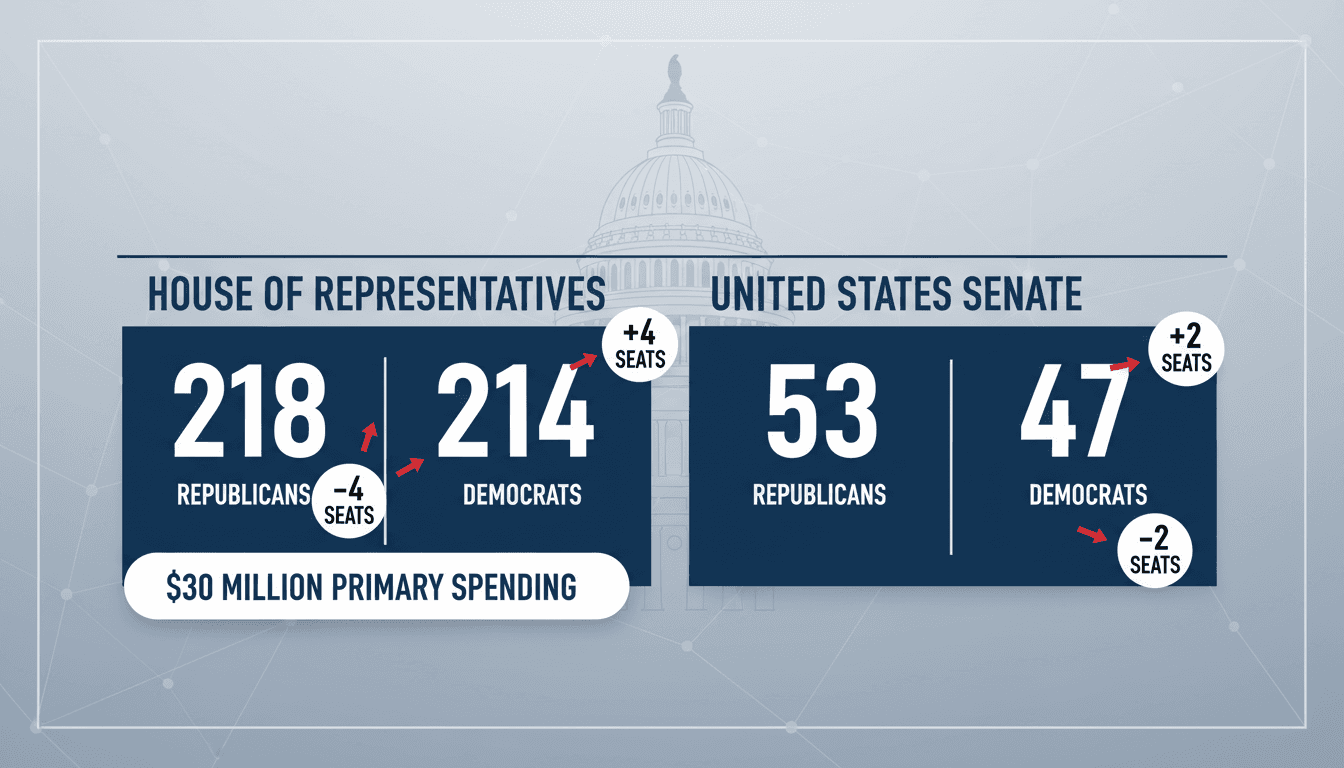
- Republicans defended razor-thin majorities: The party entered election day holding a 218–214 edge in the House of Representatives and a 53–47 lead in the Senate.
- Key party divisions faced open tests: High-profile races, including primary and general contests in Michigan and Maine, tested ideological boundaries on foreign policy and democratic socialist candidates.
The context you actually need
- Midterms consistently challenge the White House: Historical patterns show midterms function primarily as an operational check on the incumbent president's legislative agenda.
- Capital allocation intensified around primary battlegrounds: In the Michigan Senate primary, outside groups spent $30 million via AIPAC to back Haley Stevens over Abdul El-Sayed, highlighting intra-party funding disparities.
- Survey methodologies face non-response scrutiny: Polling reliability remained under review due to systemic non-response bias among Republican voter bases that complicated forecast modeling.
What's really happening
The underlying mechanics of the 2026 midterm elections center on structural incentives rather than routine electoral turnover. In the House of Representatives, where Republicans held a four-seat margin of 218 to 214, the legislative threshold is extraordinarily sensitive to minor shifts. A net movement of just three seats inverts committee leadership, reassigns subpoena power, and redirects federal appropriations priorities. In the Senate, the 53–47 composition leaves a six-seat operational buffer, but high-leverage races in states like Maine and Michigan expose diverging regional and coalition pressures.
Inside the Democratic Party, the contest exposes clear organizational and donor trade-offs. The high-dollar intervention in Michigan—where $30 million was deployed in a primary race to secure a traditional foreign policy platform—reflects a calculated resource allocation to limit the influence of candidates backed by the Democratic Socialists of America. The incentive for national political action committees is structural continuity: protecting established policy frameworks regarding the Middle East and international defense spending against insurgent ideological factions that challenge incumbent consensus.
For Republicans, the strategic calculation pivots on turnout optimization under persistent polling measurement uncertainty. Non-response bias among specific voting demographics creates a persistent divergence between public quantitative models and actual turnout results. Rather than relying on aggregate media forecasting, campaign resource distribution has increasingly moved toward field-level mechanics, prioritizing high-propensity base mobilization to offset structural mid-term attrition.
At an institutional level, the results determine the operational bandwidth of the executive branch through 2028. A divided government removes the mechanism for unilateral budget reconciliation, forcing international policy and trade governance to rely on executive orders rather than statutory law. This dynamic introduces regulatory volatility for international markets. When legislative stability dissolves, the regulatory durability of international trade agreements, defense aid commitments, and global energy policies declines, shifting decision-making from predictable congressional statutes to revocable administrative enforcement actions.
Who feels it first (and how)
- Multinational corporate planners: Experience immediate strategic friction as compliance calendars shift between statutory tax policies and potential executive-level trade revisions.
- Global energy and commodity traders: Track congressional committee outcomes that govern federal energy export licenses, strategic reserves, and cross-border infrastructure approvals.
- Defense procurement and foreign aid sectors: Face potential realignment of foreign expenditure packages, particularly concerning ongoing security frameworks in the Middle East and Eastern Europe.
- International trade and logistics operators: Absorb indirect volatility in tariff structures if legislative gridlock shifts policy execution to unilateral executive mechanisms.
What to watch next
- Certification of House threshold races: Closely watch whether net flips exceed the three-seat barrier required to transition the Speakership and committee oversight gavels.
- Senate margin stabilization: Track whether competitive contests in Maine and Michigan expand or compress the current 53–47 ratio, determining the confirmation velocity of judicial and executive nominees.
- Post-election survey variance data: Review academic and industry analyses evaluating whether non-response bias skewed pre-election quantitative models across targeted districts.
Republicans entered election day holding margins of 218–214 in the House and 53–47 in the Senate; AIPAC spent $30 million in the Michigan Senate primary contest.
Pre-election market indicators point to a higher probability of legislative seat shifts in the House than in the Senate, where structural seat distribution provides greater institutional insulation.
The final margins of both chambers remain undetermined pending certified ballot tabulations, as does the long-term electoral ceiling for democratic socialist candidates in purple-state jurisdictions.
Frequently Asked Questions
- Why it matters?
- A change in legislative margins reconfigures the regulatory boundaries of the world's largest economy and reallocates institutional power over global trade corridors and diplomatic funding.
- What happened (in 30 seconds)?
- Voters cast ballots nationwide on November 3, 2026: Americans voted to determine the legislative balance of power for the remaining two years of President Donald Trump's term. Republicans defended razor-thin majorities: The party entered election day holding a 218–214 edge in the House of Representatives and a 53–47 lead in the Senate. Key party divisions faced open tests: High-profile races, including primary and general contests in Michigan and Maine, tested ideological boundaries on foreign p
- What's really happening?
- The underlying mechanics of the 2026 midterm elections center on structural incentives rather than routine electoral turnover. In the House of Representatives, where Republicans held a four-seat margin of 218 to 214, the legislative threshold is extraordinarily sensitive to minor shifts. A net movement of just three seats inverts committee leadership, reassigns subpoena power, and redirects federal appropriations priorities. In the Senate, the 53–47 composition leaves a six-seat operational buff
- Who feels it first (and how)?
- Multinational corporate planners: Experience immediate strategic friction as compliance calendars shift between statutory tax policies and potential executive-level trade revisions. Global energy and commodity traders: Track congressional committee outcomes that govern federal energy export licenses, strategic reserves, and cross-border infrastructure approvals. Defense procurement and foreign aid sectors: Face potential realignment of foreign expenditure packages, particularly concerning ongoin
- What to watch next?
- Certification of House threshold races: Closely watch whether net flips exceed the three-seat barrier required to transition the Speakership and committee oversight gavels. Senate margin stabilization: Track whether competitive contests in Maine and Michigan expand or compress the current 53–47 ratio, determining the confirmation velocity of judicial and executive nominees. Post-election survey variance data: Review academic and industry analyses evaluating whether non-response bias skewed pre-e
Conservative-leaning political and national coverage.
"The Washington Times is a conservative-leaning newspaper known for its political coverage and advocacy of right-of-center viewpoints."
— A47 Editor
Americans put more than control of Congress to the test in the midterm elections
The Washington Times reports that the 2026 U.S. midterm elections are shaping up as a stress test for some of the biggest assumptions in American politics, beyond the usual question of which party will control Congress. The base report is framed arou...
Policy, elections, and government reporting.
"NPR is an American public media organization known for thoughtful reporting and a slightly left-leaning editorial tone."
— A47 Editor
The midterms will test the nation's political direction and confidence
The base article reports that the 2026 U.S. midterm elections are likely to test the nation's political direction and confidence in the days and weeks ahead, with that test possibly extending beyond Election Day. NPR/PBS News/Marist polling shows Dem...
News from the United States including domestic politics, society, and culture.
"The Guardian is known for its progressive editorial stance and in-depth analysis, often advocating for social justice, environmental issues, and liberal values."
— A47 Editor
What are the races to watch in the US midterm elections and why do they matter?
The Guardian reports that Donald Trump will still be US president on 4 November, but the results of the 3 November midterm elections could reshape the political landscape by determining whether Republicans retain control of Congress or Democrats gain...
Top international stories selected by The Guardian editors.
"The Guardian is known for its progressive editorial stance and in-depth analysis."
— A47 Editor
What are the US midterm elections and why do they matter?
The 2026 US midterm elections, scheduled for 3 November, will determine whether Republicans retain control of Congress or whether Democrats gain power to check Donald Trump's agenda, with all 435 House seats and a portion of the Senate at stake. The ...