
Democrats Secure Sweeping Gains in 2026 US Midterms Amid Voter Backlash Against Trump Presidency
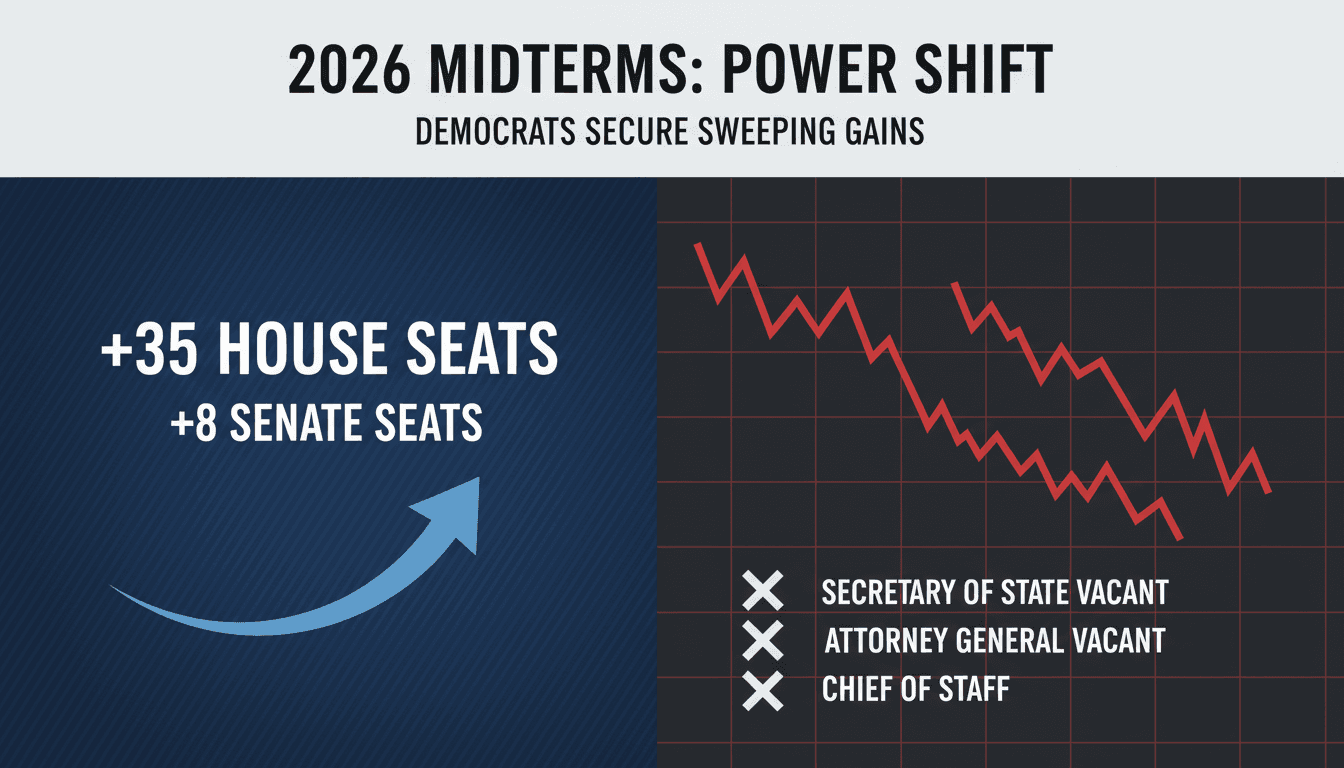
Why it matters
The transfer of House and Senate majorities resets the regulatory baseline and fiscal trajectory of the world’s largest economy, impacting international capital allocation and foreign policy commitments.
What happened (in 30 seconds)
- A decisive legislative flip: Voters delivered control of both the House of Representatives and the Senate to Democrats in the November 3, 2026 midterm elections, marking one of the steepest midterm seat reallocations against an incumbent administration since 1958.
- Quantifiable seat margins: Projected net gains exceeded 35 House seats and up to 8 Senate seats, flipping long-standing districts across states including Texas, Michigan, Maine, Ohio, and Mississippi.
- Executive branch restructuring: Immediate internal reorganization followed the results, marked by the departure of White House Chief of Staff Susie Wiles, the elevation of Stephen Miller, and broad stock market declines driven by policy uncertainty.
The context you actually need
- Economic and international friction: Persistent consumer inflation, an active military conflict involving Iran, aggressive immigration enforcement, and rising governance concerns eroded the coalition that secured the 2024 executive victory.
- Structural boundaries breached: State-level legislative redistricting in strongholds such as Texas and Florida proved unable to absorb the scale of voter turnout shifting toward opposition candidates.
- A recalibrated campaign playbook: Democratic candidates, including James Talarico in Texas, Abdul El-Sayed in Michigan, and Troy Jackson in Maine, prioritized localized, bread-and-butter platforms—such as healthcare access, education funding, and public safety—over confrontational national messaging.
What's really happening
The 2026 midterm outcome illustrates the mechanics of structural overreach when electoral mandates clash with kitchen-table economic realities. In 2016 and 2024, voter coalitions mobilized primarily around anti-establishment sentiment rooted in lingering post-2008 economic grievances. However, by late 2026, the incentives underpinning voter behavior shifted from ideological alignment to immediate cost-of-living defense.
The convergence of high domestic consumer prices and foreign entanglements—specifically the ongoing war with Iran—altered the risk calculus for core voting blocs. Rather than responding to personal appeals from the executive branch to treat the election as a direct endorsement of the presidency, moderate and independent voters prioritized baseline economic stabilization. Candidates chosen primarily for ideological fidelity rather than district-level viability underperformed across contested suburban and rural perimeters, demonstrating that loyalty-first candidate selection creates severe vulnerabilities during inflationary periods.
From an institutional standpoint, this transfer of power establishes immediate divided government. The legislative mechanism in Washington will pivot from executive enablement to aggressive statutory friction. The new majorities gain subpoena power, committee gavels, and control over discretionary spending allocations. This effectively freezes unilateral executive tax adjustments, ends budget reconciliations aimed at deregulation, and imposes strict oversight on trade actions and defense outlays.
For cross-border operators and global asset allocators, the primary mechanism to track is not rhetoric, but legislative paralysis. When congressional majorities switch parties mid-term, the incumbent administration’s domestic policy pipeline stops moving through standard statutory routes. This dynamic forces the executive branch to rely almost entirely on administrative actions, tariff authorities, and foreign policy maneuvers to project influence. In response, capital markets discount rapid domestic policy shifts and begin pricing in sustained political friction, leading directly to the equity drawdowns and elevated risk premiums observed in the immediate aftermath of the vote.
Who feels it first (and how)
- Multinational corporations and trade-dependent firms: Face an immediate freeze on anticipated domestic regulatory relief alongside heightened scrutiny of executive trade actions.
- Global asset allocators and institutional investors: Must reprice sovereign and equity risk premiums amid elevated market volatility and legislative gridlock over federal budgets.
- Federal executive agencies and leadership personnel: Face abrupt reorganizations, shifting internal power dynamics, and intensive congressional oversight inquiries into spending and foreign entanglements.
- Expatriate professionals and international investors: Experience indirect exposure via dollar volatility, shifting cross-border trade flows, and potential adjustments to global liquidity conditions.
What to watch next
- The formal transfer of committee gavels in January 2027: This structural transition dictates the volume and scope of federal investigations into administration policies, contracting, and foreign engagements.
- Federal budget negotiations and defense appropriations: Divided chambers must pass statutory spending caps, directly testing how the active war with Iran will be funded or constrained.
- Administrative rule-making and unilateral trade actions: With Congress blocked, observe whether the executive branch attempts to advance its agenda via executive orders, which face immediate legal challenges.
Democrats secured majorities in both the House and the Senate, capturing over 35 House seats and up to 8 Senate seats; stock markets registered immediate downward adjustments; Susie Wiles departed her post as White House Chief of Staff.
The incoming congressional majority will initiate broad oversight inquiries into immigration operations, foreign policy decisions, and federal personnel appointments.
The durability of foreign policy commitments regarding the ongoing war with Iran remains unresolved as divided government sets up major battles over defense appropriations.
Frequently Asked Questions
- Why it matters?
- The transfer of House and Senate majorities resets the regulatory baseline and fiscal trajectory of the world’s largest economy, impacting international capital allocation and foreign policy commitments.
- What happened (in 30 seconds)?
- A decisive legislative flip: Voters delivered control of both the House of Representatives and the Senate to Democrats in the November 3, 2026 midterm elections, marking one of the steepest midterm seat reallocations against an incumbent administration since 1958. Quantifiable seat margins: Projected net gains exceeded 35 House seats and up to 8 Senate seats, flipping long-standing districts across states including Texas, Michigan, Maine, Ohio, and Mississippi. Executive branch restructuring: Im
- What's really happening?
- The 2026 midterm outcome illustrates the mechanics of structural overreach when electoral mandates clash with kitchen-table economic realities. In 2016 and 2024, voter coalitions mobilized primarily around anti-establishment sentiment rooted in lingering post-2008 economic grievances. However, by late 2026, the incentives underpinning voter behavior shifted from ideological alignment to immediate cost-of-living defense. The convergence of high domestic consumer prices and foreign entanglements
- Who feels it first (and how)?
- Multinational corporations and trade-dependent firms: Face an immediate freeze on anticipated domestic regulatory relief alongside heightened scrutiny of executive trade actions. Global asset allocators and institutional investors: Must reprice sovereign and equity risk premiums amid elevated market volatility and legislative gridlock over federal budgets. Federal executive agencies and leadership personnel: Face abrupt reorganizations, shifting internal power dynamics, and intensive congression
- What to watch next?
- The formal transfer of committee gavels in January 2027: This structural transition dictates the volume and scope of federal investigations into administration policies, contracting, and foreign engagements. Federal budget negotiations and defense appropriations: Divided chambers must pass statutory spending caps, directly testing how the active war with Iran will be funded or constrained. Administrative rule-making and unilateral trade actions: With Congress blocked, observe whether the executi
Capitol Hill news, legislation, and policy insight.
"The Hill specializes in U.S. politics and policy, with a focus on Capitol Hill developments and a reputation for insider reporting."
— A47 Editor
A referendum? No, this was a full-fledged revolt.
The Hill reported that Democrats channeled voter anger into aspirational messaging to win seats in deep red territories and challenge Republican gerrymandering during President Trump's second-term midterms, with the piece framing the result as a full...
Policy, elections, and government reporting.
"NPR is an American public media organization known for thoughtful reporting and a slightly left-leaning editorial tone."
— A47 Editor
Democrats and Republicans reflect on midterm results and the message sent by voters
Democrats won control of the U.S. Senate and were projected to take the House in the November 3 midterm elections, a result widely described as a sweeping rebuke of President Donald Trump and the Republican Party. NPR reports that party leaders from ...
Insights and news on social issues, policy, and political movements across the United States.
"The Wall Street Journal is known for its deep political coverage, especially at the intersection of policy, regulation, and social dynamics."
— A47 Editor
Democrats won control of Congress, a majority of governorships and more in a massive midterm rebuke of President Trump. In doing so, they pulled off a feat that has bedeviled them for years: uniting around a message—affordability.
Democrats won control of Congress, including the Senate and projected House majority, along with a majority of governorships, in the November 3 midterm elections, a result widely described as a sweeping rebuke of President Trump. Party leaders unifie...
News across North, Central, and South America including politics and economics.
"France 24 is viewed as a globally focused outlet with balanced coverage and a European perspective."
— A47 Editor
Blue wave across America: Do US midterms signal beginning of the end for Trump?
Democrats won control of both the U.S. Senate and the House of Representatives in the November 3 midterm elections, a result widely described as a "blue wave" that delivered a sharp rebuke to President Donald Trump and stripped Republicans of their c...
Insights and news on social issues, policy, and political movements across the United States.
"The Wall Street Journal is known for its deep political coverage, especially at the intersection of policy, regulation, and social dynamics."
— A47 Editor
To win control of the House and Senate, Democrats on Tuesday fractured the coalition that had elected Donald Trump to the White House two years ago
Democrats won control of the U.S. House and Senate in the November 3 midterm elections, fracturing the coalition that had elected Donald Trump two years earlier as voting shifts across several voter groups helped the party flip districts that had bac...
News from the United States including domestic politics, society, and culture.
"Global News is a mainstream Canadian media outlet generally considered to have a centrist editorial stance, covering news with a focus on factual reporting and national interest."
— A47 Editor
How Trump’s ‘whack-a-mole’ trade war with Canada, others fuelled blue wave
The base article reports that affordability concerns, partly tied to President Donald Trump's trade war with Canada and other countries, contributed to many Republicans losing in the U.S. midterm elections held November 3, 2026. Democrats won control...
National coverage of politics and current events across Canada.
"Global News is a mainstream Canadian outlet with a centrist editorial stance, focusing on factual reporting."
— A47 Editor
Midterm blue wave sweep comes amid tariff backlash in Maine, Michigan
Democrats won control of Congress in the November 3, 2026 U.S. midterm elections, taking the Senate and projected to take the House, in a result described as a "blue wave" that handed a clear rejection to President Donald Trump's second term. The bas...
Global business headlines with AI angles.
"General business outlet that frequently covers AI."
— A47 Editor
Democrats Just Pulled Off A Rare Midterm Sweep. It's Happened Only Three Other Times Since World War II.
Democrats captured both chambers of Congress in a rare midterm election defeat for President Donald Trump, flipping at least seven Senate seats and ending Republican control of Congress, a result the base report describes as only the fourth such midt...
Top international stories selected by The Guardian editors.
"The Guardian is known for its progressive editorial stance and in-depth analysis."
— A47 Editor
Resounding wins for Democrats a wholesale rebuke of Trump’s Maga movement
Democrats declared sweeping victories in the November 3 midterm elections, winning control of the Senate and projected to take the House, in what The Guardian describes as a wholesale rebuke of Trump's MAGA movement.
News from the United States including domestic politics, society, and culture.
"The Guardian is known for its progressive editorial stance and in-depth analysis, often advocating for social justice, environmental issues, and liberal values."
— A47 Editor
Resounding wins for Democrats a wholesale rebuke of Trump’s Maga movement
Democrats declared sweeping victories in the November 3 midterm elections, winning control of the Senate and projected to take the House, in what The Guardian describes as a wholesale rebuke of Trump's MAGA movement.
Insights and news on social issues, policy, and political movements across the United States.
"The Wall Street Journal is known for its deep political coverage, especially at the intersection of policy, regulation, and social dynamics."
— A47 Editor
Voters delivered an astonishing rebuke to President Trump and his party on Tuesday, stripping Republicans of congressional control amid widespread frustrations with the economy
Voters delivered a sharp rebuke to President Donald Trump and the Republican Party in the November 3, 2026 midterm elections, with Democrats reclaiming control of Congress amid widespread frustration over the economy and the cost of living.
News from the United States including domestic politics, society, and culture.
"The Guardian is known for its progressive editorial stance and in-depth analysis, often advocating for social justice, environmental issues, and liberal values."
— A47 Editor
Democrats win control of Senate as US voters reject Trump’s agenda
Democrats have regained control of the US Senate in the November 3, 2026 midterm elections, routing Republicans nationwide, and are expected to take the House as well, giving them full control of Congress for the remainder of Donald Trump's presidenc...
International coverage from The Guardian's global desks.
"The Guardian is known for its progressive editorial stance and in-depth analysis."
— A47 Editor
Democrats win control of Senate as US voters reject Trump’s agenda
Democrats have regained control of the US Senate in the November 3, 2026 midterm elections, routing Republicans nationwide, and are expected to take the House as well, giving them full control of Congress for the remainder of Donald Trump's presidenc...
Breaking news, politics, business, and entertainment from the U.S. and around the world.
"The New York Post is a tabloid-format newspaper known for its sensationalist headlines and conservative-leaning editorial tone."
— A47 Editor
Blue tsunami delivers Dems both chambers of Congress in stunning defeat for GOP and Trump’s handpicked candidates
Democrats regained control of both chambers of Congress in the November 3 midterm elections, winning the Senate and projected to take the House, in what the base report describes as a stunning defeat for Republicans and candidates backed by President...