
Democrats Secure Congress Majorities Leaving CLARITY Act Stalled Ahead of 2027 Session
Why it matters
The collapse of legislative momentum for digital asset market structure shifts the center of gravity back to regulatory enforcement and agency-level interpretation in the world's largest capital market.
What happened (in 30 seconds)
- Congressional majorities flipped on November 3, 2026, as Democrats secured control of both the House of Representatives and the Senate, ending unified Republican legislative management.
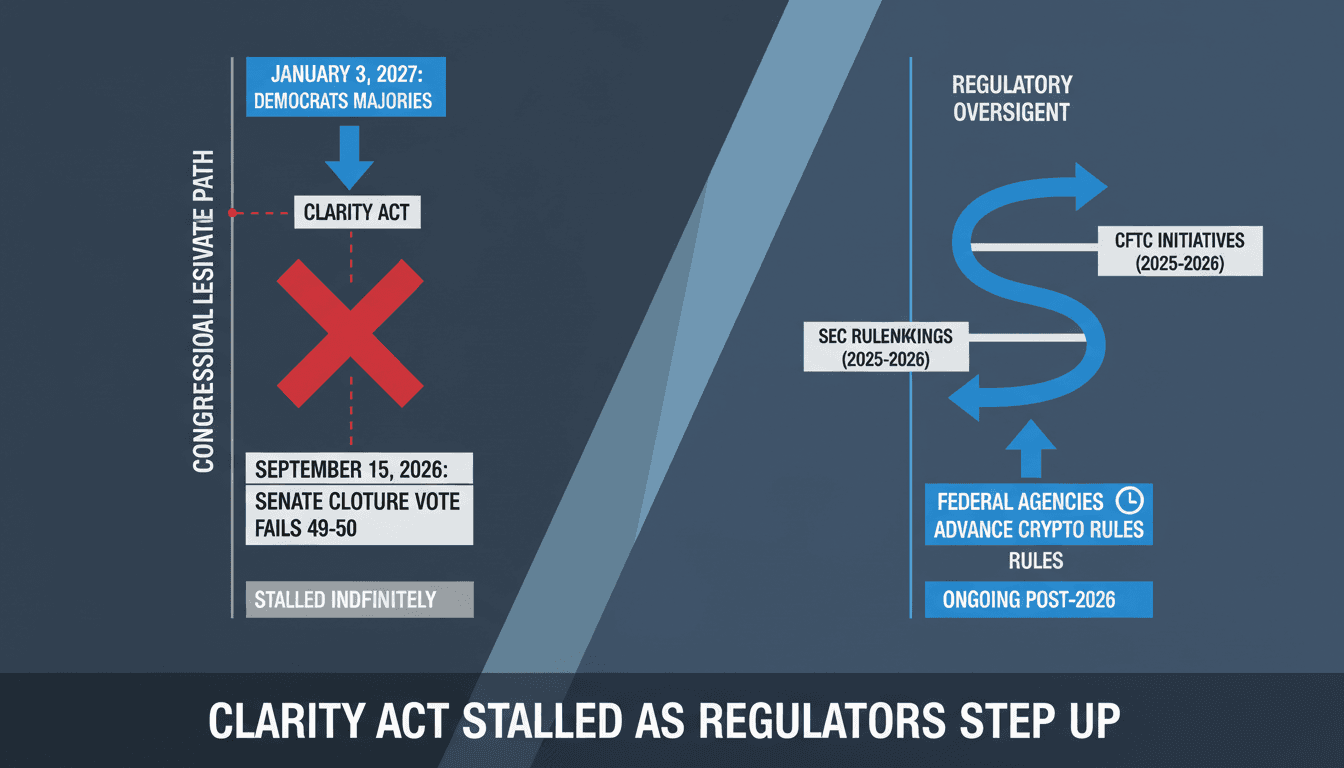
- The CLARITY Act faces procedural gridlock, having failed a Senate cloture vote on September 15, 2026, by a tally of 49-50, well short of the 60-vote threshold needed to advance.
- Incoming leadership convenes January 3, 2027, effectively benching the bill's SEC-versus-CFTC jurisdictional blueprint for a projected minimum of two years according to analysts at TD Cowen.
The context you actually need
- The bill cleared the House in July 2025, but stalled in the Senate after regional lenders raised concerns regarding stablecoin deposits and negotiators added stricter ethics and conflict provisions.
- Agency rulemaking did not wait for Congress, with the SEC publishing exemptions and custody frameworks between August and October 2026, and the CFTC issuing consultations on retail commodity transactions in October 2026.
- Lame-duck viability remains negligible, as the incoming majorities signal an immediate pivot toward investor protection mandates and executive ethics investigations rather than market-structure concessions.
What's really happening
The procedural death of the CLARITY Act illustrates the shifting incentives governing financial regulation when legislative power fractures. The draft legislation was designed to draw a clean statutory boundary between the Securities and Exchange Commission (SEC), led by Chairman Paul Atkins, and the Commodity Futures Trading Commission (CFTC), led by Chairman Michael Selig. That compromise would have shifted significant primary authority over non-security token markets toward the CFTC.
Instead of statutory realignment, the institutional mechanism now reverts to executive administrative law. When Congress fails to enact statutory definitions, administrative agencies maintain broad latitude to govern through existing, century-old securities and commodities laws. The incentive structure for federal regulators fundamentally transforms: agencies preserve their jurisdictional reach by issuing targeted exemptions and staff accounting bulletins rather than executing statutory mandates delivered by legislative committees.
The failure of the September 15, 2026, cloture motion—falling 11 votes short at 49-50—revealed structural fault lines that transcend simple party margins. Community banking coalitions warned lawmakers about the potential drain of retail deposits toward non-bank stablecoin issuers, while legislative negotiators introduced ethics requirements that complicated industry alignment. With incoming legislative leadership taking committee gavels on January 3, 2027, the legislative apparatus will prioritize oversight over deregulation.
For institutional asset allocators, this structural outcome ensures that regulatory risk cannot be priced via a federal statute. Market participants must operate within parallel administrative regimes. The SEC’s August–October 2026 proposals on asset exemptions and custody requirements, combined with the CFTC’s October 2026 retail commodity consultations, mean regulatory obligations will be shaped by Federal Register notices rather than Capitol Hill compromises. Cross-border capital that deferred structural structuring decisions in anticipation of comprehensive U.S. federal legislation must now adapt to a fractured, agency-driven framework for the foreseeable political cycle.
Who feels it first (and how)
- Cross-border digital asset funds: Encounter prolonged exposure to dual-agency interpretations, preventing clean legal categorization for tokens held across U.S. and offshore structures.
- Institutional custodians and market makers: Must navigate the SEC's custody proposals from late 2026 without the safe-harbor protections the CLARITY Act sought to formalize.
- Global regulatory hubs including Dubai: Experience indirect market sentiment shifts as global liquidity continues to price in U.S. administrative ambiguity, reinforcing regional preferences for localized, comprehensive rulebooks.
What to watch next
- SEC and CFTC administrative publications: Track Federal Register notices from SEC Chairman Paul Atkins and CFTC Chairman Michael Selig through late 2026 to see if independent agency actions compensate for missing statutory language.
- The January 3, 2027, committee transitions: Monitor committee leadership changes in the Senate Banking and House Financial Services committees for formal inquiries into digital asset market oversight.
- Secondary market volatility metrics: Watch liquidity depth across dollar-denominated digital asset pairs as institutional investors adjust models away from federal statutory relief.
Democrats won majorities in both congressional chambers on November 3, 2026, taking office on January 3, 2027, following a 49-50 failure of the CLARITY Act cloture vote.
Legislative market-structure proposals will remain stalled for at least two years while committees focus on consumer protection and executive conflict inquiries.
Whether independent agency initiatives from the SEC and CFTC can establish market stability without statutory statutory definitions.
Frequently Asked Questions
- Why it matters?
- The collapse of legislative momentum for digital asset market structure shifts the center of gravity back to regulatory enforcement and agency-level interpretation in the world's largest capital market.
- What happened (in 30 seconds)?
- Congressional majorities flipped on November 3, 2026, as Democrats secured control of both the House of Representatives and the Senate, ending unified Republican legislative management. The CLARITY Act faces procedural gridlock, having failed a Senate cloture vote on September 15, 2026, by a tally of 49-50, well short of the 60-vote threshold needed to advance. Incoming leadership convenes January 3, 2027, effectively benching the bill's SEC-versus-CFTC jurisdictional blueprint for a projected m
- What's really happening?
- The procedural death of the CLARITY Act illustrates the shifting incentives governing financial regulation when legislative power fractures. The draft legislation was designed to draw a clean statutory boundary between the Securities and Exchange Commission (SEC), led by Chairman Paul Atkins, and the Commodity Futures Trading Commission (CFTC), led by Chairman Michael Selig. That compromise would have shifted significant primary authority over non-security token markets toward the CFTC. Instea
- Who feels it first (and how)?
- Cross-border digital asset funds: Encounter prolonged exposure to dual-agency interpretations, preventing clean legal categorization for tokens held across U.S. and offshore structures. Institutional custodians and market makers: Must navigate the SEC's custody proposals from late 2026 without the safe-harbor protections the CLARITY Act sought to formalize. Global regulatory hubs including Dubai: Experience indirect market sentiment shifts as global liquidity continues to price in U.S. administr
- What to watch next?
- SEC and CFTC administrative publications: Track Federal Register notices from SEC Chairman Paul Atkins and CFTC Chairman Michael Selig through late 2026 to see if independent agency actions compensate for missing statutory language. The January 3, 2027, committee transitions: Monitor committee leadership changes in the Senate Banking and House Financial Services committees for formal inquiries into digital asset market oversight. Secondary market volatility metrics: Watch liquidity depth across
Real-time updates, analysis, and reports on the blockchain and cryptocurrency sectors.
"Crypto News delivers real-time updates, analysis, and reports on the blockchain and cryptocurrency sectors."
— A47 Editor
CLARITY Act faces a new Congress as Democrats win both chambers
Democrats have won both chambers of Congress in the US midterm elections, leaving the stalled CLARITY Act facing a change in congressional control, according to the Associated Press, while federal regulators continue developing their own crypto rules...
Beginner-friendly crypto tutorials, guides, and news.
"99Bitcoins is a crypto education and news site known for easy-to-understand content and comprehensive guides."
— A47 Editor
Bitcoin Price Wobbles as Democrats Take Congress: Crypto Market Structure Bill Faces Uncertain Future
Bitcoin briefly fell below $76,000, a seven-week low near $75,618, as reports confirmed Democrats had won control of Congress in the 2026 U.S. midterm elections, raising questions about the future of U.S. crypto regulation. The selloff coincided with...
Covers blockchain, cryptocurrency news, project analysis, and market insights.
"Cointelegraph is a leading crypto-focused media outlet known for timely news, analysis, and educational content related to blockchain and digital assets."
— A47 Editor
Democrats win US House to secure control of Congress in midterms
Democrats will take control of House committees in January 2027, following their win in the US House during the 2026 midterm elections, which gives the party authority to investigate President Donald Trump's administration.
Covers blockchain, cryptocurrency news, project analysis, and market insights.
"Cointelegraph is a leading crypto-focused media outlet known for timely news, analysis, and educational content related to blockchain and digital assets."
— A47 Editor
Democrats claim control of the US Senate
Democrats are claiming control of the U.S. Senate, a shift that Cointelegraph reports could alter the path for the CLARITY Act, reshape committee leadership and bring closer scrutiny of Trump's crypto businesses. The development follows earlier Senat...