
Democrats Capture House and Senate Leaving Trump a Lame-Duck President Amid Inflation and Energy Shock
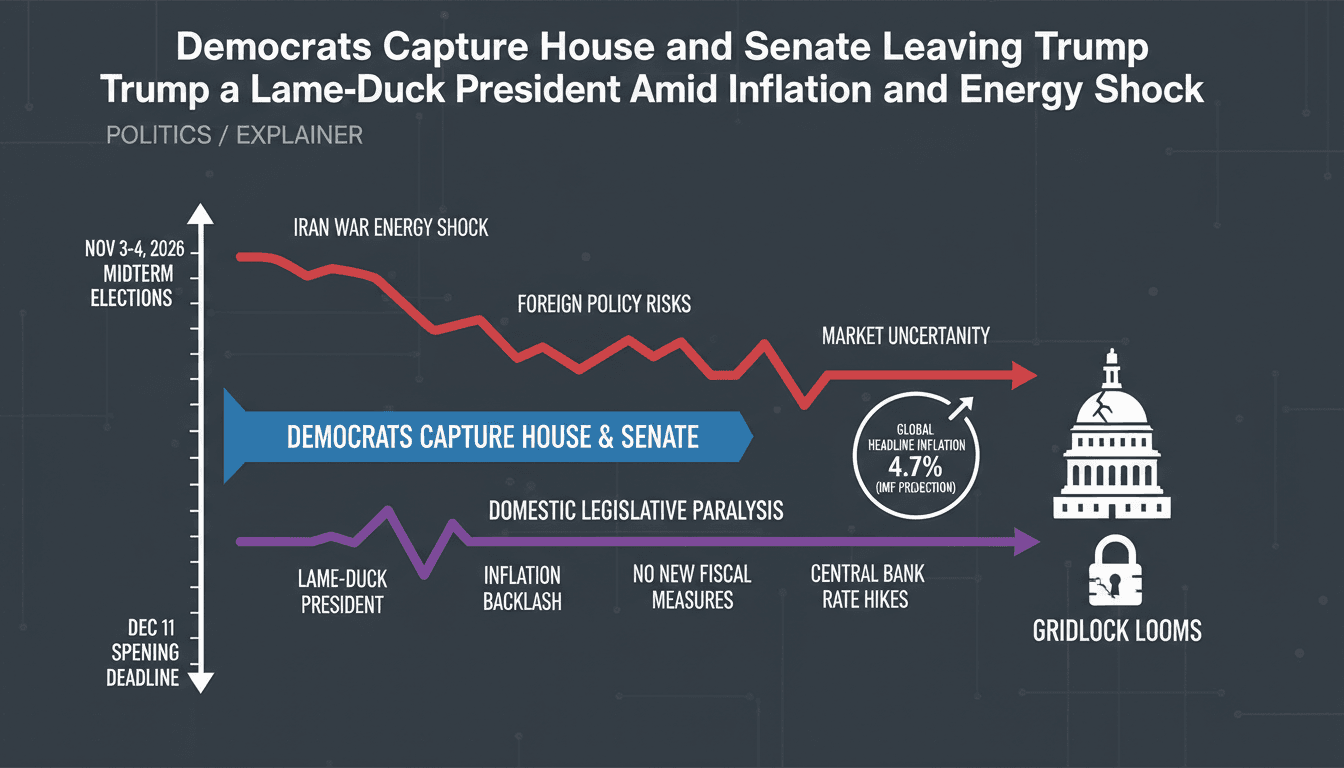
Why it matters
Institutional checks have restored legislative gridlock in the world's largest economy, curbing domestic policy shifts while leaving persistent energy inflation and monetary tightening cycles in place.
What happened (in 30 seconds)
- Democrats flipped Congress: The November 3–4, 2026 midterm elections yielded Democratic majorities in both the House of Representatives and the Senate, creating a divided government.
- The presidency entered lame-duck status: President Donald Trump conceded the legislative outcome while committing to govern defensively as "Mr Veto" against incoming congressional bills.
- Global markets split their reaction: Asian bourses absorbed initial pullbacks while European equities gained, driven by the removal of domestic legislative uncertainty alongside falling crude benchmarks.
The context you actually need
- Energy shocks fueled the political pivot: Military conflict involving the US, Israel, and Iran led to the closure of the Strait of Hormuz, driving US diesel to record peaks in August 2026 and lifting domestic inflation to 3.7%.
- Global price metrics remain stretched: The International Monetary Fund projected global headline inflation to hit 4.7% in 2026, driven primarily by raw energy input disruptions.
- Central banks remain on tightening paths: With price pressures sustained by maritime supply interruptions, the Federal Reserve, the European Central Bank, and the Bank of England face ongoing incentives to keep borrowing costs elevated.
What's really happening
The return of divided government in Washington creates structural paralysis for domestic policy while intensifying executive actions abroad. By losing both chambers of Congress, the administration loses its path for partisan fiscal expansion, supplemental domestic tax alterations, and direct legislative deregulation. For global capital, divided government historically represents a baseline of stability: it sharply reduces the risk of unexpected fiscal initiatives or aggressive domestic corporate tax reforms.
However, the incentives governing executive authority shift fundamentally when domestic channels narrow. Under a divided legislature, a president faces zero resistance when exercising unilateral powers, specifically in trade enforcement, national security measures, and foreign policy maneuvers. With the president committing to use veto authority against Democratic legislative proposals, domestic lawmaking enters complete stasis ahead of a critical December 11, 2026 government spending deadline.
This dynamic alters the calculus for international trading partners. In Asia, commercial partners facing existing or threatened tariffs now possess incentives to delay direct bilateral concessions or reciprocal investment commitments. The logic is structural: an executive branch constrained by a hostile legislature possesses diminished political capital to enforce long-term cross-border economic pacts, incentivizing foreign counterparties to run out the political clock.
Concurrently, this institutional stall does not automatically resolve underlying macroeconomic imbalances. The inflation that drove voter backlash remains rooted in physical energy disruptions linked to the Strait of Hormuz closure. While Brent crude pulled back toward $94 per barrel following the election results as traders priced in potential diplomatic momentum, structural supply chains remain compromised.
As a result, major monetary authorities cannot ease policy simply because Washington has entered legislative gridlock. With the IMF tracking global headline inflation at 4.7%, monetary officials at the Federal Reserve, the European Central Bank, and the Bank of England remain pressured to maintain restrictive policy rates. Growth models reflect this drag; economic projections from Berenberg indicate US annual output expansion will slow toward 1.5% by 2028, constrained by political paralysis, restrictive immigration rules, and persistent borrowing costs.
Who feels it first (and how)
- Corporate Treasurers and Institutional Borrowers: Face an extended period of high capital costs as central banks maintain restrictive terminal rates to combat 4.7% global baseline inflation.
- Cross-Border Asian Manufacturers: Gain tactical leverage to delay long-term bilateral tariff agreements and trade-contingent capital outlays pending US executive clarity.
- Energy Traders and Maritime Shippers: Experience pricing swings around the $94 per barrel Brent level as geopolitical developments dictate transit risk through the Strait of Hormuz.
- Gulf and Dubai Commercial Hubs: Observe indirect exposure through volatile crude benchmarks, global trade realignments, and shifting international portfolio allocations toward resilient logistics markets.
What to watch next
- The December 11 US spending deadline: Serves as the first direct structural test between the incoming Democratic majorities and the executive's veto posture, determining whether federal operations face disruption.
- Executive unilateral trade directives: Signals whether the administration will compensate for domestic legislative gridlock by raising tariffs or enforcing targeted import barriers via executive power.
- Strait of Hormuz physical transit volumes: Determines whether regional oil pricing sustains its descent toward baseline levels or triggers renewed secondary inflation metrics.
Democrats hold both the House and the Senate; global headline inflation is projected by the IMF at 4.7%; federal budget authorizations expire on December 11, 2026.
New domestic economic and fiscal bills will stall completely through 2028 as executive vetoes block congressional initiatives, anchoring US growth forecasts near 1.5%.
The degree to which trading partners in Asia will actively dismantle existing tariff-related commitments, and whether regional diplomacy will durably reopen commercial passage through the Strait of Hormuz.
Frequently Asked Questions
- Why it matters?
- Institutional checks have restored legislative gridlock in the world's largest economy, curbing domestic policy shifts while leaving persistent energy inflation and monetary tightening cycles in place.
- What happened (in 30 seconds)?
- Democrats flipped Congress: The November 3–4, 2026 midterm elections yielded Democratic majorities in both the House of Representatives and the Senate, creating a divided government. The presidency entered lame-duck status: President Donald Trump conceded the legislative outcome while committing to govern defensively as "Mr Veto" against incoming congressional bills. Global markets split their reaction: Asian bourses absorbed initial pullbacks while European equities gained, driven by the remova
- What's really happening?
- The return of divided government in Washington creates structural paralysis for domestic policy while intensifying executive actions abroad. By losing both chambers of Congress, the administration loses its path for partisan fiscal expansion, supplemental domestic tax alterations, and direct legislative deregulation. For global capital, divided government historically represents a baseline of stability: it sharply reduces the risk of unexpected fiscal initiatives or aggressive domestic corporate
- Who feels it first (and how)?
- Corporate Treasurers and Institutional Borrowers: Face an extended period of high capital costs as central banks maintain restrictive terminal rates to combat 4.7% global baseline inflation. Cross-Border Asian Manufacturers: Gain tactical leverage to delay long-term bilateral tariff agreements and trade-contingent capital outlays pending US executive clarity. Energy Traders and Maritime Shippers: Experience pricing swings around the $94 per barrel Brent level as geopolitical developments dictate
- What to watch next?
- The December 11 US spending deadline: Serves as the first direct structural test between the incoming Democratic majorities and the executive's veto posture, determining whether federal operations face disruption. Executive unilateral trade directives: Signals whether the administration will compensate for domestic legislative gridlock by raising tariffs or enforcing targeted import barriers via executive power. Strait of Hormuz physical transit volumes: Determines whether regional oil pricing s
UK and international business news, economics, and corporate coverage.
"The Guardian’s business section covers finance and markets with a progressive editorial tone."
— A47 Editor
After the US midterms, what will a lame duck Trump mean for the global economy?
Democrats swept aside Donald Trump's Republican Party in the November 3, 2026 midterm elections, taking control of the House of Representatives and the Senate and leaving the president with two years of a lame-duck term; analysts say the shift puts t...
News across North, Central, and South America including politics and economics.
"France 24 is viewed as a globally focused outlet with balanced coverage and a European perspective."
— A47 Editor
US midterm elections: A referendum on President Donald Trump?
The 2026 US midterm elections, held on 3 November, are being widely framed as a referendum on President Donald Trump's second term, with Democrats poised to seize the House and within striking distance of the Senate, according to France 24's base rep...
Key macro releases (CPI, jobs, PMIs), surprise indexes, and market implications.
"Great for data-print awareness and instant read-through to rates and risk assets."
— A47 Editor
The midterm election outcomes that could shape Trump’s final two years
The base report from Investing.com, published November 2, 2026, examines the midterm election outcomes that could shape Donald Trump's final two years in office, with the coverage carrying a neutral tone.