
Trump Announces Termination of Approximately $4 Billion Annual US Military Aid to Israel by End of 2026
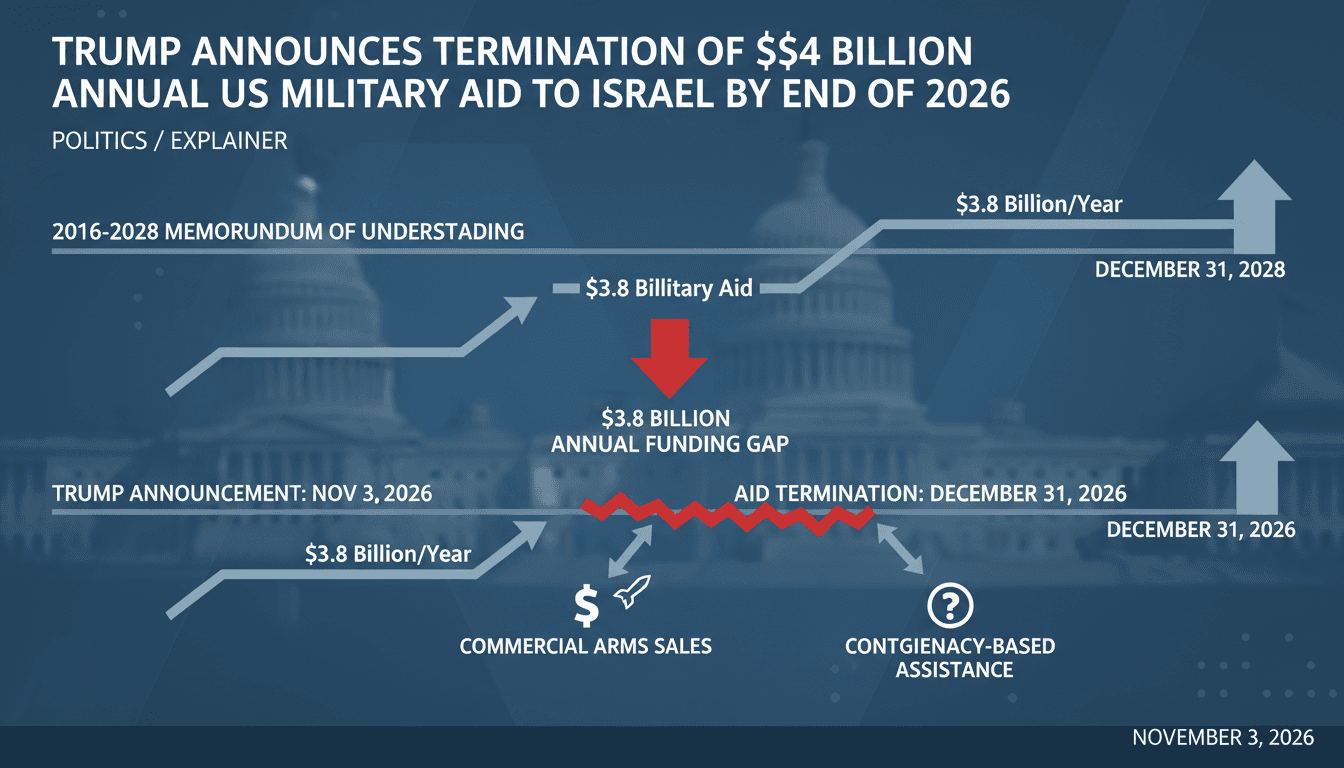
Why it matters
The early wind-down of a decade-long bilateral security commitment fundamentally reconfigures defense financing mechanisms, shifting sovereign partners from direct fiscal subsidies toward market-rate arms acquisitions and bilateral commercial contracts.
What happened (in 30 seconds)
* Aid timeline accelerated: On November 3, 2026, US President Donald Trump stated during a television interview that approximately $4 billion in annual US military assistance to Israel will terminate by the end of 2026, cutting short a ten-year bilateral agreement originally set to run through 2028. * Bilateral premise cited: The stated justification referenced Israel’s domestic economic capacity alongside prior discussions between the US President and Israeli Prime Minister Benjamin Netanyahu, while asserting that future equipment access will shift to direct arms sales. * Institutional surprise reported: Operational officials inside Israel’s defense and finance ministries received no formal administrative notice prior to the public declaration, creating immediate friction with active state budget cycles designed around continuous grant allocations.
The context you actually need
* The 2016 framework: Under the existing ten-year Memorandum of Understanding spanning 2019 through 2028, the United States pledged $38 billion in overall military support, structured primarily as $3.3 billion annually in Foreign Military Financing alongside $500 million per year dedicated to missile defense programs. * Changing political incentives: The announcement coincided with US midterm election voting, arriving amid shifting domestic polling on foreign financial allocations and broader political scrutiny regarding unconditional external assistance packages. * Regional operational environment: Israel’s defense apparatus remains actively engaged across multiple regional theaters, including direct military confrontations involving Iran, increasing the state's reliance on munitions supply lines and high-tier defensive interceptors.
What's really happening
The operational core of this transition lies in the shift from non-repayable fiscal transfers to conventional foreign military sales. For decades, the $3.8 billion annual baseline under the Memorandum of Understanding acted as a sovereign balance-sheet subsidy. It allowed Israel to procure advanced US aerospace systems—such as fifth-generation combat aircraft and precision munitions—while liberating domestic capital for research, sovereign debt servicing, and internal operational deployments. By moving the targeted end date from 2028 to the close of 2026, Washington introduces an abrupt fiscal delta that requires immediate institutional adjustment.
The fundamental mechanism driving this policy posture is rooted in domestic political incentives and economic capacity metrics. With US public sentiment showing increased sensitivity toward overseas funding, the administration is using Israel’s advanced gross domestic product and technological sector depth to justify the withdrawal of direct financial backstops. The incentive structure operates on two fronts: it offers domestic US voters a measurable reduction in outbound outlays, while preserving corporate revenue streams for American defense contractors by transitioning the recipient nation from an aid recipient into a direct purchasing client.
However, the friction generated by this accelerated timeline is administrative and budgetary. Israel’s Ministry of Finance and Ministry of Defense structure multi-year procurement programs on the assumption of guaranteed US Foreign Military Financing disbursements. Because these grants are heavily tied to purchases from American suppliers, any abrupt cessation requires Israel to either issue sovereign debt to finance future hardware deliveries, raise domestic taxes, or cut domestic departmental budgets.
Furthermore, the legal mechanics of ending an executive Memorandum of Understanding two years ahead of schedule introduce institutional ambiguity. The 2016 framework represents an agreed bilateral roadmap rather than a strictly binding treaty, granting the executive branch broad discretion over budget submissions. Yet Congress retains the statutory authority to appropriate funds. If US legislative majorities choose to allocate the standard funding increments regardless of executive declarations, the White House would face procedural hurdles in executing the cut.
Concurrently, regional commercial dynamics face realignment. As grant funding recedes, Israel will likely demand greater operational flexibility in how and where it spends its defense capital, potentially pressing for expanded domestic defense production rather than being contractually obligated to purchase US-manufactured equipment. This dynamic will reshape how Gulf entities, global defense primes, and regional sovereign funds price geopolitical integration and industrial defense partnerships across the post-2026 security architecture.
Who feels it first (and how)
* Israeli defense and finance planners: Budget directors must urgently revise national spending baselines, balancing the absorption of a $3.8 billion annual fiscal gap against ongoing wartime operational costs. * US defense contractors: Aerospace and defense manufacturers that hold multi-year delivery contracts backed by Foreign Military Financing guarantees must prepare for contract restructuring as procurement shifts to commercial credit or direct state purchasing. * Israeli asset markets and sovereign debt issuers: Institutional investors face pricing adjustments and asset volatility linked to fiscal uncertainty and the prospect of increased sovereign bond issuance to plug defense gaps. * Gulf security and procurement strategists: Defense ministries across the region will assess how changes in US security subsidization impact broader regional deterrent postures and commercial equipment availability under Abraham Accords frameworks.
What to watch next
* Congressional budget authorizations: Track whether the incoming US Congress introduces alternative foreign assistance line items or attempts to enforce the original 2028 MOU funding schedule via statutory appropriations. * Official Israeli cabinet and ministry responses: Monitor formal policy statements from the Israeli Prime Minister’s Office and Ministry of Defense clarifying whether an official bilateral phase-out agreement was actually established. * Sovereign debt pricing and credit reviews: Watch Israeli bond spreads and credit agency assessments over the coming quarters for indications of fiscal strain tied to defense self-funding requirements.
President Trump announced that approximately $4 billion in annual US military assistance to Israel will terminate by the end of 2026; Israeli ministry personnel reported having no advance notice; the 2016 MOU established a $38 billion total package through 2028.
The US will maintain standard channels for commercial arms sales, joint technological development, and ad-hoc emergency assistance packages during major regional security crises.
Whether the US executive branch can unilaterally terminate pre-authorized congressional funding before the 2028 expiration date without facing legislative resistance or legal contestation.
Frequently Asked Questions
- Why it matters?
- The early wind-down of a decade-long bilateral security commitment fundamentally reconfigures defense financing mechanisms, shifting sovereign partners from direct fiscal subsidies toward market-rate arms acquisitions and bilateral commercial contracts.
- What happened (in 30 seconds)?
- Aid timeline accelerated: On November 3, 2026, US President Donald Trump stated during a television interview that approximately $4 billion in annual US military assistance to Israel will terminate by the end of 2026, cutting short a ten-year bilateral agreement originally set to run through 2028. Bilateral premise cited: The stated justification referenced Israel’s domestic economic capacity alongside prior discussions between the US President and Israeli Prime Minister Benjamin Netanyahu, whil
- What's really happening?
- The operational core of this transition lies in the shift from non-repayable fiscal transfers to conventional foreign military sales. For decades, the $3.8 billion annual baseline under the Memorandum of Understanding acted as a sovereign balance-sheet subsidy. It allowed Israel to procure advanced US aerospace systems—such as fifth-generation combat aircraft and precision munitions—while liberating domestic capital for research, sovereign debt servicing, and internal operational deployments. By
- Who feels it first (and how)?
- Israeli defense and finance planners: Budget directors must urgently revise national spending baselines, balancing the absorption of a $3.8 billion annual fiscal gap against ongoing wartime operational costs. US defense contractors: Aerospace and defense manufacturers that hold multi-year delivery contracts backed by Foreign Military Financing guarantees must prepare for contract restructuring as procurement shifts to commercial credit or direct state purchasing. Israeli asset markets and sovere
- What to watch next?
- Congressional budget authorizations: Track whether the incoming US Congress introduces alternative foreign assistance line items or attempts to enforce the original 2028 MOU funding schedule via statutory appropriations. Official Israeli cabinet and ministry responses: Monitor formal policy statements from the Israeli Prime Minister’s Office and Ministry of Defense clarifying whether an official bilateral phase-out agreement was actually established. Sovereign debt pricing and credit reviews: Wa
Arabic political reporting and analysis.
"Arabic Post is a digital outlet focused on politics and regional affairs."
— A47 Editor
ماذا يعني إعلان ترامب وقف المساعدات العسكرية لإسرائيل؟
Donald Trump announced an agreement with Benjamin Netanyahu to end annual U.S. military aid to Israel by the end of 2026, as the United States and Israel have been at war with Iran for more than eight months. The announcement caused confusion in Isra...
Coverage of current events and conflicts in the Middle East.
"France 24 is viewed as a globally focused outlet with balanced coverage and a European perspective."
— A47 Editor
Trump cuts Israeli military aid: $3.8 billion in security assistance slashed
On Tuesday, November 3, US President Donald Trump said he reached a deal with Israeli Prime Minister Benjamin Netanyahu under which Washington would stop providing $3.8 billion in security assistance to Israel after the end of this year, according to...
European coverage of Middle East politics and security issues.
"France 24 offers international reporting with a European editorial perspective."
— A47 Editor
Trump cuts Israeli military aid: $3.8 billion in security assistance slashed
On Tuesday, November 3, US President Donald Trump said he reached a deal with Israeli Prime Minister Benjamin Netanyahu under which Washington would stop providing $3.8 billion in security assistance to Israel after the end of this year, according to...
Global business headlines with AI angles.
"General business outlet that frequently covers AI."
— A47 Editor
U.S. Will Stop Sending Billions in Funding to Israel After This Year: 'Now We'll help Israel if They Need it'
The United States will stop sending billions of dollars in funding to Israel after this year, according to reporting by the International Business Times, which cited remarks by President Trump. Trump said Israel does not need the aid and that the U.S...
European coverage of Middle East politics and security issues.
"France 24 offers international reporting with a European editorial perspective."
— A47 Editor
Trump says US will halt $4 billion in aid to Israel at the end of the year
President Donald Trump said the United States will halt its roughly $4 billion in annual aid to Israel at the end of the year, following a reported deal with Israeli Prime Minister Benjamin Netanyahu, and argued that Israel no longer needs the fundin...
Coverage of current events and conflicts in the Middle East.
"France 24 is viewed as a globally focused outlet with balanced coverage and a European perspective."
— A47 Editor
Trump says US will halt $4 billion in aid to Israel at the end of the year
President Donald Trump said the United States will halt its roughly $4 billion in annual aid to Israel at the end of the year, following a reported deal with Israeli Prime Minister Benjamin Netanyahu, and argued that Israel no longer needs the fundin...
UAE-based English-language newspaper covering regional politics, economics, and global affairs.
"The National reflects Emirati policy perspectives while maintaining international editorial standards."
— A47 Editor
Donald Trump says US will end $4bn in annual military aid to Israel
President Donald Trump said the United States will end roughly $3.8 billion to $4 billion in annual security assistance to Israel after the end of 2026, citing a deal reached with Israeli Prime Minister Benjamin Netanyahu. Coverage across outlets rep...
Arabic-language coverage of political affairs and current events.
"Okaz political coverage typically follows mainstream Saudi framing on national and regional affairs."
— A47 Editor
ترمب يوقف المساعدات لإسرائيل نهاية العام
U.S. President Donald Trump announced that aid to Israel will stop at the end of the year, stating that Israel does not need it, and that Washington will not continue funding Israel after this year. Trump said in an interview with FOX NEWS' "Fox & Fr...