
Trump Says US Will End Annual Military Aid to Israel by Year-End 2026
Why it matters
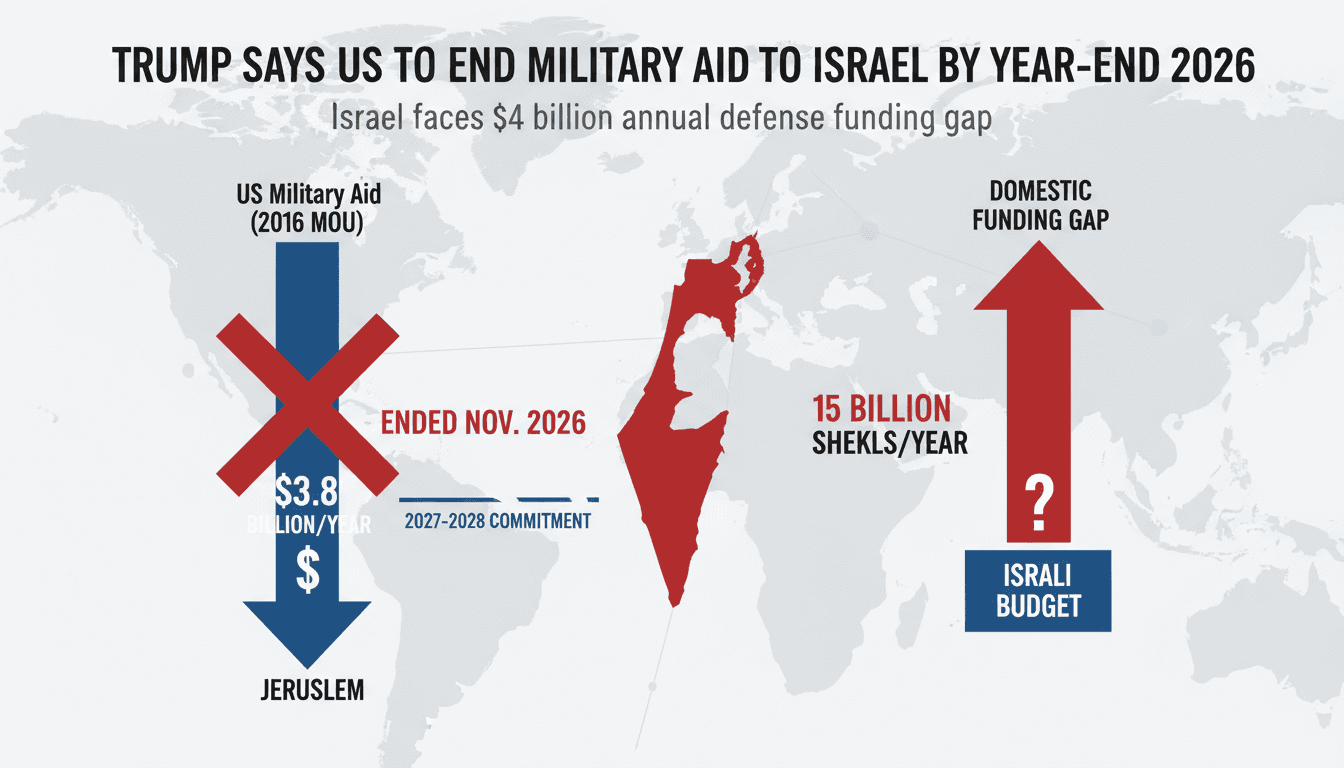
Accelerating the end of a ten-year bilateral assistance pact forces an immediate budgetary substitution of roughly 15 billion shekels per year, altering long-term defense financing mechanisms two years ahead of schedule.
What happened (in 30 seconds)
- The policy declaration: U.S. President Donald Trump announced on November 3, 2026, during a Fox News interview, that the United States will end direct annual military assistance of approximately $4 billion to Israel by the end of 2026.
- The bilateral premise: Trump framed the termination as the result of a mutual understanding reached months earlier with Israeli Prime Minister Benjamin Netanyahu, stating that Israel has the capacity to self-fund and purchase arms independently.
- The institutional reaction: Defense and finance officials in Israel reported receiving no advance documentation, expressing concern over the immediate need to replace roughly 15 billion shekels annually for active procurement and aircraft acquisition plans.
The context you actually need
- The existing framework: Washington and Israel currently operate under a 2016 memorandum of understanding committing $38 billion in military assistance over ten years, averaging $3.8 billion annually through fiscal year 2028.
- Foreign Military Financing mechanics: The 2016 structure specifically subsidizes Foreign Military Financing (FMF) for U.S.-manufactured defense equipment alongside dedicated funding for joint missile defense programs.
- The trajectory versus the timeline: While Prime Minister Netanyahu previously advocated for a gradual long-term reduction in dependency on U.S. aid, neither government had formalized or operationalized an accelerated cutoff for year-end 2026.
What's really happening
The mechanics of this shift transform a structured, multi-year subsidy into an open-market transactional sales relationship two full fiscal years before the current bilateral framework expires.
Under the 2016 memorandum of understanding, the $38 billion total allocation functioned as a predictable baseline for long-cycle defense investments. In practice, this meant roughly $3.8 billion per year flowed directly into American industrial production lines to supply advanced hardware, primarily specialized aircraft acquisitions and integrated missile defense platforms. Because these funds were ring-fenced through Foreign Military Financing, procurement offices could schedule multi-year delivery timetables knowing that direct federal appropriations would absorb the capital burden.
Terminating this transfer by the end of 2026 leaves an annual structural shortfall of approximately 15 billion shekels ($4 billion) that Israel's domestic budget must absorb if current acquisition rates remain intact. This creates an immediate operational trade-off inside Israel’s Ministry of Finance and Ministry of Defense. When an external sovereign subsidy of this size ends on an accelerated timeline, domestic capital must pivot from alternate state expenditures, increase sovereign debt issuance, or defer high-ticket equipment contracts.
The incentive structure on the U.S. side shifts the baseline from direct assistance to standard foreign military sales. Trump's assertion that Israel can purchase equipment as needed moves the relationship from subsidized security assistance to commercial-style transactions. For U.S. defense contractors, the volume of equipment orders may theoretically remain stable if Israel buys the same systems directly, but the sovereign payment risk and funding execution transfer entirely to Israeli domestic taxpayers.
At the same time, the absence of written transition blueprints leaves procurement offices navigating institutional uncertainty. Channel 12 and Israeli public broadcasters noted that defense planners are already assessing how to protect long-range aircraft programs that depend on multi-year financing commitments. Because Prime Minister Netanyahu’s office offered no immediate formal confirmation and the Finance Ministry received no advance documentation, bureaucratic institutions must now run internal solvency and budget reviews to prepare for alternate financing pathways before fiscal year 2027 begins.
Who feels it first (and how)
- Israeli Ministry of Finance planners: Must immediately locate alternative funding sources or restructure sovereign balance sheets to bridge a roughly 15 billion shekels annual funding gap without triggering fiscal strain.
- Defense procurement and acquisition directors: Face potential renegotiations, deferrals, or restructuring of long-cycle capital contracts, particularly for U.S.-origin aircraft fleets and joint missile defense systems.
- U.S. defense manufacturers: Must transition billing structures and multi-year production agreements from federally guaranteed Foreign Military Financing pipelines to direct sovereign client contracts.
- Regional market observers: Monitor sovereign debt metrics and fiscal reallocation decisions across Israeli ministries, even as direct economic impacts on hubs like Dubai remain absent.
What to watch next
- Formal diplomatic documentation: Watch for official bilateral memorandums or public statements from the Prime Minister’s Office that confirm whether the 2016 agreement is legally amended or terminated early.
- The Israeli defense budget adjustment: Monitor whether the Ministry of Finance issues supplementary debt or reallocates capital from domestic budgets to replace the 15 billion shekels annual shortfall.
- Contract transition models: Track whether upcoming U.S. arms packages transition into commercial sales frameworks, subsidized loan mechanisms, or scaled-back procurement orders.
Trump announced on Fox News that approximately $4 billion in annual U.S. military aid to Israel will end by late 2026; the current memorandum of understanding runs through fiscal year 2028; Israeli defense planners estimate the gap at roughly 15 billion shekels annually.
Israeli defense and finance ministries will initiate internal structural reviews to adjust procurement pipelines and prioritize critical aircraft programs over non-essential capital expenditures.
Whether formal diplomatic instruments have been drafted to override the existing 2016 agreement, how joint missile defense funding will be separated from direct aid, and whether the U.S. Congress will weigh in on the existing statutory commitment.
Frequently Asked Questions
- Why it matters?
- Accelerating the end of a ten-year bilateral assistance pact forces an immediate budgetary substitution of roughly 15 billion shekels per year, altering long-term defense financing mechanisms two years ahead of schedule.
- What happened (in 30 seconds)?
- The policy declaration: U.S. President Donald Trump announced on November 3, 2026, during a Fox News interview, that the United States will end direct annual military assistance of approximately $4 billion to Israel by the end of 2026. The bilateral premise: Trump framed the termination as the result of a mutual understanding reached months earlier with Israeli Prime Minister Benjamin Netanyahu, stating that Israel has the capacity to self-fund and purchase arms independently. The institutional
- What's really happening?
- The mechanics of this shift transform a structured, multi-year subsidy into an open-market transactional sales relationship two full fiscal years before the current bilateral framework expires. Under the 2016 memorandum of understanding, the $38 billion total allocation functioned as a predictable baseline for long-cycle defense investments. In practice, this meant roughly $3.8 billion per year flowed directly into American industrial production lines to supply advanced hardware, primarily spe
- Who feels it first (and how)?
- Israeli Ministry of Finance planners: Must immediately locate alternative funding sources or restructure sovereign balance sheets to bridge a roughly 15 billion shekels annual funding gap without triggering fiscal strain. Defense procurement and acquisition directors: Face potential renegotiations, deferrals, or restructuring of long-cycle capital contracts, particularly for U.S.-origin aircraft fleets and joint missile defense systems. U.S. defense manufacturers: Must transition billing structu
- What to watch next?
- Formal diplomatic documentation: Watch for official bilateral memorandums or public statements from the Prime Minister’s Office that confirm whether the 2016 agreement is legally amended or terminated early. The Israeli defense budget adjustment: Monitor whether the Ministry of Finance issues supplementary debt or reallocates capital from domestic budgets to replace the 15 billion shekels annual shortfall. Contract transition models: Track whether upcoming U.S. arms packages transition into comm
Arabic-language coverage of political affairs and current events.
"Okaz political coverage typically follows mainstream Saudi framing on national and regional affairs."
— A47 Editor
بعد إعلان ترمب.. ارتباك في إسرائيل بشأن مصير المساعدات الأمريكية
Donald Trump announced his intention to end U.S. aid to Israel by the end of the current year, prompting concern and uncertainty within Israel's security establishment. Officials are unclear whether the decision means an immediate halt to financial t...
Arabic-language coverage of international news and geopolitics.
"RT Arabic is a Russian state-funded outlet often criticized for promoting Kremlin-aligned narratives."
— A47 Editor
"اليسار" و"المصري السيد" وراء إعلان ترامب وقف المساعدات الأمريكية لإسرائيل
The base article, published by RT Arabic, reports that the announcement by Donald Trump to halt US aid to Israel is attributed to pressure from the left and the figure "Al-Masri Al-Sayed" (as named in the source). The piece notes that the issue has b...
Arabic-language coverage of international news and geopolitics.
"RT Arabic is a Russian state-funded outlet often criticized for promoting Kremlin-aligned narratives."
— A47 Editor
ارتباك وقلق في إسرائيل بعد إعلان ترامب وقف المساعدات الأمنية والمالية
Israel's security establishment is reported to be in a state of confusion and anxiety following Donald Trump's statement that U.S. security and financial assistance to Israel would end by the end of the year, according to Channel 12 as cited by RT Ar...
Arabic-language coverage of international news and geopolitics.
"RT Arabic is a Russian state-funded outlet often criticized for promoting Kremlin-aligned narratives."
— A47 Editor
صدمة في إسرائيل بعد إعلان ترامب وقف المساعدات الأمنية والمالية لها
Israel's Broadcasting Authority reported that the Israeli Ministry of Defense and the Israeli military were caught off guard by U.S. President Donald Trump's announcement that Washington would halt security and financial aid to Israel by the end of t...
Jordanian news and regional updates.
"Roya News is a Jordanian outlet focused on breaking news and local affairs."
— A47 Editor
ترمب: اتفقت مع نتنياهو على إيقاف المساعدات لـ إسرائيل نهاية العام لأنها لم تعد تحتاج إليها
U.S. President Donald Trump said he reached an agreement with Israeli Prime Minister Benjamin Netanyahu to end U.S. aid to Israel at the end of the year, stating that Israel no longer needs it. The announcement, reported by Royanews and based on a su...