
AI Super PACs Yield Mixed Results in 2026 US Midterms Despite Multimillion-Dollar Spending
Why it matters
A $72.28 million capital deployment into political action committees failed to produce a unified legislative consensus, demonstrating that financial firepower alone cannot override broader electoral currents to deliver a pre-emptive national regulatory framework.
What happened (in 30 seconds)
- AI political action committees deployed tens of millions of dollars across primary and general congressional races in the 2026 U.S. midterm elections, testing whether focused industry capital could shape legislative boundaries before federal statutory frameworks solidify.
- Electoral outcomes diverged sharply from campaign expenditures, as pro-industry groups like Leading the Future (LTF) and pro-safety organizations like Public First and Guardrails Alliance backed multiple losing candidates amid wider Democratic gains.
- Both factions confirmed plans to continue spending through 2028, maintaining pressure on congressional seats with an emphasis on primary contests to influence federal oversight mechanisms.
The context you actually need
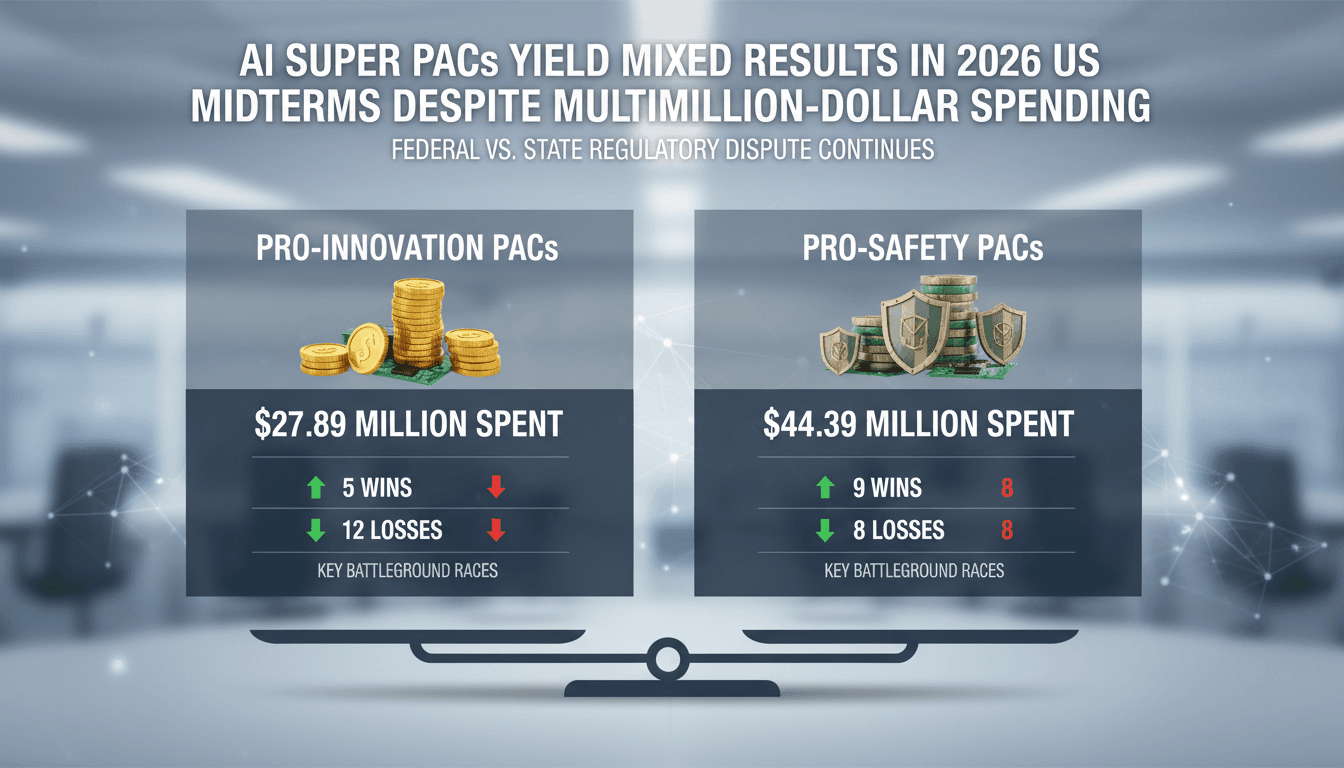
- A multi-million-dollar funding split defined the cycle, with pro-safety super PACs deploying $44.39 million compared to $27.89 million spent by pro-innovation networks, bringing aggregate verified spending to $72.28 million.
- The regulatory dispute centers on preemption versus state autonomy, pitting enterprise leaders seeking a uniform, lighter-touch federal rule against safety coalitions seeking to preserve independent state-level oversight and make corporate campaign contributions politically toxic.
- Spending concentrated heavily in early primaries, including an $8 million push by LTF affiliates opposing New York Assembly member Alex Bores, before general election investments yielded defeats for figures like South Carolina Senate candidate Darline Graham.
What's really happening
The capital deployed across the 2026 midterm cycle reveals an incentive structure caught between regulatory preemption and public skepticism. Industry-aligned entities—such as Leading the Future (LTF) and its donor base including OpenAI president Greg Brockman and Andreessen Horowitz—allocated $27.38 million directly to primaries. The operational logic was simple: primary races require lower capital thresholds to establish policy commitments on artificial intelligence before candidates face general electorates.
However, translating primary leverage into general election policy control broke down under macro-political conditions. In the general election, pro-industry vehicles American Mission and Building the Future allocated $4.8 million behind South Carolina Senate candidate Darline Graham, and more than $500,000 each toward Montana's Aaron Flint and North Carolina's Laurie Buckhout. All three candidates lost. While LTF's Democratic vehicle, Think Big, saw Florida Representative Jared Moskowitz retain his seat, the aggregate return on capital was diluted by broader partisan shifts that overshadowed technology-specific advocacy.
Simultaneously, safety-aligned organizations engineered their own capital counterweight. Groups such as Public First, backed by Anthropic, and Guardrails Alliance spent $44.39 million to enforce political friction around corporate tech donations. Public First directed $3 million toward California state Senator Scott Wiener, who took the lead in his congressional contest, while Guardrails Alliance spent over $1 million opposing California Representative Jimmy Gomez and Aaron Flint—both of whom lost—while lifting Angela Gonzales-Torres past Gomez.
For global operators, this spending dynamic illustrates that technology regulation is no longer an isolated policy vertical negotiated quietly in committee rooms. It is a factional electoral battleground. By deploying capital against specific legislative profiles, pro-safety groups demonstrated that corporate-backed tech platforms can be framed as liabilities in competitive districts. Concurrently, pro-industry donors established that while capital cannot reliably reverse macro-level voting waves, it can successfully eliminate specific skeptics during low-turnout primary cycles.
Because neither camp secured a decisive legislative majority, Congress enters 2027 without a clear mandate to override state laws. The resulting equilibrium favors continued regulatory decentralization: individual states retain latitude to enforce independent guardrails, while federal agencies face divided congressional committees with competing directives.
Who feels it first (and how)
- Enterprise Chief Legal Officers and Compliance Teams: Must prepare dual-track compliance budgets to navigate disparate state-level rules rather than relying on a harmonized federal framework.
- Venture Capital Partners and Incubator Leads: Face valuation discounts and longer deployment runways for early-stage portfolio companies forced to address varying jurisdictional compliance standards across regional markets.
- State-Level Regulators and Attorneys General: Retain enforcement autonomy and legislative space to introduce standalone algorithmic auditing, disclosure, and safety requirements without immediate federal preemption.
- Congressional Committee Staff and Policy Advocates: Encounter entrenched, well-funded lobbying operations on both flanks, ensuring that future hearings maintain polarized positions regarding innovation exemptions and strict liability.
What to watch next
- 2027 Congressional Committee Assignments: Monitor leadership appointments on House and Senate commerce and technology subcommittees to determine whether pro-innovation or pro-safety allies secure jurisdictional control over federal preemption legislation.
- State-Level Legislative Filing Deadlines: Track whether bellwether state legislatures introduce new liability and safety statutes now that federal legislative preemption has stalled.
- 2028 Cycle Primary Filings: Watch early financial commitments from Leading the Future and Guardrails Alliance as both organizations recalibrate their targeting strategies ahead of the next federal election.
AI-focused political action committees spent $72.28 million on the 2026 cycle ($27.89 million from pro-innovation groups and $44.39 million from pro-safety groups), producing mixed returns across contested districts.
Federal legislative efforts to enact an overarching preemption framework will stall in the near term, keeping state-level governance active and relevant for enterprise deployment.
Whether public scrutiny of tech donor spending will make corporate contributions an operational liability for candidates in future general elections, or if primary-targeted capital will remain an effective channel for pre-clearing sympathetic lawmakers.
Frequently Asked Questions
- Why it matters?
- A $72.28 million capital deployment into political action committees failed to produce a unified legislative consensus, demonstrating that financial firepower alone cannot override broader electoral currents to deliver a pre-emptive national regulatory framework.
- What happened (in 30 seconds)?
- AI political action committees deployed tens of millions of dollars across primary and general congressional races in the 2026 U.S. midterm elections, testing whether focused industry capital could shape legislative boundaries before federal statutory frameworks solidify. Electoral outcomes diverged sharply from campaign expenditures, as pro-industry groups like Leading the Future (LTF) and pro-safety organizations like Public First and Guardrails Alliance backed multiple losing candidates amid
- What's really happening?
- The capital deployed across the 2026 midterm cycle reveals an incentive structure caught between regulatory preemption and public skepticism. Industry-aligned entities—such as Leading the Future (LTF) and its donor base including OpenAI president Greg Brockman and Andreessen Horowitz—allocated $27.38 million directly to primaries. The operational logic was simple: primary races require lower capital thresholds to establish policy commitments on artificial intelligence before candidates face gene
- Who feels it first (and how)?
- Enterprise Chief Legal Officers and Compliance Teams: Must prepare dual-track compliance budgets to navigate disparate state-level rules rather than relying on a harmonized federal framework. Venture Capital Partners and Incubator Leads: Face valuation discounts and longer deployment runways for early-stage portfolio companies forced to address varying jurisdictional compliance standards across regional markets. State-Level Regulators and Attorneys General: Retain enforcement autonomy and legisl
- What to watch next?
- 2027 Congressional Committee Assignments: Monitor leadership appointments on House and Senate commerce and technology subcommittees to determine whether pro-innovation or pro-safety allies secure jurisdictional control over federal preemption legislation. State-Level Legislative Filing Deadlines: Track whether bellwether state legislatures introduce new liability and safety statutes now that federal legislative preemption has stalled. 2028 Cycle Primary Filings: Watch early financial commitments
Startup news with frequent AI coverage.
"Covers launches, funding, and product updates in AI."
— A47 Editor
AI PACs spent millions trying to shape Congress — here’s how they fared
AI industry political action committees spent millions trying to shape the 2026 congressional midterms, with mixed results, according to TechCrunch. The base story reports that the groups are already looking ahead to the next election cycle.
Corporate leadership, finance, technology, and market trends.
"Fortune covers financial trends, leadership, and innovation with a pragmatic editorial approach."
— A47 Editor
Here’s how the candidates backed by AI super PACs fared
AI-focused super PACs spent a combined $79 million during the current election cycle, with most of that spending occurring before November, according to a Fortune report examining what the candidates they backed achieved in return.
Global business headlines with AI angles.
"General business outlet that frequently covers AI."
— A47 Editor
Three Races Within the Midterms: AI Money, Musk's Influence and the Fight for Regulation
The International Business Times reports that the 2026 midterm elections could show whether voters respond to AI regulation, how Elon Musk's financial backing shapes individual races, and whether AI regulation advocates can gain influence in Congress...
Corporate leadership, finance, technology, and market trends.
"Fortune covers financial trends, leadership, and innovation with a pragmatic editorial approach."
— A47 Editor
AI is on the ballot. Data centers are a major political issue in the midterms. But the implications of today’s vote for AI go much further
The Fortune analysis published on election day examines how a possible Democratic-controlled Congress could bring more regulation and scrutiny of AI companies, as data centers become a major political issue in the US midterm elections and experts wat...