
Democratic Senate Flips in Rural States Position Farm Relief on Fuel and Commodity Costs for January 2027 Congress
Why it matters
The capture of both congressional chambers by Democrats in the November 2026 midterms reconfigures baseline statutory policy on tariffs, renewable fuel mandates, and federal lending limits directly driven by farm-sector balance sheet pressure.
What happened (in 30 seconds)
- Senate seats flipped across agricultural strongholds, with Democratic challengers securing victories in Kansas, Texas, and Iowa while competing closely in Mississippi during the November 3–4, 2026 elections.
- Voters responded to direct operational cost pressures, driven by elevated diesel expenses, persistent fertilizer inflation, and tariff friction across livestock and crop markets.
- Democrats secured majorities across both chambers of Congress, transferring control over the upcoming 120th Congress convening in January 2027 and opening the path for legislative intervention on agricultural relief.
The context you actually need
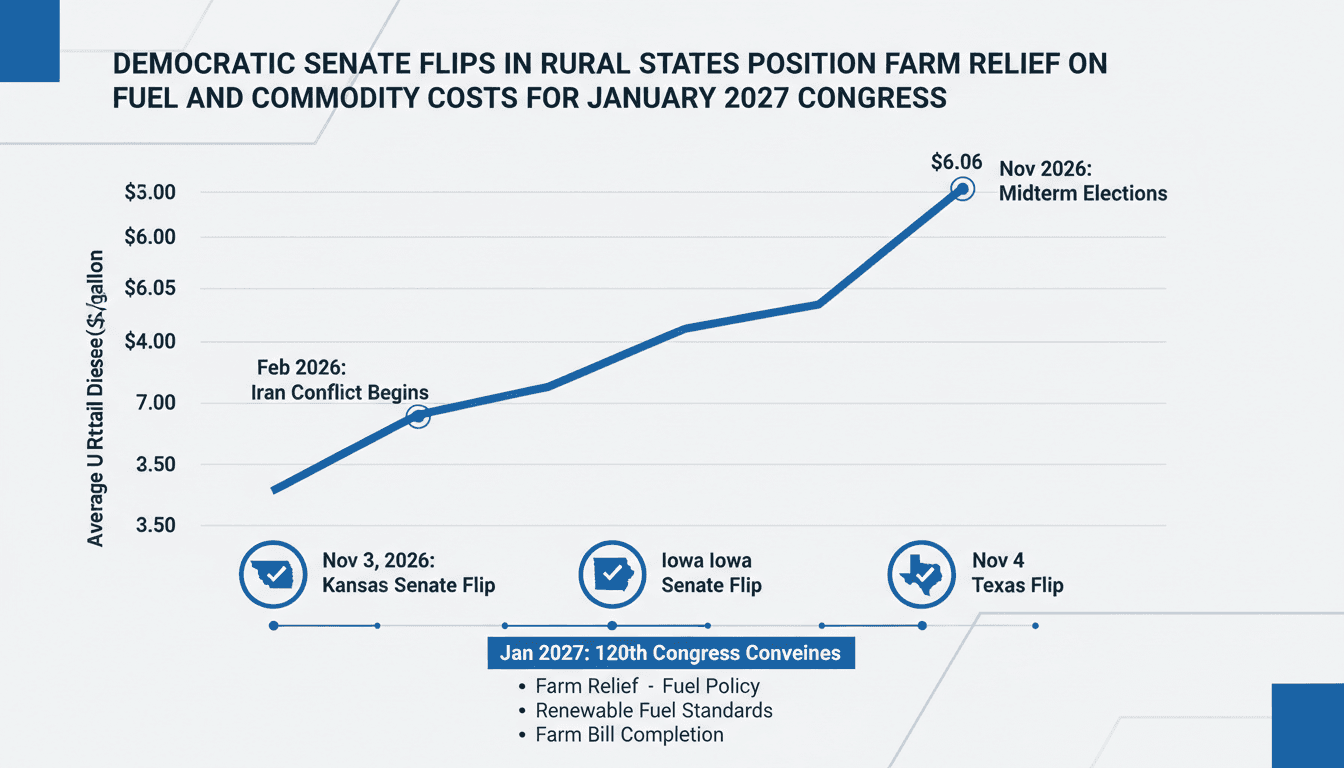
- Diesel prices climbed by roughly $2.56 per gallon year-over-year, according to AAA metrics cited following the initiation of conflict with Iran in late February 2026, directly eroding margins for operators running heavy machinery.
- Federal tariff programs and ongoing inflation pressed livestock operators, altering beef pricing economics and elevating Chapter 12 farm bankruptcy filings across rural regions.
- Incoming lawmakers campaigned on specific structural targets, focusing on rolling back conflict-related expenditures, restructuring agricultural credit ceilings, and re-evaluating tariff frameworks.
What's really happening
The political outcome of the November 2026 midterms reveals an incentive realignment driven entirely by input balance sheets rather than historical voting patterns. For agricultural enterprises, profitability hinges on the spread between baseline input costs—chiefly diesel fuel, synthetic fertilizer, and commercial credit—and realized commodity prices at the terminal elevator or auction yard.
When national retail diesel advanced by an average of $2.56 per gallon year-over-year following the conflict that began in February 2026, the cost per acre of basic operational runs escalated simultaneously across planting, cultivation, and harvest windows. Heavy machinery cannot substitute away from diesel fuel in the short term. Consequently, these operational expenditures directly pressured operating margins across rural production zones.
This margin contraction interacted directly with international trade constraints. Tariff mechanisms imposed during the second Trump administration shifted export and import cost balances in protein segments, altering rancher economics across beef supply chains. As domestic consumer prices for beef held high, producers faced asymmetric cost structures where elevated processing, transportation, and feed costs counteracted farmgate margins. These financial bottlenecks contributed to an acceleration in Chapter 12 bankruptcy petitions across traditional agricultural regions.
Faced with severe operational debt, voter behavior in agricultural counties detached from traditional historical margins. Democratic candidates targeted these cost pressures by pledging statutory action on fuel relief, revisions to renewable fuel standards, changes to beef labeling requirements, and expansions of federal credit limits in the stalled Farm Bill. By focusing on immediate balance-sheet items, challengers flipped seats in rural states including Kansas, Iowa, and Texas.
The resulting institutional landscape creates a high-friction dynamic for the 120th Congress starting in January 2027. While Democratic majorities in the House and Senate will set the legislative calendar, establish committee leadership, and introduce measures modifying commodity programs, executive approval remains vested in President Donald Trump. This structural separation establishes an incentive test: agricultural lawmakers must calibrate Farm Bill provisions, tariff adjustments, and fuel mandates to secure rural constituent relief while navigating potential presidential vetoes.
Who feels it first (and how)
- Commercial grain and crop producers: Farm operators managing extensive acreage face immediate cash-flow decisions influenced by whether Congress revises renewable fuel quotas and expands Farm Bill operating loan maximums.
- Cattle ranchers and beef processors: Protein supply chain participants navigate potential shifts in trade policy, country-of-origin labeling, and processing capacity subsidies aimed at easing livestock economics.
- Agricultural lenders and credit institutions: Regional agricultural banks holding debt portfolios exposed to Chapter 12 restructuring face shifts depending on how rapidly statutory credit limits and federal guarantees are adjusted.
- Logistics and heavy transport providers: Fleet operators dependent on bulk agricultural haulage and industrial diesel must factor potential legislative maneuvers around energy markets and fuel standards into operating contracts.
What to watch next
- The Farm Bill baseline draft in January 2027: When the 120th Congress convenes, the specific language setting statutory credit caps and conservation subsidies will reveal the realistic margin relief available to producers.
- Executive veto positions on trade adjustments: Legislative moves to alter trade authority or reduce retaliatory tariffs will test whether the White House will veto measures targeted at agricultural relief.
- Renewable Fuel Standard blending volume adjustments: Direct committee action on biofuel blending targets will signal how fast lawmakers attempt to alter demand for grain commodities and adjust fuel price structures.
Democratic candidates defeated incumbents in Kansas, Texas, and Iowa to secure majorities in both congressional chambers ahead of the 120th Congress, propelled by rural dissatisfaction with diesel prices up $2.56 per gallon year-over-year and farm balance sheet strains.
The incoming congressional leadership will prioritize the overdue Farm Bill, targeting expanded credit limits, agricultural processing capacity funds, and adjustments to renewable fuel standards.
Whether legislative packages targeting tariff rollbacks, commodity supports, and fuel costs can clear presidential veto hurdles or survive divided executive-legislative negotiations.
Frequently Asked Questions
- Why it matters?
- The capture of both congressional chambers by Democrats in the November 2026 midterms reconfigures baseline statutory policy on tariffs, renewable fuel mandates, and federal lending limits directly driven by farm-sector balance sheet pressure.
- What happened (in 30 seconds)?
- Senate seats flipped across agricultural strongholds, with Democratic challengers securing victories in Kansas, Texas, and Iowa while competing closely in Mississippi during the November 3–4, 2026 elections. Voters responded to direct operational cost pressures, driven by elevated diesel expenses, persistent fertilizer inflation, and tariff friction across livestock and crop markets. Democrats secured majorities across both chambers of Congress, transferring control over the upcoming 120th Congr
- What's really happening?
- The political outcome of the November 2026 midterms reveals an incentive realignment driven entirely by input balance sheets rather than historical voting patterns. For agricultural enterprises, profitability hinges on the spread between baseline input costs—chiefly diesel fuel, synthetic fertilizer, and commercial credit—and realized commodity prices at the terminal elevator or auction yard. When national retail diesel advanced by an average of $2.56 per gallon year-over-year following the co
- Who feels it first (and how)?
- Commercial grain and crop producers: Farm operators managing extensive acreage face immediate cash-flow decisions influenced by whether Congress revises renewable fuel quotas and expands Farm Bill operating loan maximums. Cattle ranchers and beef processors: Protein supply chain participants navigate potential shifts in trade policy, country-of-origin labeling, and processing capacity subsidies aimed at easing livestock economics. Agricultural lenders and credit institutions: Regional agricultur
- What to watch next?
- The Farm Bill baseline draft in January 2027: When the 120th Congress convenes, the specific language setting statutory credit caps and conservation subsidies will reveal the realistic margin relief available to producers. Executive veto positions on trade adjustments: Legislative moves to alter trade authority or reduce retaliatory tariffs will test whether the White House will veto measures targeted at agricultural relief. Renewable Fuel Standard blending volume adjustments: Direct committee a
Capitol Hill news, legislation, and policy insight.
"The Hill specializes in U.S. politics and policy, with a focus on Capitol Hill developments and a reputation for insider reporting."
— A47 Editor
Democrats rode rural frustration to Senate wins. Now farmers want results
Democrats flipped Senate seats in previously deep-red states such as Kansas and Texas, in part by criticizing Trump administration policies that contributed to high diesel and beef costs. Farmers now expect the party to translate campaign promises in...
24/7 international news from a French perspective in multiple languages.
"France 24 is viewed as a globally focused outlet with balanced coverage and a European perspective."
— A47 Editor
From Kansas to Texas, Democrats win big in Republican heartlands
Democrats are set to take control of both the House and Senate after winning races in states including South Carolina, Kansas and Texas, a result described as a historic upset in Republican heartlands. President Donald Trump has said he will accept t...
Global business headlines with AI angles.
"General business outlet that frequently covers AI."
— A47 Editor
The Democrats Have Won The House And The Senate After Defeating GOP In Several Republican Strongholds
Democrats are projected to control both chambers of Congress after flipping Senate seats in several Republican strongholds, including Texas and Kansas, where the GOP has dominated for decades. Voters cited concerns about democracy, the Iran war and t...