
Israeli Election Deadlock Elevates Arab Parties to Kingmaker Status as Netanyahu Rejects Partnership
Why it matters
A structural legislative impasse in the Knesset directly clouds bilateral commercial momentum under the Abraham Accords and elevates risk premiums across Levantine capital markets.
What happened (in 30 seconds)
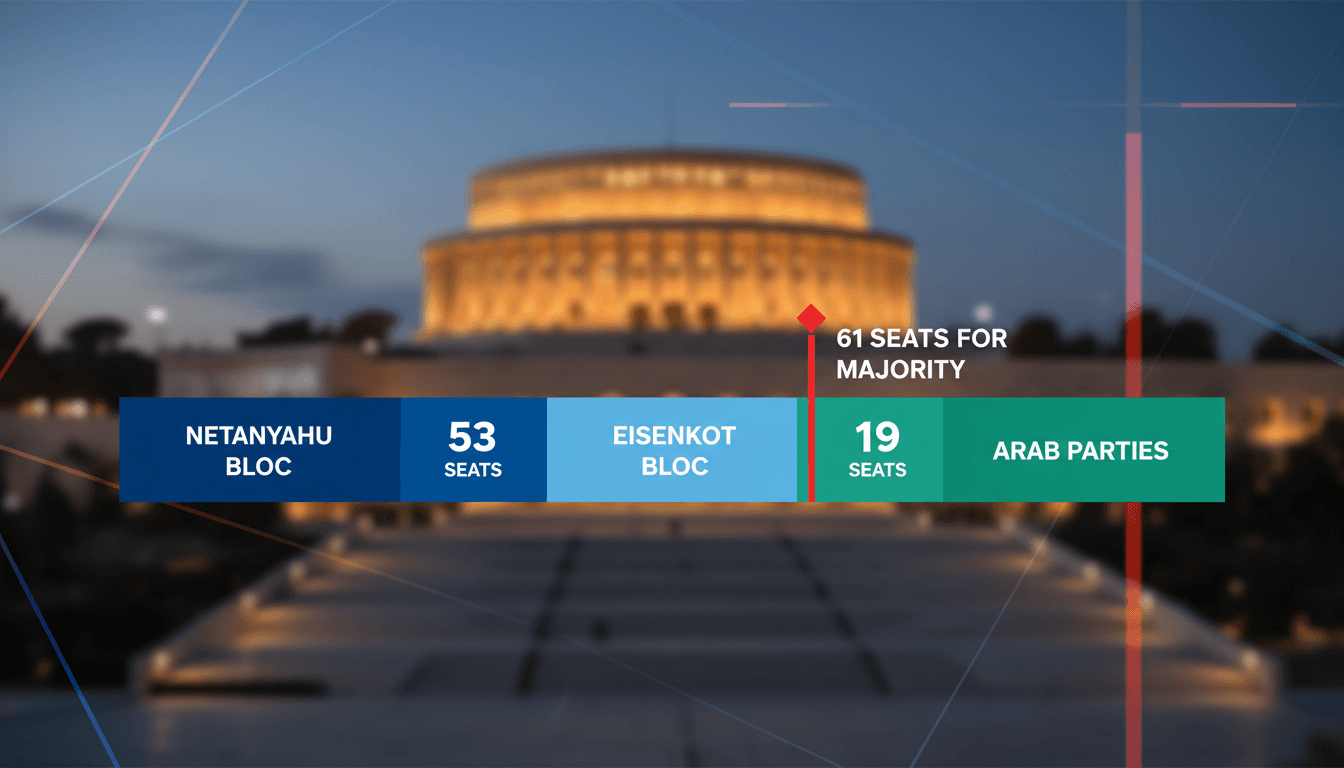
* A fractured electorate yielded zero majorities: The 27 October 2026 parliamentary election resulted in Benjamin Netanyahu's right-wing bloc securing 53 seats and Gadi Eisenkot's centrist opposition claiming 48 seats, leaving both short of the 61-seat governing threshold. * Arab-majority factions captured decisive leverage: The Joint List and Ra'am secured a combined 19 seats—nearly doubling their prior parliamentary strength—following an estimated 80% Arab voter turnout. * Coalition formation entered immediate gridlock: Netanyahu explicitly rejected working with Arab factions, while Eisenkot faced acute internal resistance regarding the terms of external parliamentary cooperation.
The context you actually need
* A history of coalition fragility: Israel's 120-seat Knesset requires 61 seats to establish a government, a dynamic that has historically forced fragile alliances between disparate political factions. * Domestic stressors mobilized turnout: Elevated crime rates in Arab municipalities and prolonged regional conflict catalyzed historic participation among Arab citizens, translating demographic weight into legislative power. * Cross-bloc vetoes paralyze negotiation: The arithmetic dictates that no standard governing coalition can cross the line without either breaking ideological taboos or forcing a return to the ballot box.
What's really happening
The mechanics of the 2026 Knesset outcome reflect a mathematical reality that upends traditional Israeli coalition management. With 120 total seats, reaching executive power requires 61 votes. Benjamin Netanyahu's conservative alignment holds 53 seats, representing a hard ceiling given that his partners refuse any tactical or structural alignment with Arab-led parties. Conversely, Gadi Eisenkot's opposition controls 48 seats. The balance of power rests entirely with the 19 seats distributed between the Joint List (11 to 12 seats) and Mansour Abbas's Ra'am (7 to 8 seats).
This distribution creates an incentive trap for every major actor. For Eisenkot, accepting an executive mandate backed by 19 Arab lawmakers requires balancing complex domestic trade-offs. His coalition partners demand stringent baseline criteria, including formal recognition of the state's character and explicit denouncements of non-state armed groups. Simultaneously, Arab party leaders face structural pressure from an electorate that mobilized at roughly 80% turnout precisely to counter right-wing policies, meaning unconditional support for a centrist military-led bloc carries severe domestic reputational costs.
For Netanyahu, the incentives are defensive. Rejecting the legitimacy of Arab parties as governing partners preserves his base cohesion across religious and nationalist factions. However, it completely locks his bloc out of reaching 61 seats unless he can trigger defections from the opposition—a prospect complicated by deep personal and strategic divergences between the party chiefs.
The systemic result is functional paralysis. Without an agreement, executive authority operates in a caretaker capacity, restricting long-term statutory planning, sovereign fiscal allocations, and strategic state appointments. This deadlock exposes Israel's financial instruments to persistent sentiment shocks, visible in spot foreign exchange pressure on the Israeli shekel. For regional counterparties, the inability of the Knesset to seat a stable cabinet means delayed bilateral working groups, stalled infrastructure treaties, and lingering policy unpredictability across the broader Middle East.
Who feels it first (and how)
* Regional venture and institutional investors: Private equity and sovereign capital navigating Abraham Accords corridors face deferred public-sector approvals, slowing joint venture execution. * Foreign exchange and fixed-income traders: Capital allocators exposed to the Israeli shekel face heightened volatility premiums until a stable fiscal framework passes. * Gulf-based multinational executives: Corporate leaders operating regional hubs in Dubai and Abu Dhabi experience slower project rollouts across cross-border water, energy, and tech verticals.
What to watch next
* Opposition alliance negotiations: Monitor whether Gadi Eisenkot agrees to confidence-and-supply terms with Ra'am and the Joint List, which would clarify whether an executive administration can avoid snap elections. * Shekel volatility thresholds: Track performance metrics in Israeli currency pairs, as continued failure to build a coalition typically induces institutional capital hedging. * Abraham Accords operational cadences: Watch for public delays or rescheduled dates for high-level regional ministerial summits, signaling bureaucratic inertia from Jerusalem's caretaker posture.
Netanyahu's bloc holds 53 seats, Eisenkot's opposition holds 48 seats, and Arab-majority parties control 19 seats in the 120-member Knesset.
The legislative arithmetic will prevent either major bloc from forming an internal, majority cabinet without protracted delays or outside parliamentary backing.
Whether internal dissent within Eisenkot's centrist camp will sink an agreement with Arab factions, triggering yet another snap election cycle.
Frequently Asked Questions
- Why it matters?
- A structural legislative impasse in the Knesset directly clouds bilateral commercial momentum under the Abraham Accords and elevates risk premiums across Levantine capital markets.
- What happened (in 30 seconds)?
- A fractured electorate yielded zero majorities: The 27 October 2026 parliamentary election resulted in Benjamin Netanyahu's right-wing bloc securing 53 seats and Gadi Eisenkot's centrist opposition claiming 48 seats, leaving both short of the 61-seat governing threshold. Arab-majority factions captured decisive leverage: The Joint List and Ra'am secured a combined 19 seats—nearly doubling their prior parliamentary strength—following an estimated 80% Arab voter turnout. Coalition formation entere
- What's really happening?
- The mechanics of the 2026 Knesset outcome reflect a mathematical reality that upends traditional Israeli coalition management. With 120 total seats, reaching executive power requires 61 votes. Benjamin Netanyahu's conservative alignment holds 53 seats, representing a hard ceiling given that his partners refuse any tactical or structural alignment with Arab-led parties. Conversely, Gadi Eisenkot's opposition controls 48 seats. The balance of power rests entirely with the 19 seats distributed betw
- Who feels it first (and how)?
- Regional venture and institutional investors: Private equity and sovereign capital navigating Abraham Accords corridors face deferred public-sector approvals, slowing joint venture execution. Foreign exchange and fixed-income traders: Capital allocators exposed to the Israeli shekel face heightened volatility premiums until a stable fiscal framework passes. Gulf-based multinational executives: Corporate leaders operating regional hubs in Dubai and Abu Dhabi experience slower project rollouts acr
- What to watch next?
- Opposition alliance negotiations: Monitor whether Gadi Eisenkot agrees to confidence-and-supply terms with Ra'am and the Joint List, which would clarify whether an executive administration can avoid snap elections. Shekel volatility thresholds: Track performance metrics in Israeli currency pairs, as continued failure to build a coalition typically induces institutional capital hedging. Abraham Accords operational cadences: Watch for public delays or rescheduled dates for high-level regional mini
Pan-Arab political news and analysis.
"Al-Quds Al-Arabi is a London-based Arabic newspaper known for political coverage."
— A47 Editor
إسرائيل بعد الانتخابات… ليس دون الشراكة مع الأحزاب العربية إلا الحرب الأهلية
Following Israel's elections, the Al-Quds Al-Arabi commentary argues that, despite the maneuvers attributed to Netanyahu and Liberman, a change government is reasonably likely to be formed, possibly faster than experts expect, and that the alternativ...
Arabic-language coverage of international news and geopolitics.
"RT Arabic is a Russian state-funded outlet often criticized for promoting Kremlin-aligned narratives."
— A47 Editor
إسرائيل.. الخلافات وعقبات تشكيل الحكومة
Israel's domestic audience awaits a Sunday address by President Yitzhak Herzog, at which he is expected to task a figure with forming the government amid ongoing disputes and obstacles to the coalition-building process.
Arabic-language coverage of political affairs and current events.
"Okaz political coverage typically follows mainstream Saudi framing on national and regional affairs."
— A47 Editor
هرتسوغ يحسم اسم المرشح (الأحد).. ترقب لتكليف آيزنكوت تشكيل الحكومة الإسرائيلية
Israeli opposition leader Gadi Eisenkot has gained the upper hand over Prime Minister Benjamin Netanyahu in coalition consultations, receiving recommendations from 67 of the 120 Knesset members compared with 46 for Netanyahu, while the United Torah J...
Arabic-language reporting on global and regional news.
"BBC Arabic is part of the BBC, generally regarded for editorial standards and broad international coverage."
— A47 Editor
الرئيس الإسرائيلي يحدد الأحد المقبل موعداً لاختيار مرشح لتشكيل الحكومة
Israeli President Isaac Herzog announced in a video message at the end of two days of consultations with party leaders that he intends to task a member of the Knesset with forming the government next Sunday. He said 67 lawmakers recommended Eisenkot ...
Arabic-language coverage of international news and geopolitics.
"RT Arabic is a Russian state-funded outlet often criticized for promoting Kremlin-aligned narratives."
— A47 Editor
آيزنكوت يتفوق على نتنياهو بـ67 تزكية لتشكيل الحكومة
Israeli President Isaac Herzog concluded his consultations with parliamentary blocs on Thursday, with Gadi Eisenkot receiving recommendations from 67 lawmakers to form the next government, compared with 46 for Prime Minister Benjamin Netanyahu.
Pan-Arab political news and analysis.
"Al-Quds Al-Arabi is a London-based Arabic newspaper known for political coverage."
— A47 Editor
إعلام عبري: ليبرمان يبدي مرونة حيال مشاركة الحريديم بحكومة آيزنكوت
Channel 12 reported that Avigdor Liberman, leader of Yisrael Beytenu, has shown greater flexibility toward cooperating with Haredi parties, backing away from his earlier opposition to including them in an alternative government to Benjamin Netanyahu'...
Arabic-language coverage of international news and geopolitics.
"RT Arabic is a Russian state-funded outlet often criticized for promoting Kremlin-aligned narratives."
— A47 Editor
القائمة العربية المشتركة تدعم رسميا تكليف آيزنكوت تشكيل الحكومة الإسرائيلية وترفع الـ"توصيات" إلى 67
The joint Arab list formally announced its decision to back Yesh Atid leader Gantz Eisenkot (Gadi Eisenkot) being tasked with forming the Israeli government, raising the number of recommendations supporting him to 67, compared with 46 for Prime Minis...
Arabic-language political and world news coverage for UAE readers.
"Emarat Al Youm world coverage usually presents international developments through a UAE and Arab audience lens."
— A47 Editor
القائمة العربية المشتركة تعلن دعم غادي آزينكوت لتشكيل الحكومة الإسرائيلية المقبلة القائمة العربية المشتركة تعلن دعم غادي آزينكوت لتشكيل الحكومة الإسرائيلية المقبلة
The Joint Arab List, which won 11 seats in the Israeli elections, announced its support for opposition leader Gadi Eisenkot in forming the next Israeli government, according to a report by Emarat Al Youm.