
Israeli Election Deadlock Leaves Eisenkot Tasked With Forming Government After Netanyahu Bloc Falls Short of Majority
Why it matters
A divided 120-seat parliament leaves Israel without a clear governing majority, directly impacting regional security alignments, fiscal policy stabilization, and trade frameworks across the Middle East.
What happened (in 30 seconds)
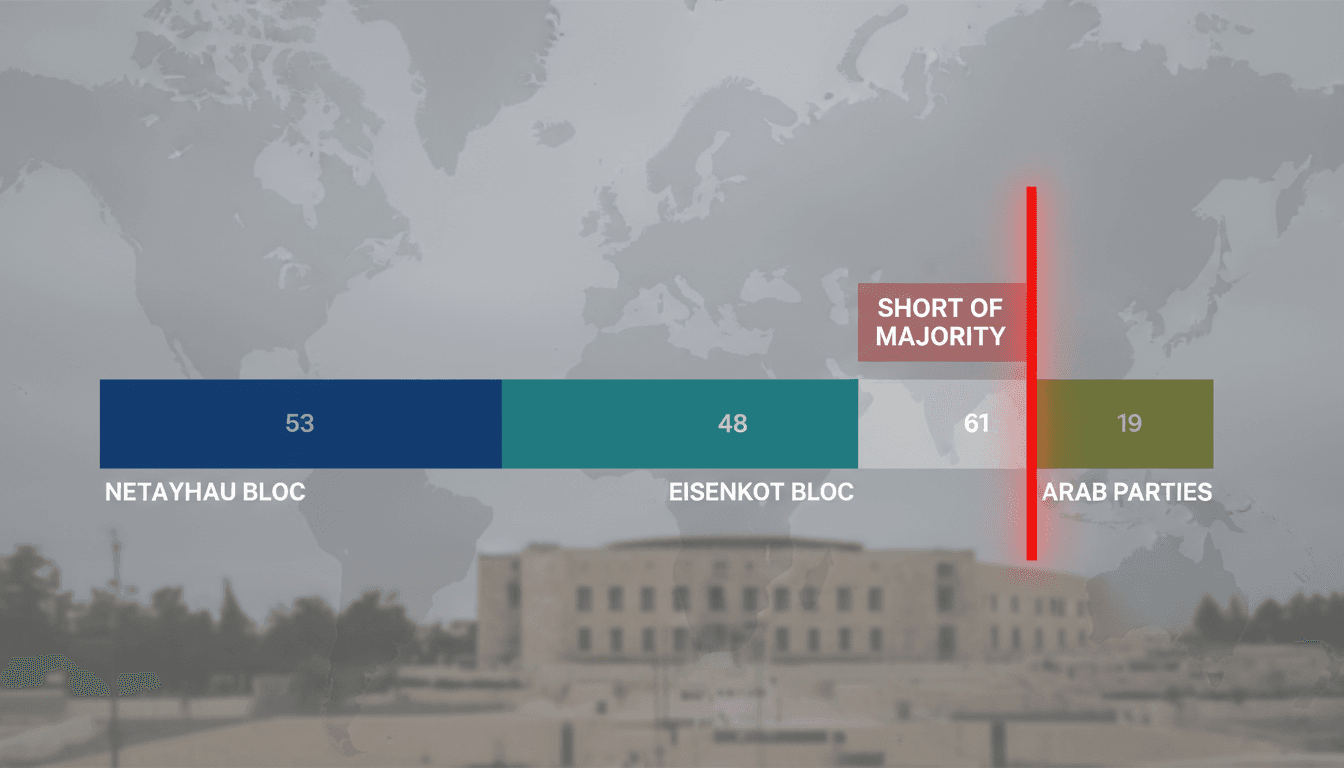
- The October 27, 2026 election yielded no outright winner: Benjamin Netanyahu's right-wing bloc secured 53 seats, while Gadi Eisenkot's opposition bloc captured 48 seats, leaving both short of the 61-seat threshold.
- Arab parties reached a record high: Securing 19 seats in the Knesset, Arab factions hold the mathematical balance of power in an intensely polarized chamber.
- President Isaac Herzog assigned the mandate: On November 8, 2026, former military chief Gadi Eisenkot received a 28-day window to form a coalition government before the mandate potentially transfers back to Netanyahu.
The context you actually need
- Years of prolonged conflict reshaped the electorate: The domestic political landscape fractured sharply following the October 7, 2023 conflict, subsequent economic strains, and diplomatic scrutiny regarding Israeli military operations.
- Netanyahu's Likud remains the single largest party: Holding approximately 27 seats within his 53-seat bloc, Netanyahu retains deep institutional leverage and a disciplined base despite lacking an outright majority.
- Eisenkot's path requires balancing irreconcilable partners: Building a 61-seat governing majority demands aligning centrist figures like Yair Lapid, right-leaning operators like Naftali Bennett, and potentially relying on outside support from Arab parties.
What's really happening
The mathematical reality of the 120-seat Knesset reveals structural incentives that work against long-term political stability. With the threshold for a working government fixed at 61 seats, the split between Netanyahu’s 53-seat bloc and Eisenkot’s 48-seat bloc exposes an arithmetic trap. Because Arab parties hold 19 seats—a historic high—neither mainstream Jewish bloc can assemble an organic, ideologically aligned majority on its own.
For Eisenkot, the operational incentives are clear: he must build an emergency cross-spectrum coalition. To clear the 61-seat bar, his 48-seat bloc must either convince right-wing members of Netanyahu's alliance to defect, or secure informal parliamentary confidence agreements with Arab parties. Both pathways carry heavy political friction. Reaching across the aisle to right-wing elements requires concessions on settlement policy and judicial structures, which alienation-prone centrist allies like Lapid would struggle to digest. Conversely, leaning on support from Arab factions exposes any potential coalition to procedural challenges and internal defections over national security votes and resource distribution.
Netanyahu’s incentive structure operates on defensive delay. Holding 53 seats—anchored by Likud’s roughly 27 seats—his bloc needs to peel away only eight additional lawmakers to retake power. If Eisenkot exhausts his initial 28-day window without producing a viable pact, the mandate reverts under Israeli parliamentary procedure, positioning Netanyahu to present himself as the sole guarantor of stable right-of-center governance. Netanyahu is actively deploying this arithmetic to frame alternative coalitions as non-viable, betting that partner exhaustion will push centrist factions toward a national unity structure on his terms.
This dynamic leaves Israel operating under a caretaker administration with restricted legislative reach. Major budgetary corrections, fiscal adjustments needed to absorb post-2023 conflict expenditures, and strategic decisions concerning conscription for ultra-Orthodox communities remain frozen. For international counterparties, policy continuity persists purely by institutional inertia rather than executive direction.
Who feels it first (and how)
- Gulf-Israel joint venture managers: Cross-border investment vehicles face delays in bilateral regulatory approvals, state-level guarantees, and strategic trade implementations until a formal cabinet forms.
- Regional energy and commodities traders: Uncertainty regarding pipeline approvals, offshore gas export permits, and Mediterranean transit security keeps localized risk premiums intact.
- Israeli fiscal and monetary authorities: The Ministry of Finance and central bank planners operate without an approved multi-year fiscal budget, limiting their capacity to address sovereign debt costs and high post-conflict expenditure.
- Regional tourism and aviation operators: Carriers routing through Middle Eastern hubs, including Dubai, maintain defensive contingency planning as diplomatic normalization initiatives pause during coalition bargaining.
What to watch next
- The expiration of Eisenkot's 28-day mandate: Indicates whether the opposition can formalize an emergency alliance or whether President Herzog must transfer coalition assembly authority back to Netanyahu.
- Knesset defense and budget committee appointments: Reveals whether key right-wing factions are willing to compromise on ultra-Orthodox military conscription rules to unlock a broader unity government.
- Arab party voting alignment on preliminary bills: Demonstrates whether the 19-seat bloc intends to act as a unified tactical leverage point or fragment along domestic socioeconomic lines.
The Knesset is divided at 53 seats for Netanyahu's bloc, 48 seats for Eisenkot's bloc, and 19 seats for Arab parties, with no group commanding the required 61-seat majority.
Government formation negotiations will consume the maximum statutory timeframe, leading either to a fragile, narrow-margin coalition or an extended caretaker period heading into repeat elections.
Whether cross-bloc defections will materialize to grant Eisenkot a governing mandate without requiring structural concessions to outside Arab party support.
Frequently Asked Questions
- Why it matters?
- A divided 120-seat parliament leaves Israel without a clear governing majority, directly impacting regional security alignments, fiscal policy stabilization, and trade frameworks across the Middle East.
- What happened (in 30 seconds)?
- The October 27, 2026 election yielded no outright winner: Benjamin Netanyahu's right-wing bloc secured 53 seats, while Gadi Eisenkot's opposition bloc captured 48 seats, leaving both short of the 61-seat threshold. Arab parties reached a record high: Securing 19 seats in the Knesset, Arab factions hold the mathematical balance of power in an intensely polarized chamber. President Isaac Herzog assigned the mandate: On November 8, 2026, former military chief Gadi Eisenkot received a 28-day window
- What's really happening?
- The mathematical reality of the 120-seat Knesset reveals structural incentives that work against long-term political stability. With the threshold for a working government fixed at 61 seats, the split between Netanyahu’s 53-seat bloc and Eisenkot’s 48-seat bloc exposes an arithmetic trap. Because Arab parties hold 19 seats—a historic high—neither mainstream Jewish bloc can assemble an organic, ideologically aligned majority on its own. For Eisenkot, the operational incentives are clear: he mus
- Who feels it first (and how)?
- Gulf-Israel joint venture managers: Cross-border investment vehicles face delays in bilateral regulatory approvals, state-level guarantees, and strategic trade implementations until a formal cabinet forms. Regional energy and commodities traders: Uncertainty regarding pipeline approvals, offshore gas export permits, and Mediterranean transit security keeps localized risk premiums intact. Israeli fiscal and monetary authorities: The Ministry of Finance and central bank planners operate without an
- What to watch next?
- The expiration of Eisenkot's 28-day mandate: Indicates whether the opposition can formalize an emergency alliance or whether President Herzog must transfer coalition assembly authority back to Netanyahu. Knesset defense and budget committee appointments: Reveals whether key right-wing factions are willing to compromise on ultra-Orthodox military conscription rules to unlock a broader unity government. Arab party voting alignment on preliminary bills: Demonstrates whether the 19-seat bloc intends
Egyptian politics, economy, and society coverage.
"Al Masry Al Youm is a major Egyptian newspaper with broad national coverage."
— A47 Editor
إسرائيل بعد نتنياهو: هل يتحول انتصار المعارضة إلى إخفاق استراتيجى؟
Israeli media coverage, as reflected in an Al-Masry Al-Youm report, examines the selection of Gadi Eisenkot to form a new Israeli government to succeed Benjamin Netanyahu, questioning whether the opposition's electoral victory will prove to be a stra...
Arabic-language reporting on global and regional news.
"BBC Arabic is part of the BBC, generally regarded for editorial standards and broad international coverage."
— A47 Editor
غادي آيزنكوت: من هو المكلف بتشكيل الحكومة الإسرائيلية؟
Former Israeli army chief Gadi Eisenkot is profiled by BBC Arabic as the figure posing the largest political challenge to Prime Minister Benjamin Netanyahu ahead of the upcoming general election, with the report examining his background and his path ...
Arabic-language coverage of political affairs and current events.
"Okaz political coverage typically follows mainstream Saudi framing on national and regional affairs."
— A47 Editor
هرتسوغ يحسم اسم المرشح (الأحد).. ترقب لتكليف آيزنكوت تشكيل الحكومة الإسرائيلية
Israeli opposition leader Gadi Eisenkot has gained the upper hand over Prime Minister Benjamin Netanyahu in coalition consultations, receiving recommendations from 67 of the 120 Knesset members compared with 46 for Netanyahu, while the United Torah J...