
Iran Rules Out Export of Enriched Uranium as US-Iran Diplomacy Stalls
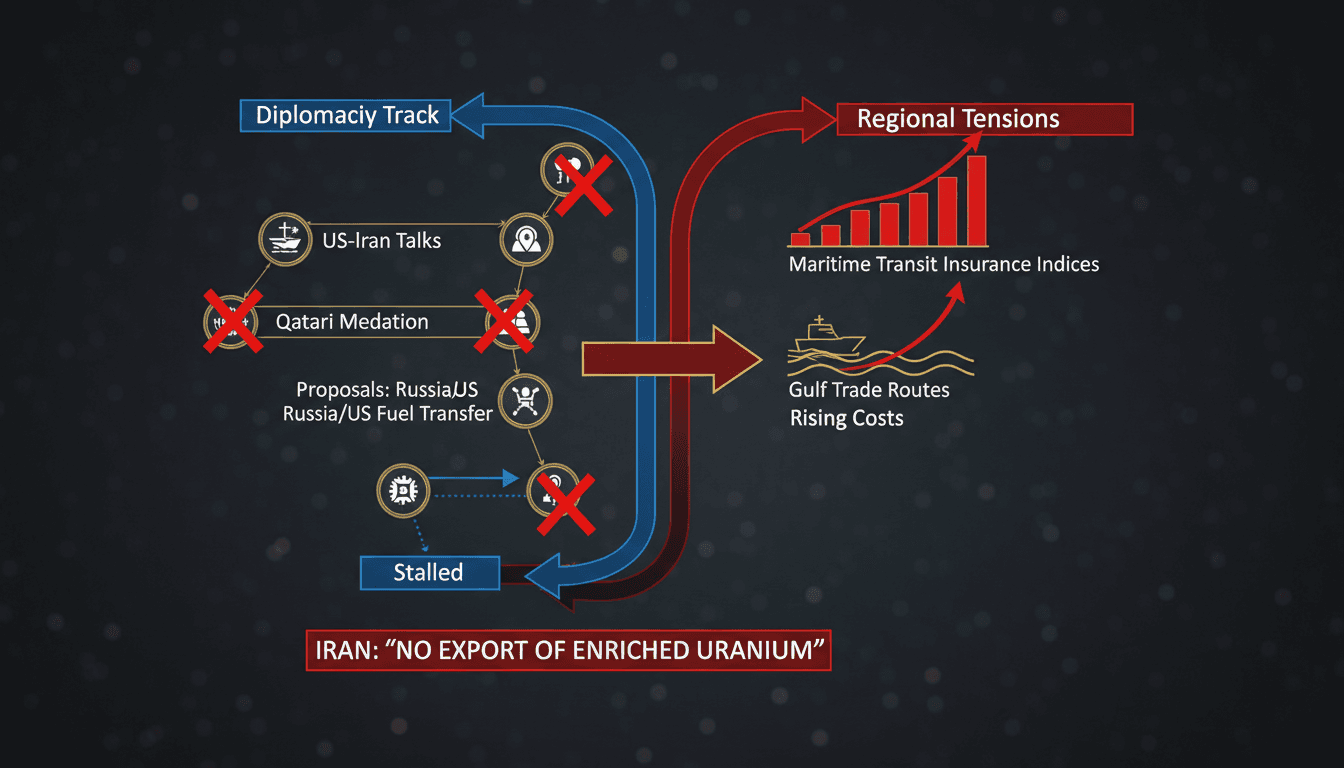
Persistent diplomatic gridlock over regional nuclear stockpiles elevates baseline operational risk, energy market exposure, and maritime transit insurance costs across Gulf trade corridors.
Why it matters
Tehran's explicit refusal to export its enriched material closes a primary de-escalation pathway, cementing a structural standoff that directly influences Gulf logistics and global crude volatility.
What happened (in 30 seconds)
- A definitive refusal on material transfer: Supreme National Security Council Secretary Mohsen Rezaei announced on November 11, 2026, that Iran will not allow any enriched uranium to leave its sovereign territory under any proposed settlement.
- Direct signaling to Moscow and Washington: Speaking with Lebanese broadcaster Al Mayadeen, Rezaei confirmed that Russian leadership has been formally informed of this position following high-level meetings in Moscow, while seven conditions were delivered to U.S. representatives via Qatari mediators.
- Threats of asymmetric retaliation: The security official framed the stockpile as an essential domestic asset for projects such as marine nuclear propulsion, warning that further strikes on sovereign infrastructure would trigger strikes against distant military installations.
The context you actually need
- A legacy of facility strikes: Regional friction intensified significantly after joint and unilateral military operations targeted Iranian enrichment infrastructure in June 2025 and February 2026, intended to restrict fuel-cycle output.
- The Russian export precedent: Previous multilateral frameworks and subsequent de-escalation concepts advanced by Moscow relied on transferring enriched inventories abroad to diminish breakout capacity while allowing civilian nuclear research.
- The baseline stockpile calculation: Prior to the June 2025 strikes on domestic facilities, International Atomic Energy Agency measurements tracked Iranian holdings of 60% enriched uranium at 440.9 kg, establishing the volume scale underlying the current diplomatic impasse.
What's really happening
The formal declaration that enriched uranium will not cross sovereign boundaries signals an incentive realignment within Tehran's security establishment. For international negotiators, moving stockpiles out of the country has historically served as the lowest-friction mechanism to extend technical breakout timelines without demanding the complete dismantling of domestic enrichment cascades. By explicitly rejecting that concession, Iranian planners are establishing the physical custody of enriched material as an non-negotiable strategic counterweight to external military pressure.
This posture alters the diplomatic mechanics running through Doha. When intermediary channels convey terms, the central trade-off is no longer structured around swapping physical material for sanctions relief or non-aggression commitments. Instead, Iranian policymakers are tying the preservation of domestic fissile inventory directly to defense calculations. By categorizing enriched supplies as an input for maritime nuclear propulsion, the state builds an institutional framework for retaining high-assay isotopes inside national borders under an ostensibly civilian, dual-use justification.
The incentive structure operates on three interconnected fronts:
First, domestic deterrence calculations have changed following the kinetic actions of June 2025 and February 2026. External strikes intended to suppress fuel-cycle facilities appear to have incentivized the dispersal and hardening of existing inventories rather than compliance. Dispersing material across domestic facilities guarantees that physical control remains inside national borders, denying external powers an easy off-ramp based on external custody or third-party storage in states like Russia.
Second, the diplomatic channel involving Russian mediation faces structural limits. A prior meeting between Rezaei and Russian President Vladimir Putin highlighted ongoing coordination, yet Tehran's public stance establishes a hard boundary on what Moscow can broker. Even if external partners propose custody models that mitigate Western concerns, Iranian leadership has committed to retaining every metric unit of enriched inventory domestically.
Third, the strategy leverages regional geography as economic leverage. Without an active pathway to remove physical stockpiles, the probability of periodic escalation cycles remains elevated. This dynamic directly prices an ongoing security margin into Gulf operations, particularly concerning commercial shipping, energy transport, and infrastructure development across the primary maritime nodes of the Persian Gulf.
Who feels it first (and how)
- Maritime logistics operators and cargo insurers: Companies moving assets through the Strait of Hormuz face structural premiums as sovereign warnings keep regional naval corridors at an elevated threat index.
- Energy trading desks and corporate treasuries: Commodity analysts must model structural crude pricing floors without the prospect of immediate supply stabilization from a formal U.S.-Iran diplomatic breakthrough.
- Gulf corporate executives and regional planners: Enterprises managing capital expenditure in regional hubs like Dubai must navigate chronic regional geopolitical friction alongside sustained capital inflows.
- International compliance and legal officers: Cross-border trade operators encounter extended uncertainty as secondary sanctions frameworks remain firmly locked in place without an operational nuclear agreement.
What to watch next
- Response metrics from Qatari backchannels: Whether U.S. policymakers formally reject or selectively counter the seven conditions submitted via Doha will indicate if direct diplomatic alternatives remain viable.
- Enrichment monitoring data from international inspectors: Subsequent technical reporting on the status of the 440.9 kg baseline of 60% enriched material will demonstrate whether processing rates are expanding or stabilizing.
- Infrastructure adjustments at regional maritime choke points: Any movement in commercial vessel insurance ratings or security posture adjustments in the Strait of Hormuz will serve as the earliest market-pricing signal for physical supply risks.
Iran’s Supreme National Security Council has explicitly prohibited the external transfer of enriched uranium, notified Russian leadership of the policy, and submitted seven negotiating conditions to the United States through Qatari intermediaries.
The formal refusal to export nuclear material prolongs the diplomatic impasse, eliminating the prospect of a near-term multilateral agreement modeled on stockpile-relocation frameworks.
The operational distribution, physical containment conditions, and current enrichment volume of high-assay stockpiles following the military strikes of June 2025 and February 2026.
Frequently Asked Questions
- Why it matters?
- Tehran's explicit refusal to export its enriched material closes a primary de-escalation pathway, cementing a structural standoff that directly influences Gulf logistics and global crude volatility.
- What happened (in 30 seconds)?
- A definitive refusal on material transfer: Supreme National Security Council Secretary Mohsen Rezaei announced on November 11, 2026, that Iran will not allow any enriched uranium to leave its sovereign territory under any proposed settlement. Direct signaling to Moscow and Washington: Speaking with Lebanese broadcaster Al Mayadeen, Rezaei confirmed that Russian leadership has been formally informed of this position following high-level meetings in Moscow, while seven conditions were delivered to
- What's really happening?
- The formal declaration that enriched uranium will not cross sovereign boundaries signals an incentive realignment within Tehran's security establishment. For international negotiators, moving stockpiles out of the country has historically served as the lowest-friction mechanism to extend technical breakout timelines without demanding the complete dismantling of domestic enrichment cascades. By explicitly rejecting that concession, Iranian planners are establishing the physical custody of enriche
- Who feels it first (and how)?
- Maritime logistics operators and cargo insurers: Companies moving assets through the Strait of Hormuz face structural premiums as sovereign warnings keep regional naval corridors at an elevated threat index. Energy trading desks and corporate treasuries: Commodity analysts must model structural crude pricing floors without the prospect of immediate supply stabilization from a formal U.S.-Iran diplomatic breakthrough. Gulf corporate executives and regional planners: Enterprises managing capital e
- What to watch next?
- Response metrics from Qatari backchannels: Whether U.S. policymakers formally reject or selectively counter the seven conditions submitted via Doha will indicate if direct diplomatic alternatives remain viable. Enrichment monitoring data from international inspectors: Subsequent technical reporting on the status of the 440.9 kg baseline of 60% enriched material will demonstrate whether processing rates are expanding or stabilizing. Infrastructure adjustments at regional maritime choke points: An
Conservative-leaning political and national coverage.
"The Washington Times is a conservative-leaning newspaper known for its political coverage and advocacy of right-of-center viewpoints."
— A47 Editor
Tehran will not move 'a single atom' of enriched uranium from its territory, Iranian official says
Iran on Wednesday ruled out transferring its highly enriched nuclear material out of the country as part of any peace agreement with the United States, with an Iranian official stating that Tehran will not move "a single atom" of enriched uranium fro...
Regional coverage and analysis focused on politics, diplomacy, and business across the Middle East.
"Al-Monitor is known for analytical reporting on Middle East politics and policy developments."
— A47 Editor
Iran will not allow enriched nuclear material to leave the country, security chief says
Iran's top security official Mohsen Rezaei said Tehran will not allow even a single particle of enriched nuclear material to leave the country and warned there would be consequences if the United States carries out new strikes, according to remarks b...
Global business headlines with AI angles.
"General business outlet that frequently covers AI."
— A47 Editor
Iran Won't Budge on Keeping Its Uranium in the Country as Negotiations to End the War Continue
Iran has ruled out transferring its enriched uranium abroad, as officials dispute claims of damage to its nuclear sites while U.S.-Iran negotiations to end the war continue amid renewed warnings from both sides.