
U.S. and Iran Agree to End Hostilities and Reopen Strait of Hormuz
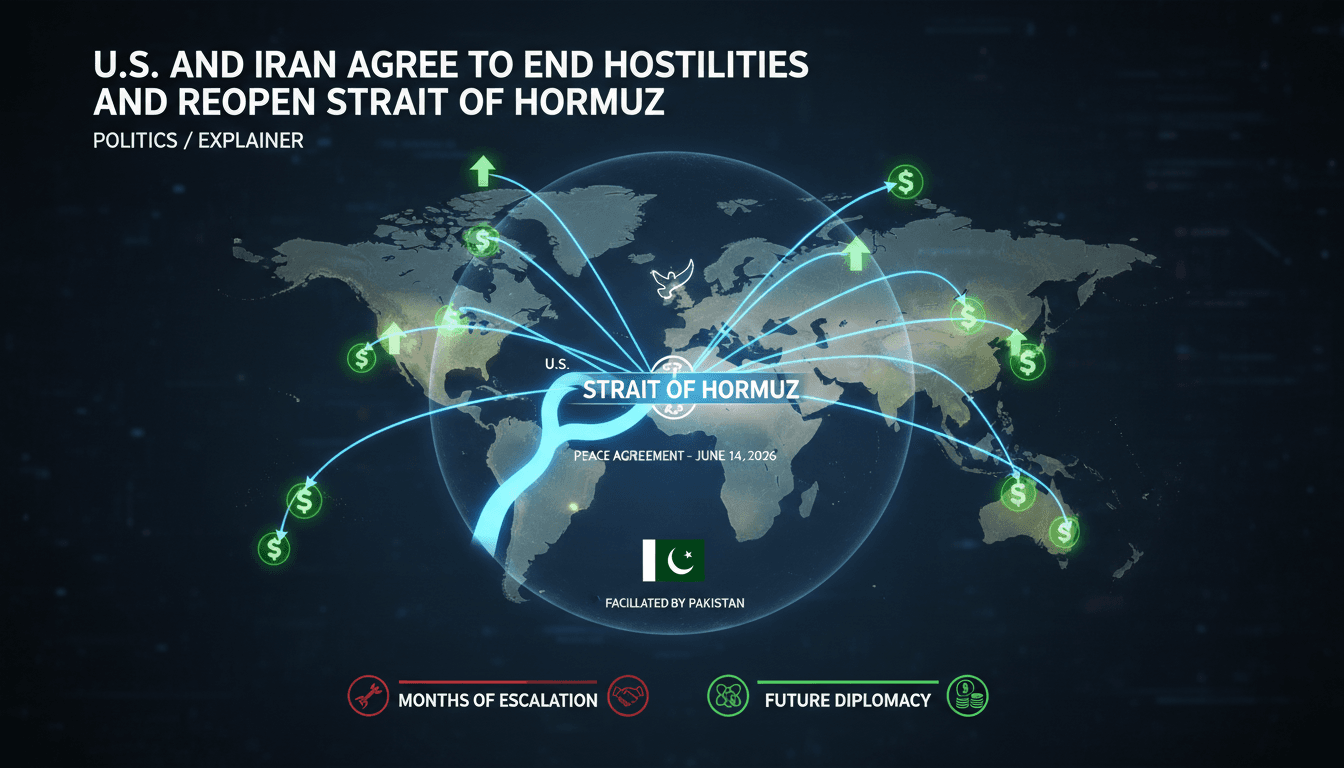
Here's what it means for you.
If you rely on global shipping or oil markets, this agreement could lead to more stable prices and improved supply chains.
Why it matters
The agreement directly impacts global oil supply and shipping routes, crucial for economic stability.
What happened (in 30 seconds)
- U.S. and Iran reached a peace agreement on June 14, 2026, to cease hostilities and reopen the Strait of Hormuz.
- The deal includes lifting the U.S. naval blockade, allowing commercial shipping to resume through this vital waterway.
- A signing ceremony is scheduled for June 19, 2026, in Switzerland, with ongoing negotiations about sanctions and Iran's nuclear program.
The context you actually need
- The conflict escalated after military actions by the U.S. and Israel on February 28, 2026, disrupting oil and gas shipments.
- Diplomatic efforts led by Pakistan have been crucial in facilitating this agreement, highlighting the importance of third-party mediation.
- The ceasefire has been in effect since April 7, 2026, but intermittent military actions have kept tensions high.
What's really happening
The recent agreement between the U.S. and Iran marks a significant turning point in a conflict that has severely disrupted oil and gas shipments from the Persian Gulf. The Strait of Hormuz is a critical chokepoint for global oil transport, with approximately 20% of the world's oil passing through it. The U.S. naval blockade, imposed in response to escalating tensions, had led to skyrocketing oil prices and uncertainty in shipping routes, affecting economies worldwide.
The peace deal, facilitated by Pakistan's Prime Minister Shehbaz Sharif, aims to stabilize the region by ensuring the free flow of commerce through the Strait. Both nations have expressed optimism about the agreement, although some Iranian officials have indicated that final details are still being negotiated. The deal includes a 60-day period for detailed discussions on sanctions relief and Iran's nuclear program, which are critical issues that have long strained U.S.-Iran relations.
The lifting of the blockade is expected to have immediate effects on oil prices, which have been volatile due to the conflict. Corporate stakeholders in the oil and shipping industries are already reacting positively, anticipating a return to normal operations. This stabilization is crucial not only for the economies of the U.S. and Iran but also for global markets that rely on consistent oil supply.
However, the situation remains delicate. While the ceasefire has been in effect since early April, military actions have continued intermittently, indicating that underlying tensions have not been fully resolved. The international community is watching closely, urging both parties to adhere to the terms of the agreement and continue diplomatic engagement. The success of this deal could set a precedent for future negotiations in the region, potentially leading to a broader peace framework.
Who feels it first (and how)
- Oil and gas companies: Expect fluctuations in stock prices and operational adjustments based on renewed shipping routes.
- Shipping industries: Will benefit from reduced shipping costs and increased reliability in transport schedules.
- Consumers: May see changes in fuel prices and availability as markets stabilize.
- Middle Eastern economies: Countries reliant on oil exports will experience economic relief and potential growth.
What to watch next
- Oil prices: Monitor fluctuations in global oil prices as the agreement takes effect; stability could lead to lower prices.
- Shipping traffic: Watch for increases in shipping traffic through the Strait of Hormuz, indicating a return to normalcy in global trade.
- Diplomatic developments: Keep an eye on further negotiations regarding sanctions and Iran's nuclear program, as these will influence long-term stability.
The U.S. and Iran have reached a peace agreement to cease hostilities.
Oil markets will stabilize, leading to more predictable pricing and supply chains.
The long-term adherence to the agreement and its impact on Iran's nuclear ambitions.
Frequently Asked Questions
- Why it matters?
- The agreement directly impacts global oil supply and shipping routes, crucial for economic stability.
- What happened (in 30 seconds)?
- U.S. and Iran reached a peace agreement on June 14, 2026, to cease hostilities and reopen the Strait of Hormuz. The deal includes lifting the U.S. naval blockade, allowing commercial shipping to resume through this vital waterway. A signing ceremony is scheduled for June 19, 2026, in Switzerland, with ongoing negotiations about sanctions and Iran's nuclear program.
- What's really happening?
- The recent agreement between the U.S. and Iran marks a significant turning point in a conflict that has severely disrupted oil and gas shipments from the Persian Gulf. The Strait of Hormuz is a critical chokepoint for global oil transport, with approximately 20% of the world's oil passing through it. The U.S. naval blockade, imposed in response to escalating tensions, had led to skyrocketing oil prices and uncertainty in shipping routes, affecting economies worldwide. The peace deal, facilitate
- Who feels it first (and how)?
- Oil and gas companies: Expect fluctuations in stock prices and operational adjustments based on renewed shipping routes. Shipping industries: Will benefit from reduced shipping costs and increased reliability in transport schedules. Consumers: May see changes in fuel prices and availability as markets stabilize. Middle Eastern economies: Countries reliant on oil exports will experience economic relief and potential growth.
- What to watch next?
- Oil prices: Monitor fluctuations in global oil prices as the agreement takes effect; stability could lead to lower prices. Shipping traffic: Watch for increases in shipping traffic through the Strait of Hormuz, indicating a return to normalcy in global trade. Diplomatic developments: Keep an eye on further negotiations regarding sanctions and Iran's nuclear program, as these will influence long-term stability.
Global political, business, and cultural coverage from WSJ international desks.
"The Wall Street Journal offers extensive international reporting with a reputation for financial insight and a center-right editorial stance."
— A47 Editor
U.S. and Iran Have Reached a Deal to Stop Fighting, Reopen Shipping
The United States and Iran have reached a significant agreement aimed at halting hostilities and reopening shipping routes, with a formal signing scheduled for Friday. This development marks a potential turning point in a conflict that has significan...
Conservative-leaning coverage of current events.
"Fox News is a highly influential conservative news outlet known for right-leaning political commentary and coverage."
— A47 Editor
Israel fears Trump weary of ‘highly suspicious’ Netanyahu and could 'flip' amid Iran deal: analyst
Fears are escalating in Jerusalem that President Trump may reconsider his support for Israeli Prime Minister Netanyahu amid ongoing tensions surrounding a potential U.S.-Iran peace deal. Recent Israeli airstrikes in Beirut, targeting Hezbollah, have ...
International news coverage curated for readers in the UAE and Gulf region.
"Emirates 24|7 world coverage presents global developments through a UAE-facing and Gulf-relevant editorial lens."
— A47 Editor
Trump urges Israel and Iran to avoid escalation as ceasefire deal nears Trump urges Israel and Iran to avoid escalation as ceasefire deal nears
U.S. President Donald Trump has urged Israel and Iran to avoid further escalation following an Israeli airstrike on Beirut, which targeted Hezbollah positions. This warning comes as negotiations for a ceasefire agreement intensify, with Trump emphasi...
Global business headlines with AI angles.
"General business outlet that frequently covers AI."
— A47 Editor
Enraged Trump Fumes At 'Bibi' After Israeli Strikes In Lebanon But Vows Iran-US Peace Deal Is On
Tensions escalated in the Middle East as Israel and Hezbollah exchanged strikes, prompting President Donald Trump to express anger towards Israeli Prime Minister Benjamin Netanyahu during a heated call. This military escalation raises concerns about ...
Corporate leadership, finance, technology, and market trends.
"Fortune covers financial trends, leadership, and innovation with a pragmatic editorial approach."
— A47 Editor
Trump warns Israel and Iran not to ‘blow it’ after new strikes threaten ceasefire deal that he says will bring peace to Lebanon
President Trump has urged Israeli Prime Minister Benjamin Netanyahu to cease aggressive military actions against Lebanon as a ceasefire deal approaches, warning both Israel and Iran not to jeopardize the potential for peace in the region. Despite Tru...
Pan-Arab news coverage spanning politics, business, sports, and regional affairs.
"Asharq Al-Awsat reflects a broad Arab editorial perspective with strong attention to regional geopolitics."
— A47 Editor
تل أبيب قلقة من اتفاق واشنطن وطهران… لكنها لا تريد إغضاب ترمب
Israeli Prime Minister Benjamin Netanyahu is compelled to praise the recent U.S.-Iran understandings while carefully choosing words that will not upset President Donald Trump. This situation reflects the delicate balance Netanyahu must maintain in ad...
Breaking news, politics, business, and entertainment from the U.S. and around the world.
"The New York Post is a tabloid-format newspaper known for its sensationalist headlines and conservative-leaning editorial tone."
— A47 Editor
Trump criticizes Israel for striking Lebanon, says attack could delay imminent Iran peace deal: ‘Let’s not blow it!’
Israel conducted airstrikes near Beirut in response to Hezbollah firing shots towards Israeli territory, prompting criticism from former President Trump. He warned that such military actions could jeopardize a potential peace deal with Iran, which he...
Arabic-language coverage of political affairs and current events.
"Okaz political coverage typically follows mainstream Saudi framing on national and regional affairs."
— A47 Editor
شكوك ومخاوف إسرائيلية.. ترمب لنتنياهو: حان وقت إنهاء حرب إيران
U.S. President Donald Trump informed Israeli Prime Minister Benjamin Netanyahu that a deal with Iran could be signed soon, raising Israeli concerns about a settlement that may not meet their objectives. Netanyahu, who viewed the war as an opportunity...