
COP31 Antalya Opens With Sharply Reduced Head-of-State Attendance as Host Promotes New Oil and Gas Exploration
Why it matters
The drop in executive participation at multilateral climate summits marks a structural transition where domestic industrial priorities and energy security take precedence over unified global carbon frameworks.
What happened (in 30 seconds)
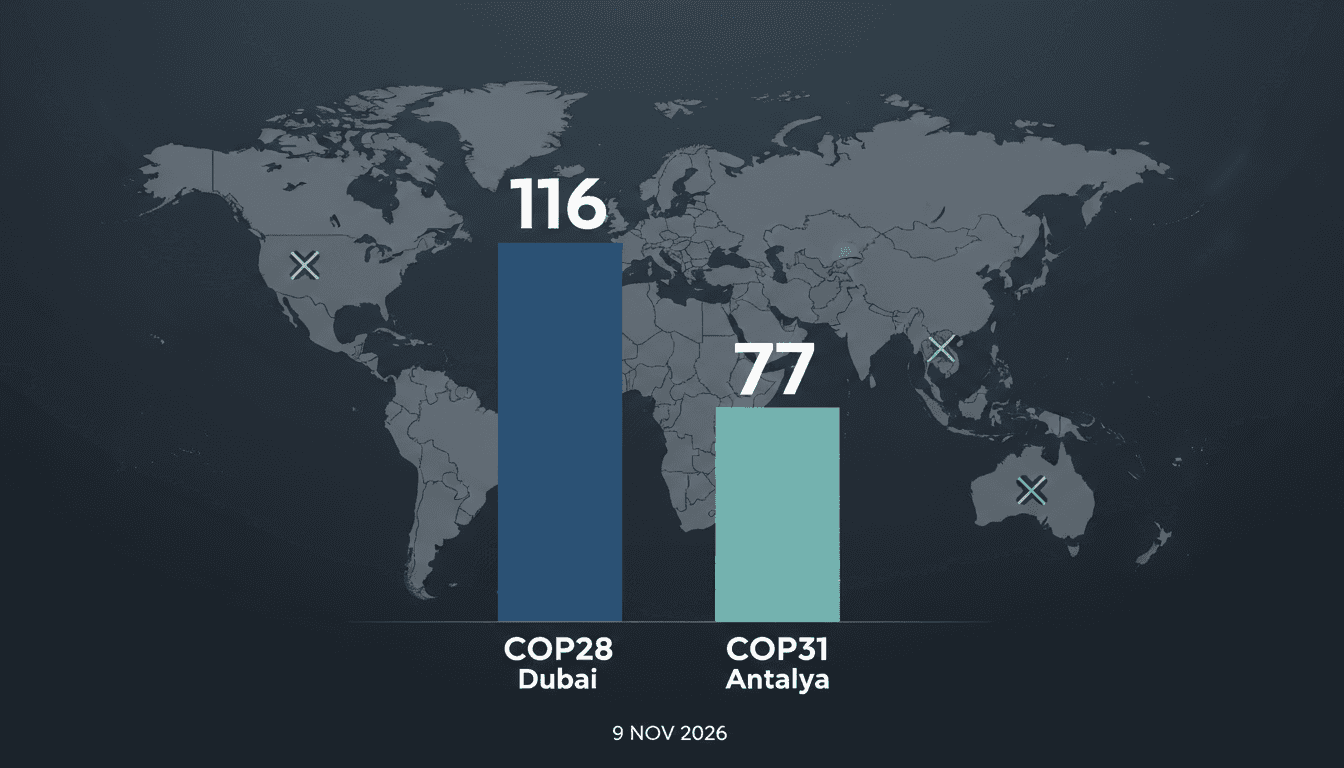
- High-level turnout plummeted: Only 77 heads of state and government scheduled addresses during the leaders' segment at COP31 in Antalya, down from 116 at COP28 in Dubai.
- Key geopolitical absences expanded: The summit proceeded without heads of state from the United States, China, and key European nations including France, reflecting diminished political prioritization across major economies.
- Host strategies diverged: While UN Secretary-General António Guterres urged rapid reductions in fossil fuel dependence, host country Türkiye promoted domestic oil discoveries alongside joint exploration ventures with Venezuela.
The context you actually need
- A shifting host partnership: COP31 is structured under an operational split between Türkiye providing the Antalya Expo Center venue and Australia leading the multilateral negotiations.
- US treaty departure: The summit convened following the formal withdrawal of the United States from both the Paris Agreement and the UNFCCC under the second Trump administration, removing direct federal executive participation.
- A decade of temperature extremes: Antalya's discussions took place against a verified physical backdrop of the warmest 12 years on record, exacerbated by ongoing El Niño effects.
What's really happening
The decline in head-of-state attendance at COP31 exposes a structural shift in how national governments manage the trade-off between domestic energy security and international climate architecture. When 77 heads of state arrive instead of the 116 seen three years earlier in Dubai, the operational signal is unambiguous: executive-level sponsorship of centralized, consensus-driven climate negotiations is waning among the world’s largest emitters.
This dynamic is driven by concrete state incentives rather than ideological rhetoric. For major economies, the political return on international summit pledges has diminished relative to immediate domestic pressures. The absence of the United States—driven by its formal withdrawal from the UNFCCC and Paris Agreement—alongside the physical absence of China’s Xi Jinping and France’s Emmanuel Macron, removes the high-level leverage needed to force breakthroughs on contentious finance and mitigation targets. Without the primary decision-makers in the room, national delegations operate on constrained, pre-approved technical mandates, dampening expectations for accelerated delivery on existing electrification and emissions pathways.
At the host level, state behavior illustrates this dual-track reality. While COP31 President Murat Kurum and Australian Minister Chris Bowen preside over formal negotiations on adaptation finance and electrification targets, Turkish President Recep Tayyip Erdoğan opened the summit highlighting domestic oil discoveries, paired with announcements of joint hydrocarbon exploration alongside Venezuela. These parallel tracks reflect an emerging baseline for state actors: maintain diplomatic standing by hosting multilateral governance platforms while simultaneously securing sovereign energy supplies.
Consequently, the venue reveals a shift in market attention. Financial markets displayed limited immediate volatility during the opening week of the Antalya conference, discounting the likelihood of binding regulatory surprises. International capital allocations are instead reacting to individual jurisdictions' industrial, trade, and tariff regimes. Rather than driving synchronized regulatory shifts across borderlines, multilateral climate diplomacy has entered an execution phase where technical working groups negotiate accounting frameworks, while national capitals advance independent energy strategies aligned with local fiscal, industrial, and electoral incentives.
Who feels it first (and how)
- Multinational Energy Operators: Cross-border energy corporations face fragmented compliance landscapes as multilateral regulatory convergence slows, requiring distinct operational strategies across Western, Asian, and developing markets.
- Climate Finance & Carbon Market Desks: Institutional desks pricing sovereign carbon offsets face persistent valuation risk due to the absence of centralized, high-level executive backing for new standardized capital commitments.
- Urban Infrastructure Leaders: Municipal administrators managing infrastructure in heat-stressed regions—including metropolitan hubs like Dubai navigating urban heat island effects alongside record global temperatures—must fund adaptation initiatives without expanded foreign-aid allocations.
What to watch next
- Adaptation Finance Text Finalization: Watch the closing draft from the Antalya Expo Center; the final language on monetary allocations will measure whether mid-level negotiators can advance funding targets without executive sponsorship.
- Bilateral Hydrocarbon Agreements: Track follow-up bilateral agreements between Mediterranean and Latin American energy ministries, which will quantify how aggressively host economies advance traditional fuel production alongside multilateral summits.
- Australian COP Presidency Strategy: Monitor Australia's diplomatic maneuvers as lead negotiator to determine if a bridge can be maintained between fragmented national priorities and UN-mandated mitigation goals.
Only 77 heads of state or government scheduled addresses at COP31, marking a decline from 116 at COP28; the United States formally withdrew from the UNFCCC; and Türkiye announced new hydrocarbon exploration initiatives during the event's opening.
The absence of major-economy leaders will prevent new high-level mitigation pacts, constraining COP31 outcomes to narrow technical adjustments rather than regulatory shifts.
It remains uncertain whether emerging market coalitions will accept technical compromise texts on adaptation finance in the absence of capital guarantees from G7 leadership.
Frequently Asked Questions
- Why it matters?
- The drop in executive participation at multilateral climate summits marks a structural transition where domestic industrial priorities and energy security take precedence over unified global carbon frameworks.
- What happened (in 30 seconds)?
- High-level turnout plummeted: Only 77 heads of state and government scheduled addresses during the leaders' segment at COP31 in Antalya, down from 116 at COP28 in Dubai. Key geopolitical absences expanded: The summit proceeded without heads of state from the United States, China, and key European nations including France, reflecting diminished political prioritization across major economies. Host strategies diverged: While UN Secretary-General António Guterres urged rapid reductions in fossil fu
- What's really happening?
- The decline in head-of-state attendance at COP31 exposes a structural shift in how national governments manage the trade-off between domestic energy security and international climate architecture. When 77 heads of state arrive instead of the 116 seen three years earlier in Dubai, the operational signal is unambiguous: executive-level sponsorship of centralized, consensus-driven climate negotiations is waning among the world’s largest emitters. This dynamic is driven by concrete state incentive
- Who feels it first (and how)?
- Multinational Energy Operators: Cross-border energy corporations face fragmented compliance landscapes as multilateral regulatory convergence slows, requiring distinct operational strategies across Western, Asian, and developing markets. Climate Finance & Carbon Market Desks: Institutional desks pricing sovereign carbon offsets face persistent valuation risk due to the absence of centralized, high-level executive backing for new standardized capital commitments. Urban Infrastructure Leaders: Mun
- What to watch next?
- Adaptation Finance Text Finalization: Watch the closing draft from the Antalya Expo Center; the final language on monetary allocations will measure whether mid-level negotiators can advance funding targets without executive sponsorship. Bilateral Hydrocarbon Agreements: Track follow-up bilateral agreements between Mediterranean and Latin American energy ministries, which will quantify how aggressively host economies advance traditional fuel production alongside multilateral summits. Australian C
24/7 international news from a French perspective in multiple languages.
"France 24 is viewed as a globally focused outlet with balanced coverage and a European perspective."
— A47 Editor
As world gripped by climate emergency, COP31’s empty chairs signal low ambitions
COP31, the UN climate summit, opened in Antalya, Turkey, on November 9 with nearly 190 countries taking part, but France 24 reports that the event has drawn low-level leadership attendance, with empty chairs signalling limited ambition as the world f...
UK and international business news, economics, and corporate coverage.
"The Guardian’s business section covers finance and markets with a progressive editorial tone."
— A47 Editor
Cop31: how far off target are we? - video
The Guardian reports that heads of government are gathering in Turkey for a fortnight of climate talks at COP31, as the planet faces unprecedented human-caused global heating. Guardian correspondent Madeleine Finlay, speaking with co-host Ian Sample,...
Reports on science policy, discoveries, and public debate in the scientific realm.
"The Guardian’s science section is known for thoughtful and critical reporting on global research, ethics, and public understanding of science."
— A47 Editor
Cop31: how far off target are we? - video
The Guardian's science desk, through video reporting by Madeleine Finlay with co-host Ian Sample, examines how far off target the world is as heads of government gather in Turkey for the COP31 UN climate talks, which run for a fortnight amid unpreced...
Top international stories selected by The Guardian editors.
"The Guardian is known for its progressive editorial stance and in-depth analysis."
— A47 Editor
Cop31: how far off target are we? - video
The Guardian video piece, co-hosted by Ian Sample and featuring Madeleine Finlay, examines how far off target the world is as COP31 climate talks open in Antalya, Turkey, with heads of government meeting for a two-week round of negotiations amid unpr...
Reporting on emerging tech including AI.
"Magazine covering AI’s business and social impacts."
— A47 Editor
What to know about this year’s UN climate talks
The annual UN climate talks, COP31, have opened in Antalya, Turkey, with negotiations beginning on November 8 and Turkey and Australia serving as cohosts. Thousands of delegates, lobbyists, and journalists are gathering for the talks, which are descr...