
Israeli Government Formation Stalls After Inconclusive October 2026 Elections With Arab Parties Holding Pivotal Seats
Why it matters
A fragmented 120-seat Knesset without a natural majority locks Israeli security policy on auto-pilot while neutralizing parliamentary checks on ongoing military operations.
What happened (in 30 seconds)
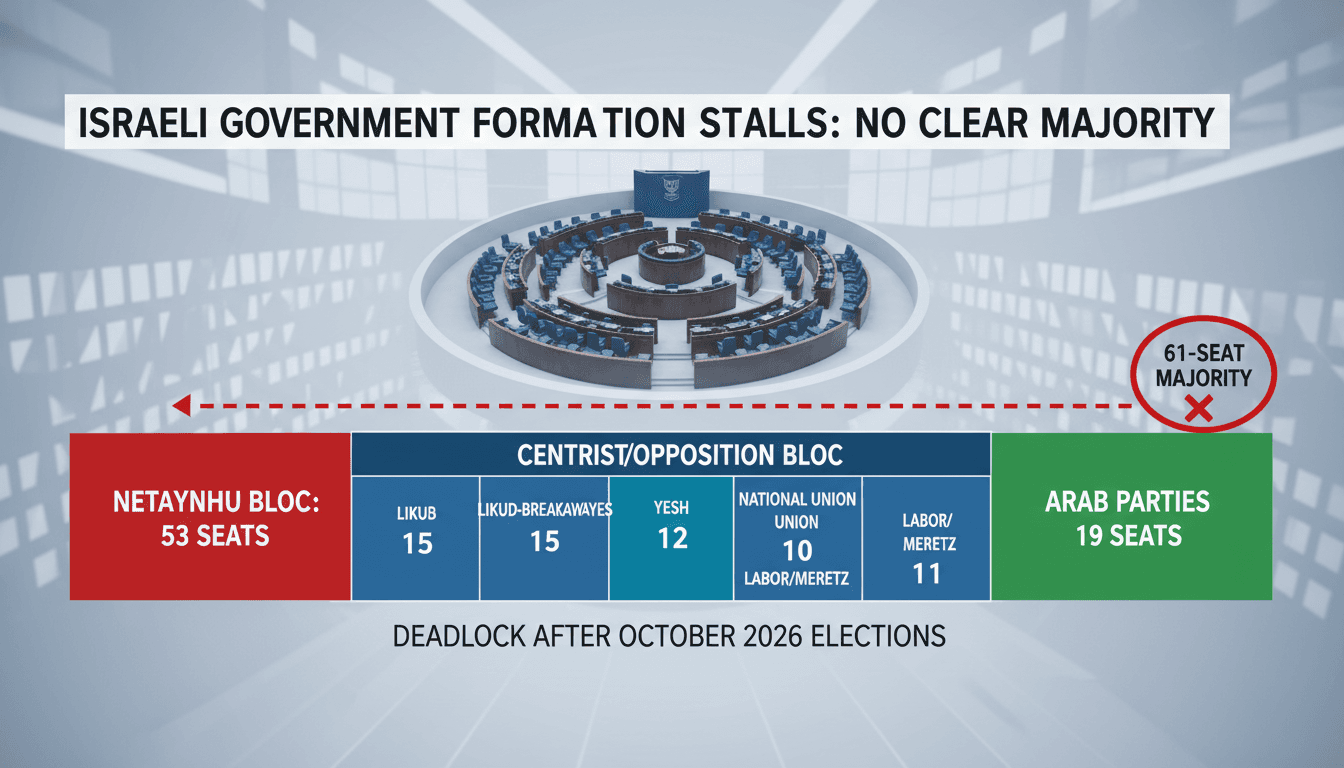
- The right-wing alliance fell short: Benjamin Netanyahu's incumbent bloc secured 53 seats in the late October 2026 elections, missing the 61-seat threshold required to govern.
- The mandate shifted to the center: President Isaac Herzog tasked Gadi Eisenkot of the Yeshar party with building a coalition after receiving recommendations from 67 lawmakers across disparate opposition factions.
- Arab parties set an electoral record: Arab Palestinian parties won 19 seats, establishing a pivotal numerical leverage point while exposing sharp ideological resistance to their formal inclusion in executive governance.
The context you actually need
- A multi-year pattern of instability: The vote followed prolonged security operations initiated in October 2023, along with deep legislative fractures over judicial authority and military conscription exemptions.
- Structural barriers to 61 seats: While 67 lawmakers recommended Eisenkot to block a Netanyahu-led administration, those 67 members span anti-Netanyahu nationalists, secular centrists, and Arab party lists that hold mutually incompatible policy demands.
- Military continuity during political transition: Ground operations and enforcement measures in Gaza and the West Bank persisted without pause throughout the election and subsequent consultations.
What's really happening
The November 2026 deadlock is not merely a routine bout of parliamentary friction; it is an arithmetic trap created by competing domestic red lines. The Knesset requires 61 seats to install an executive cabinet. Following the late October vote, the distribution of political power splintered into three non-aligned components: the right-wing alliance holding 53 seats, the centrist and right-leaning opposition, and Arab Palestinian parties holding 19 seats.
President Isaac Herzog's decision to grant Gadi Eisenkot the primary 28-day formation mandate reflects an aggregate total of 67 recommendations. However, recommendations to confer a mandate do not translate into signatures on a joint coalition agreement. To reach 61 seats without Benjamin Netanyahu’s 53-seat bloc, Eisenkot must bridge factions that refuse to sit with one another. The right-leaning wings of the opposition refuse formal partnerships or policy concessions with the 19 Arab lawmakers. Concurrently, Arab party platforms maintain baseline conditions concerning military actions in Gaza and the West Bank that centrist security figures cannot accept without alienating their core constituencies.
This creates an incentive structure where no faction leader can compromise without risking immediate internal defection. For the incumbent Likud-led camp, prolonging the crisis preserves the operational status quo under an interim authority, avoiding concessions on judicial policy or military draft enforcement. For Eisenkot’s Yeshar party, entering an unstable minority arrangement dependent on external parliamentary votes leaves any potential cabinet vulnerable to sudden dissolution.
Because caretaker administrations retain full statutory control over defense institutions, strategic continuity supersedes legislative consensus. Executive institutions continue prosecuting multi-front military campaigns in Gaza and the West Bank irrespective of the stalemate in Jerusalem. The structural implication for the state is an institutional divergence: legislative functions remain paralyzed by demographic and identity boundaries, while military command operates with total autonomy, detached from direct parliamentary oversight or electoral mandates.
Who feels it first (and how)
- Cross-border infrastructure and energy investors: Regional funds balancing asset allocations face prolonged risk pricing and volatile project timelines across the Eastern Mediterranean corridor.
- Defense and emergency planners: Regional procurement offices and security liaisons must navigate operational uncertainty as Israeli military actions continue without clear cabinet-level diplomatic off-ramps.
- Multinational corporate operators in the Levant: Corporate entities managing dual-market supply chains encounter persistent operational friction and heightened insurance overhead.
- Palestinian civilian populations: Residents in Gaza and the West Bank face unyielding security operations that proceed entirely independent of electoral and coalition outcomes in Jerusalem.
What to watch next
- The 28-day mandate deadline: Watch whether Eisenkot requests a statutory extension or yields the mandate back to the president, signaling a complete impasse within the change camp.
- External support maneuvers: Track whether any Arab party factions negotiate issue-specific parliamentary voting pacts from outside the formal executive cabinet.
- Likud counter-mobilization: Monitor attempts by the 53-seat bloc to peel away individual right-wing defectors from Eisenkot’s recommendation list to construct an alternate 61-seat majority.
Benjamin Netanyahu’s right-wing bloc secured 53 seats; Arab Palestinian parties won 19 seats; Gadi Eisenkot holds a 28-day presidential mandate supported by 67 preliminary recommendations.
The 28-day period will exhaust without a stable, sworn-in majority government, elevating the probability of mandate reassignment or repeat elections.
Whether centrist factions will breach their stated red lines to construct a minority administration reliant on outside votes from Arab lawmakers.
Frequently Asked Questions
- Why it matters?
- A fragmented 120-seat Knesset without a natural majority locks Israeli security policy on auto-pilot while neutralizing parliamentary checks on ongoing military operations.
- What happened (in 30 seconds)?
- The right-wing alliance fell short: Benjamin Netanyahu's incumbent bloc secured 53 seats in the late October 2026 elections, missing the 61-seat threshold required to govern. The mandate shifted to the center: President Isaac Herzog tasked Gadi Eisenkot of the Yeshar party with building a coalition after receiving recommendations from 67 lawmakers across disparate opposition factions. Arab parties set an electoral record: Arab Palestinian parties won 19 seats, establishing a pivotal numerical le
- What's really happening?
- The November 2026 deadlock is not merely a routine bout of parliamentary friction; it is an arithmetic trap created by competing domestic red lines. The Knesset requires 61 seats to install an executive cabinet. Following the late October vote, the distribution of political power splintered into three non-aligned components: the right-wing alliance holding 53 seats, the centrist and right-leaning opposition, and Arab Palestinian parties holding 19 seats. President Isaac Herzog's decision to gra
- Who feels it first (and how)?
- Cross-border infrastructure and energy investors: Regional funds balancing asset allocations face prolonged risk pricing and volatile project timelines across the Eastern Mediterranean corridor. Defense and emergency planners: Regional procurement offices and security liaisons must navigate operational uncertainty as Israeli military actions continue without clear cabinet-level diplomatic off-ramps. Multinational corporate operators in the Levant: Corporate entities managing dual-market supply c
- What to watch next?
- The 28-day mandate deadline: Watch whether Eisenkot requests a statutory extension or yields the mandate back to the president, signaling a complete impasse within the change camp. External support maneuvers: Track whether any Arab party factions negotiate issue-specific parliamentary voting pacts from outside the formal executive cabinet. Likud counter-mobilization: Monitor attempts by the 53-seat bloc to peel away individual right-wing defectors from Eisenkot’s recommendation list to construct
Pan-Arab political news and analysis.
"Al-Quds Al-Arabi is a London-based Arabic newspaper known for political coverage."
— A47 Editor
الحكومة الإسرائيلية: مخاض عسير وإبادة متواصلة
Ghadi Eisenkot has been tasked with forming Israel's new government, but the assignment has so far only exposed further consequences of the difficult political process that followed the recent Knesset elections, including the failure to produce a suf...
Jordanian news and regional updates.
"Roya News is a Jordanian outlet focused on breaking news and local affairs."
— A47 Editor
آيزنكوت يصف دعوة نتنياهو لتشكيل حكومة وحدة وطنية بـالمناورة السياسية
Israeli official Gadi Eisenkot, who has been tasked with forming the government, on Saturday described Prime Minister Benjamin Netanyahu's call to form a national unity government as a political maneuver, according to a report by Roya News.
Arabic-language coverage of international news and geopolitics.
"RT Arabic is a Russian state-funded outlet often criticized for promoting Kremlin-aligned narratives."
— A47 Editor
آيزنكوت: دعوة نتنياهو للمفاوضات مناورة إعلامية مكشوفة قبل لقاء طواقم يشار والليكود غدا
Israeli lawmaker Gadi Eisenkot, leader of the Yashar party, has dismissed remarks by outgoing Prime Minister Benjamin Netanyahu calling for negotiations as a transparent media maneuver, ahead of a planned meeting between Yashar and Likud teams.
Arabic-language political and world news coverage for UAE readers.
"Emarat Al Youm world coverage usually presents international developments through a UAE and Arab audience lens."
— A47 Editor
نتنياهو لآيزنكوت بشأن حكومة وحدة: "لندخل الغرفة دون شروط مسبقة ونتوصل إلى تفاهمات" نتنياهو لآيزنكوت بشأن حكومة وحدة: "لندخل الغرفة دون شروط مسبقة ونتوصل إلى تفاهمات"
Israeli Prime Minister Benjamin Netanyahu issued a statement calling on Gadi Eisenkot, leader of the Yashar party, to enter negotiations on a unity government "without preconditions" in order to reach understandings, according to Emarat Al Youm's rep...
Arabic-language coverage of international news and geopolitics.
"RT Arabic is a Russian state-funded outlet often criticized for promoting Kremlin-aligned narratives."
— A47 Editor
نتنياهو يدعو آيزنكوت لتشكيل حكومة وحدة لمواجهة إيران
Israeli caretaker Prime Minister Benjamin Netanyahu sought to persuade Gadi Eisenkot to form a national unity government, warning that Iran is seeking to revive its nuclear program. The report, published by RT Arabic, frames the appeal as an attempt ...