
U.S. Senate Passes Bipartisan Permitting Reform Bill to Accelerate Energy and Infrastructure Projects
Why it matters
The legislation rewires the regulatory mechanics governing interstate transmission lines, energy facilities, and data infrastructure, prioritizing project development velocity to absorb rising power loads.
What happened (in 30 seconds)
* The Senate cleared the measure: On November 19, 2026, the Senate approved the Bipartisan American Affordability and Jobs Act in a 62-33 vote, drawing support from nearly all Republicans alongside 15 Democrats. * The statutory mechanisms changed: The bill establishes statutory deadlines for environmental reviews, restricts retroactive permit cancellations, and expands federal siting authority over interstate electrical transmission. * The costs shifted to consumers: The framework introduces a direct mandate requiring large-scale data centers to pay for their own incremental infrastructure expenditures rather than passing those costs onto general utility ratepayers.
The context you actually need
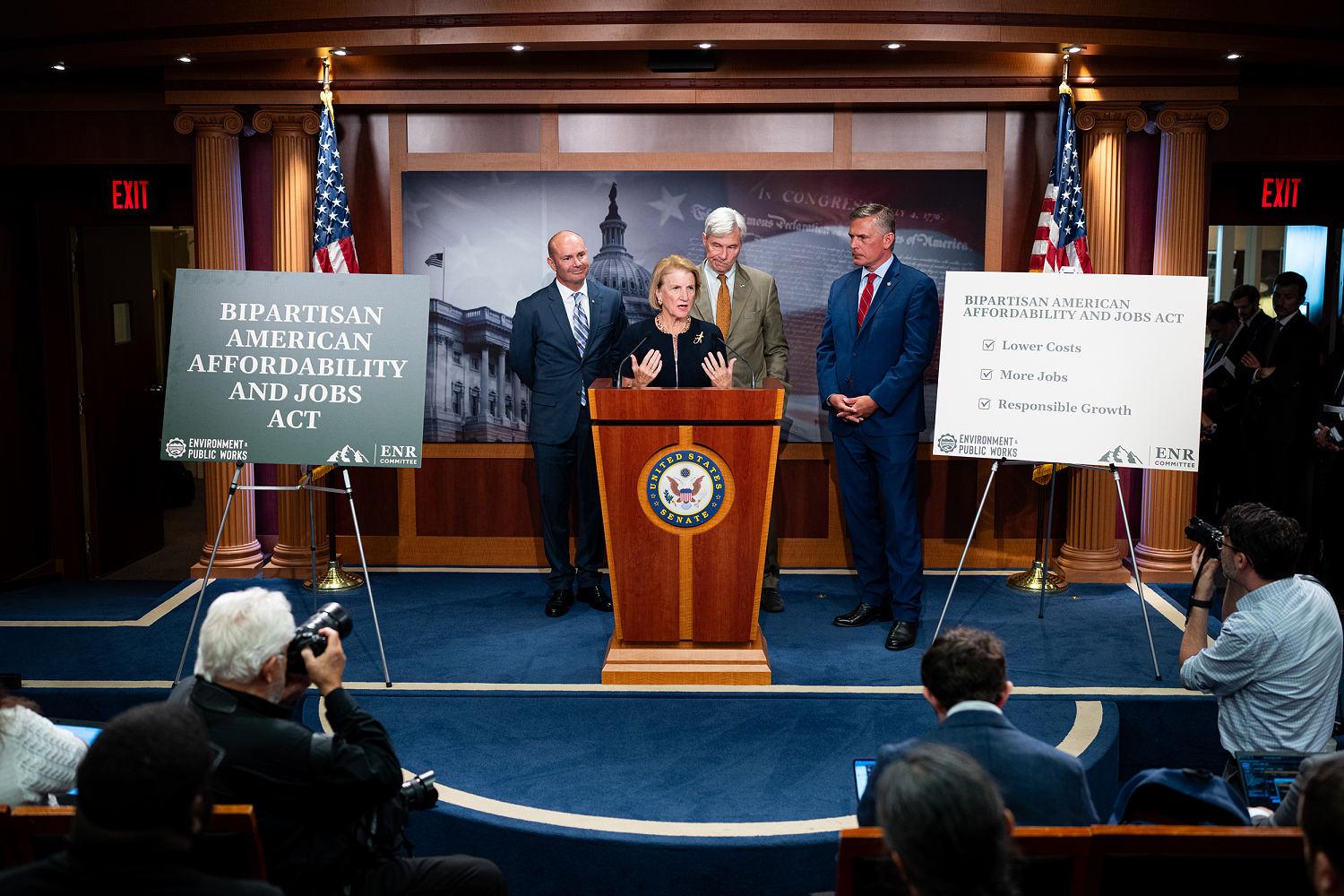
* Decades of regulatory friction: Reviews under the National Environmental Policy Act (NEPA) and related frameworks historically subjected interstate infrastructure projects to multi-year assessments, overlapping agency jurisdictions, and prolonged legal challenges. * The power crunch meets the balance sheet: Surging domestic electricity consumption from compute-heavy data centers, paired with deployment objectives from the Inflation Reduction Act, exposed a widening gap between energy generation capacity and grid delivery capability. * A convergence of political incentives: Key negotiators—including Senators Shelley Moore Capito, Sheldon Whitehouse, Mike Lee, and Martin Heinrich—assembled a cross-coalition compromise designed to lower development costs and resolve transmission bottlenecks while preserving underlying environmental standards.
What's really happening
The mechanics of modern energy development are fundamentally bound to timeline predictability. For years, the development cycle of an energy asset—whether clean generation, fossil extraction, or regional high-voltage transmission—faced open-ended review windows and the operational hazard of post-approval litigation. By capping review durations and narrowing the conditions under which issued permits can be revoked, this measure shifts the regulatory model from open-ended administrative caution to fixed-schedule agency determinations.
The economic core of the legislation lies in transmission line authority. Interstate high-voltage lines represent a classic coordination failure: power generation frequently occurs hundreds of miles from metropolitan demand centers, yet projects routinely stall at state boundaries due to fragmented approvals. By widening federal oversight over interstate transmission routing, the federal government removes localized veto points that previously blocked regional grid expansion.
Simultaneously, the legislation introduces a structural boundary for the digital economy. The rapid expansion of artificial intelligence facilities and enterprise data operations has placed unprecedented load requirements on localized power systems. Under baseline utility regulation, system-wide capital upgrades are frequently amortized across the entire rate base, effectively socializing the capital cost of network expansion. This bill alters that financial structure by requiring major data operators to directly absorb the marginal capital expenditures necessary to connect their facilities.
This structure creates an explicit economic trade-off. Energy developers receive compressed regulatory timelines and reduced legal risk, which materially lowers their cost of capital. In return, energy-intensive technology firms lose the ability to shift balance-sheet infrastructure requirements onto residential and commercial utility ratepayers.
The friction generated by the bill highlights the administrative tension inherent in this model. By shortening environmental review calendars and curtailing consultation frameworks, the statute systematically limits the legal recourse available to conservation groups and Native American tribal organizations that have traditionally relied on judicial oversight to challenge large-scale projects. The measure proceeds on the assumption that infrastructure buildout velocity must be prioritized to sustain grid stability and industrial output.
Who feels it first (and how)
* Data center operators and enterprise tech builders: Face direct balance-sheet liabilities to pay for the dedicated power substations and transmission tie-ins required to support high-density compute facilities. * Power generation and transmission developers: Gain accelerated capital deployment cycles due to predictable federal environmental review timelines and enhanced interstate siting authority. * Native American tribes and regional environmental organizations: Experience reduced statutory windows to review project filings and diminished avenues for environmental litigation or permit revocations. * Industrial and residential energy consumers: Benefit from ratepayer protection provisions that isolate regional utility bills from the capital outlays demanded by rapid compute-cluster expansion.
What to watch next
* House reconciliation mechanics: Monitor whether House Majority Leader Steve Scalise and House leadership advance the Senate version without major amendments during the lame-duck period, which determines the operational timeline for administrative implementation. * Federal agency rule-making guidance: Watch how agencies calibrate staffing and review standards to meet statutory environmental review deadlines without inviting procedural administrative challenges. * Data center capital allocation: Track whether corporate hyperscalers shift their geographic site-selection strategies toward states with existing power capacity to bypass dedicated infrastructure payments.
The Senate approved the Bipartisan American Affordability and Jobs Act by a 62-33 vote, creating strict review timelines, interstate transmission mechanisms, and data center cost-allocation rules.
The House will review the legislation during the lame-duck session, supported by positive signals from leadership and the declared support of President Donald Trump.
The exact regulatory threshold defining which specific data center sizes trigger the mandatory infrastructure reimbursement mandates remains subject to administrative interpretation.
Frequently Asked Questions
- Why it matters?
- The legislation rewires the regulatory mechanics governing interstate transmission lines, energy facilities, and data infrastructure, prioritizing project development velocity to absorb rising power loads.
- What happened (in 30 seconds)?
- The Senate cleared the measure: On November 19, 2026, the Senate approved the Bipartisan American Affordability and Jobs Act in a 62-33 vote, drawing support from nearly all Republicans alongside 15 Democrats. The statutory mechanisms changed: The bill establishes statutory deadlines for environmental reviews, restricts retroactive permit cancellations, and expands federal siting authority over interstate electrical transmission. The costs shifted to consumers: The framework introduces a direct
- What's really happening?
- The mechanics of modern energy development are fundamentally bound to timeline predictability. For years, the development cycle of an energy asset—whether clean generation, fossil extraction, or regional high-voltage transmission—faced open-ended review windows and the operational hazard of post-approval litigation. By capping review durations and narrowing the conditions under which issued permits can be revoked, this measure shifts the regulatory model from open-ended administrative caution to
- Who feels it first (and how)?
- Data center operators and enterprise tech builders: Face direct balance-sheet liabilities to pay for the dedicated power substations and transmission tie-ins required to support high-density compute facilities. Power generation and transmission developers: Gain accelerated capital deployment cycles due to predictable federal environmental review timelines and enhanced interstate siting authority. Native American tribes and regional environmental organizations: Experience reduced statutory window
- What to watch next?
- House reconciliation mechanics: Monitor whether House Majority Leader Steve Scalise and House leadership advance the Senate version without major amendments during the lame-duck period, which determines the operational timeline for administrative implementation. Federal agency rule-making guidance: Watch how agencies calibrate staffing and review standards to meet statutory environmental review deadlines without inviting procedural administrative challenges. Data center capital allocation: Track
Public radio coverage of American news and issues.
"NPR is an American public media organization known for thoughtful reporting and a slightly left-leaning editorial tone."
— A47 Editor
Senate passes bipartisan energy bill amid environmental concerns
The U.S. Senate passed the Bipartisan American Affordability and Jobs Act (BAAJA), a bipartisan bill to simplify federal permitting rules and speed approvals for power plants, transmission lines, data centers and other energy infrastructure, by a 62-...
Oil, metals, and agriculture: supply/demand headlines, OPEC chatter, inventories, and price action.
"Solid tape for energy and metals traders tracking macro and micro catalysts."
— A47 Editor
US Senate passes bipartisan bill to speed energy, infrastructure projects
The US Senate has passed a bipartisan bill aimed at speeding up the approval and construction of energy and infrastructure projects, according to a report from Investing.com. The measure is presented as a step toward accelerating permitting for major...
Scientific research, space, environment, and health coverage.
"The New York Times is a globally recognized newspaper offering authoritative reporting with a center-left editorial stance."
— A47 Editor
Senate Passes Major Permitting Bill to Speed Up Energy Projects
The Senate has passed a major permitting bill that would overhaul federal environmental laws to make it easier to build energy infrastructure, including gas pipelines and wind farms. The measure still faces hurdles in the House, where its prospects r...
Insights and news on social issues, policy, and political movements across the United States.
"The Wall Street Journal is known for its deep political coverage, especially at the intersection of policy, regulation, and social dynamics."
— A47 Editor
The Senate passed a bipartisan bill designed to speed up energy, mining and other infrastructure projects, overcoming concerns among many Democrats that it would weaken environmental protection laws
The U.S. Senate passed the Bipartisan American Affordability and Jobs Act (BAAJA), a bipartisan bill to simplify federal permitting rules and speed up energy, mining and other infrastructure projects, by a 62-33 vote on Thursday, sending it to the Ho...
Coverage of national news and issues shaping the United States, including politics, economy, and society.
"The Wall Street Journal is one of the most respected financial and news publications in the U.S., known for its rigorous reporting and center-right editorial perspective."
— A47 Editor
Senate Passes Measure Designed to Speed Up Energy Projects, Lower Consumer Costs
The U.S. Senate passed the Bipartisan American Affordability and Jobs Act (BAAJA), a bipartisan measure designed to simplify federal permitting rules and speed up energy and infrastructure projects while aiming to lower consumer costs, with a 62-33 v...
Major U.S. developments and regional news.
"ABC News delivers broad national coverage with a mainstream editorial stance, focusing on accessibility and balanced reporting."
— A47 Editor
Senate approves bill to speed up permitting reviews, force data centers to pay for energy costs
The U.S. Senate passed the Bipartisan American Affordability and Jobs Act (BAAJA), a bipartisan bill to simplify federal permitting rules for power plants, transmission lines and other energy infrastructure, with a 62-33 vote on Thursday, and sent it...
Right-of-center views on political news.
"The Washington Times is a conservative-leaning newspaper known for its political coverage and advocacy of right-of-center viewpoints."
— A47 Editor
Senate passes bipartisan permitting overhaul but without changes senators sought
The U.S. Senate passed the Bipartisan American Affordability and Jobs Act (BAAJA), a bipartisan overhaul of federal permitting rules intended to speed up domestic energy and infrastructure development and lower costs for consumers, but the final bill...
National headlines across the United States including breaking stories and societal issues.
"NBC News is a mainstream media outlet known for comprehensive national and international news coverage with a centrist to slightly left-leaning editorial tone."
— A47 Editor
Senate passes bill simplifying permitting rules to build in America, sending it to House
The U.S. Senate voted 62-33 on Thursday night to pass the Bipartisan American Affordability and Jobs Act (BAAJA), a sweeping bill intended to simplify and overhaul permitting rules for energy and infrastructure projects, and sent the measure to the H...
Capitol Hill news, legislation, and policy insight.
"The Hill specializes in U.S. politics and policy, with a focus on Capitol Hill developments and a reputation for insider reporting."
— A47 Editor
Senate approves key permitting reform bill, sends to House
The Senate on Thursday passed a major bipartisan permitting reform bill, the Bipartisan American Affordability and Jobs Act (BAAJA), by a 62-33 vote, aimed at speeding the buildout of the nation's energy and infrastructure projects and sending the me...