
Trump, Putin and Xi Hold Closed-Door Nuclear Talks in Shenzhen as Crimean Bridge Strikes Trigger Russian Retaliation
Why it matters
The formal convergence of Washington, Moscow, and Beijing on energy stability and nuclear nonproliferation signals an effort to firewall systemic trade architecture from escalatory regional conflicts.
What happened (in 30 seconds)
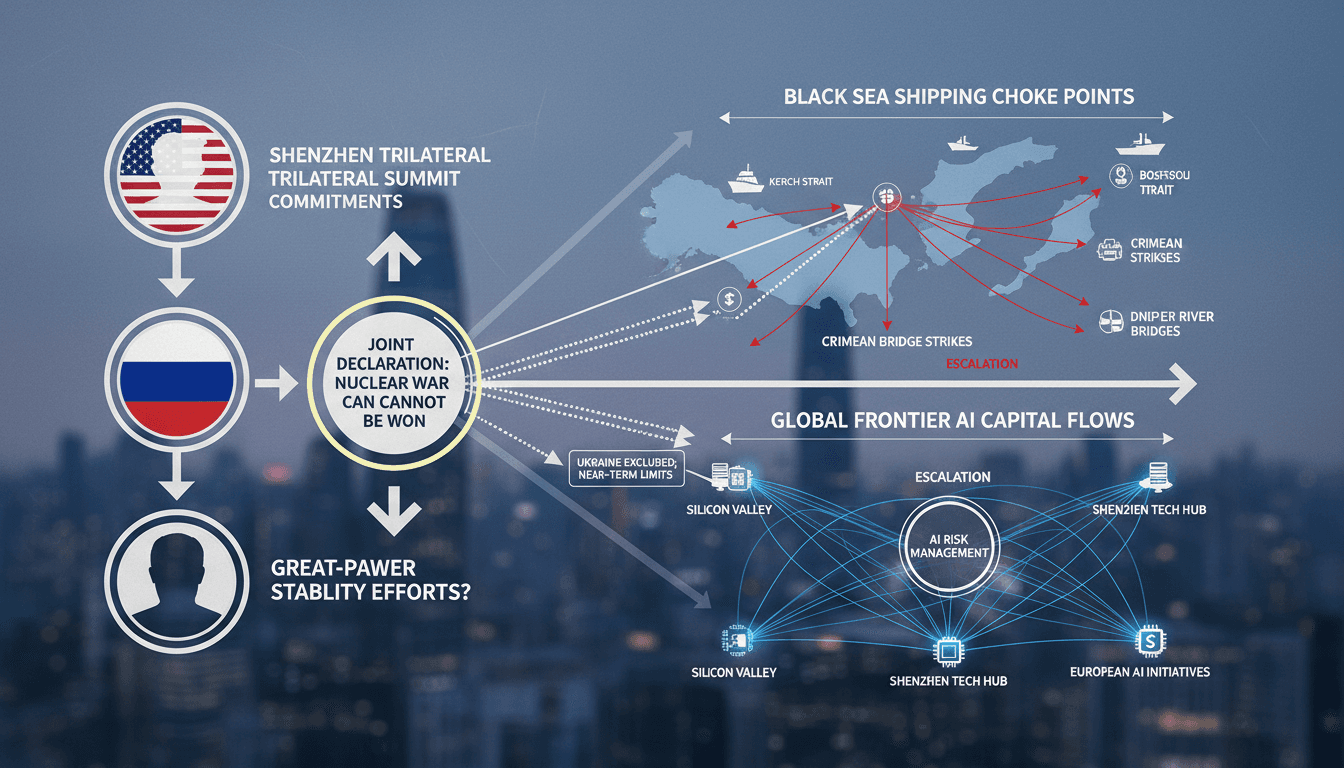
* The Shenzhen summit convened: U.S. President Donald Trump, Russian President Vladimir Putin, and Chinese President Xi Jinping held a 90-minute closed-door trilateral session on November 19, 2026, during the APEC summit in Shenzhen, issuing a joint declaration confirming that nuclear war cannot be won and must never be fought. * Escalations hit transit hubs: Following partial damage to the Crimean Bridge from Ukrainian drone and missile strikes on November 17–18, Russian forces initiated retaliatory strikes across November 19–20 targeting Dnieper River bridges, Odessa ports, and power grid nodes. * AI capital concentrated sharply: Amid public sector leadership reshuffles in cyber oversight, Anthropic finalized a record initial public offering, raising $107.3 billion at a $1.5 trillion valuation as open-source versus closed-source regulatory frictions widened.
The context you actually need
* Nuclear risk containment protocols: The Shenzhen declaration establishes a shared diplomatic baseline between the three primary nuclear-armed states, concentrating formal discussions on fuel supply continuity, United Nations systemic reforms, and diplomatic immunities. * Infrastructure disruption patterns: The exchange of strikes targeting logistical nodes across Ukraine and Crimea highlights continuing physical supply chain interdictions across the Black Sea transit corridor and Eastern European agricultural export routes. * Technological decoupling metrics: Disagreements surrounding compute governance and proprietary AI architectures continue to expand, set against corporate leadership adjustments at critical component providers including Nvidia.
What's really happening
The Shenzhen trilateral engagement illustrates an incentive-driven attempt by major state actors to insulate macroeconomic stability from kinetic military theaters. A 90-minute trilateral format among Donald Trump, Vladimir Putin, and Xi Jinping reflects a structural consensus: open-ended escalation carries systemic liabilities that outstrip tactical territorial gains. By codifying joint non-use language around nuclear arsenals and formalizing parameters on fuel flows, the participating states are attempting to de-risk baseline global trade conduits without resolving root territorial disputes.
This creates a deliberate bifurcation between high-table diplomacy and regional warfare. While the joint declaration explicitly prioritized cross-border fuel supply arrangements and UN procedural adaptations, it omitted operational settlements regarding the Russia-Ukraine front line. Consequently, the operational environment shifted immediately toward asymmetric enforcement. Ukrainian operations targeted the logistical utility of the Crimean Bridge, seeking to disrupt transit corridors supporting Russian deployments in Donetsk Oblast. The reciprocal response focused on infrastructural assets along the Dnieper River and deep-water ports in Odessa.
These kinetic reactions reveal that regional military posture remains disconnected from tripartite geopolitical compacts. When primary transit arteries—such as maritime loading facilities and logistics bridges—sustain physical degradation, freight rates, energy insurance premiums, and grain futures react independently of top-tier diplomatic communiqués.
At the same time, the institutional battleground has broadened into technological dominance. The deployment of advanced computational models and algorithmic infrastructure is now treated as a nonproliferation issue comparable to conventional armaments. Anthropic's $107.3 billion capital deployment at a $1.5 trillion valuation demonstrates that private markets are allocating immense capital directly into sovereign-scale compute capability.
The policy divide between proprietary closed-source AI and public-weight open-source architectures directly influences national industrial policy. Shifts within federal digital infrastructure oversight, punctuated by the replacement of the U.S. national cyber director, underscore that digital resilience and foundational frontier models are treated as baseline state assets. For global operators, the dynamic presents a segmented landscape: political actors guarantee core strategic fuel lanes at the summit level, while logistics arteries face acute local disruption and private technology sectors absorb immense institutional liquidity.
Who feels it first (and how)
* Logistics and maritime freight operators: Black Sea carriers and multimodal shippers navigating Eastern European trade lanes face immediate route reconfigurations and elevated marine hull insurance premiums due to targeted strikes on Odessa port assets and Dnieper river crossings. * Global tech strategists and compute allocators: Enterprise software executives must navigate escalating compliance friction between open-source frameworks and proprietary walled gardens following Anthropic's $107.3 billion IPO and state-level scrutiny over frontier models. * Energy procurement executives: Industrial consumers reliant on stable hydrocarbon and refined fuel corridors must price contracts against the variance between summit-level supply commitments and kinetic infrastructure damage near transit pipelines. * Central European trade liaisons: Industrial managers in export-heavy European markets encounter shifting diplomacy as state leaders, including German Chancellor Friedrich Merz, assess conditional terms for participation in Moscow-hosted regional security talks.
What to watch next
* European participation in Moscow diplomacy: Monitor formal European responses to Vladimir Putin’s invitation for talks, specifically conditional attendance markers signaled by Germany's Friedrich Merz, which will clarify continental trade alignment. * Black Sea maritime transit volumes: Track verified commercial vessel clearances out of Odessa to evaluate whether retaliatory strikes produce sustained operational halts or temporary transshipment delays. * Frontier model capital flows: Watch capital expenditure deployments following Anthropic's $107.3 billion public listing to determine how closed-source AI enterprises capture enterprise infrastructure contracts relative to open-source competitors.
The U.S., Russia, and China met in Shenzhen on November 19, 2026, for a 90-minute trilateral summit, ratifying a joint security statement regarding fuel supplies, UN reforms, and nuclear nonproliferation; Ukrainian strikes partially damaged the Crimean Bridge; and Anthropic raised $107.3 billion at a $1.5 trillion valuation.
Kinetic infrastructure strikes on Ukrainian port nodes and river crossings will force short-term re-routing of agricultural output, driving localized price volatility across regional commodities.
Whether Moscow's invitation for negotiations with European representatives will overcome baseline participation conditions or result in tangible ceasefires affecting contested logistics lines.
Frequently Asked Questions
- Why it matters?
- The formal convergence of Washington, Moscow, and Beijing on energy stability and nuclear nonproliferation signals an effort to firewall systemic trade architecture from escalatory regional conflicts.
- What happened (in 30 seconds)?
- The Shenzhen summit convened: U.S. President Donald Trump, Russian President Vladimir Putin, and Chinese President Xi Jinping held a 90-minute closed-door trilateral session on November 19, 2026, during the APEC summit in Shenzhen, issuing a joint declaration confirming that nuclear war cannot be won and must never be fought. Escalations hit transit hubs: Following partial damage to the Crimean Bridge from Ukrainian drone and missile strikes on November 17–18, Russian forces initiated retaliator
- What's really happening?
- The Shenzhen trilateral engagement illustrates an incentive-driven attempt by major state actors to insulate macroeconomic stability from kinetic military theaters. A 90-minute trilateral format among Donald Trump, Vladimir Putin, and Xi Jinping reflects a structural consensus: open-ended escalation carries systemic liabilities that outstrip tactical territorial gains. By codifying joint non-use language around nuclear arsenals and formalizing parameters on fuel flows, the participating states a
- Who feels it first (and how)?
- Logistics and maritime freight operators: Black Sea carriers and multimodal shippers navigating Eastern European trade lanes face immediate route reconfigurations and elevated marine hull insurance premiums due to targeted strikes on Odessa port assets and Dnieper river crossings. Global tech strategists and compute allocators: Enterprise software executives must navigate escalating compliance friction between open-source frameworks and proprietary walled gardens following Anthropic's $107.3 bil
- What to watch next?
- European participation in Moscow diplomacy: Monitor formal European responses to Vladimir Putin’s invitation for talks, specifically conditional attendance markers signaled by Germany's Friedrich Merz, which will clarify continental trade alignment. Black Sea maritime transit volumes: Track verified commercial vessel clearances out of Odessa to evaluate whether retaliatory strikes produce sustained operational halts or temporary transshipment delays. Frontier model capital flows: Watch capital e
RT is a Russian state-funded network covering global events from a Russian perspective.
"RT is widely criticized for promoting pro-Kremlin narratives and is considered by many to be a state propaganda outlet."
— A47 Editor
Trilateral diplomacy, Russian retribution in Ukraine, AI’s source wars: The stories that shaped the week
Russian President Vladimir Putin, US President Donald Trump and Chinese President Xi Jinping held a first-of-its-kind trilateral meeting on the sidelines of the APEC summit in Shenzhen, China, which Beijing described as historic. The base report, an ...
English-language reporting on Saudi politics, policy, and society.
"Saudi Gazette reflects mainstream Saudi institutional perspectives."
— A47 Editor
Trilateral summit ends with 'peace declaration' but no mention of Ukraine and Iran
The first-ever trilateral summit between US President Donald Trump, Chinese President Xi Jinping and Russian President Vladimir Putin concluded in Shenzhen on the sidelines of the APEC gathering with a 'peace declaration' focused on UN reforms, fuel ...
Regional coverage and analysis focused on politics, diplomacy, and business across the Middle East.
"Al-Monitor is known for analytical reporting on Middle East politics and policy developments."
— A47 Editor
US, China can help end Ukraine war, Trump tells Xi before trilateral with Putin
US President Donald Trump told Chinese President Xi Jinping on Thursday in Shenzhen that both countries should help end the war in Ukraine, ahead of an unprecedented trilateral meeting with Russian President Vladimir Putin on the sidelines of the APE...