
Trump Executive Order Requires Federal Contractors to Route Congressional Inquiries Through White House
Why it matters
The mandate alters operational risk for tens of thousands of vendors by turning routine legislative document requests into potential triggers for contract termination or debarment.
What happened (in 30 seconds)
- A sweeping mandate took effect: On November 21, 2026, President Donald Trump issued an executive order requiring federal contractors and subcontractors to consult the White House before answering congressional inquiries.
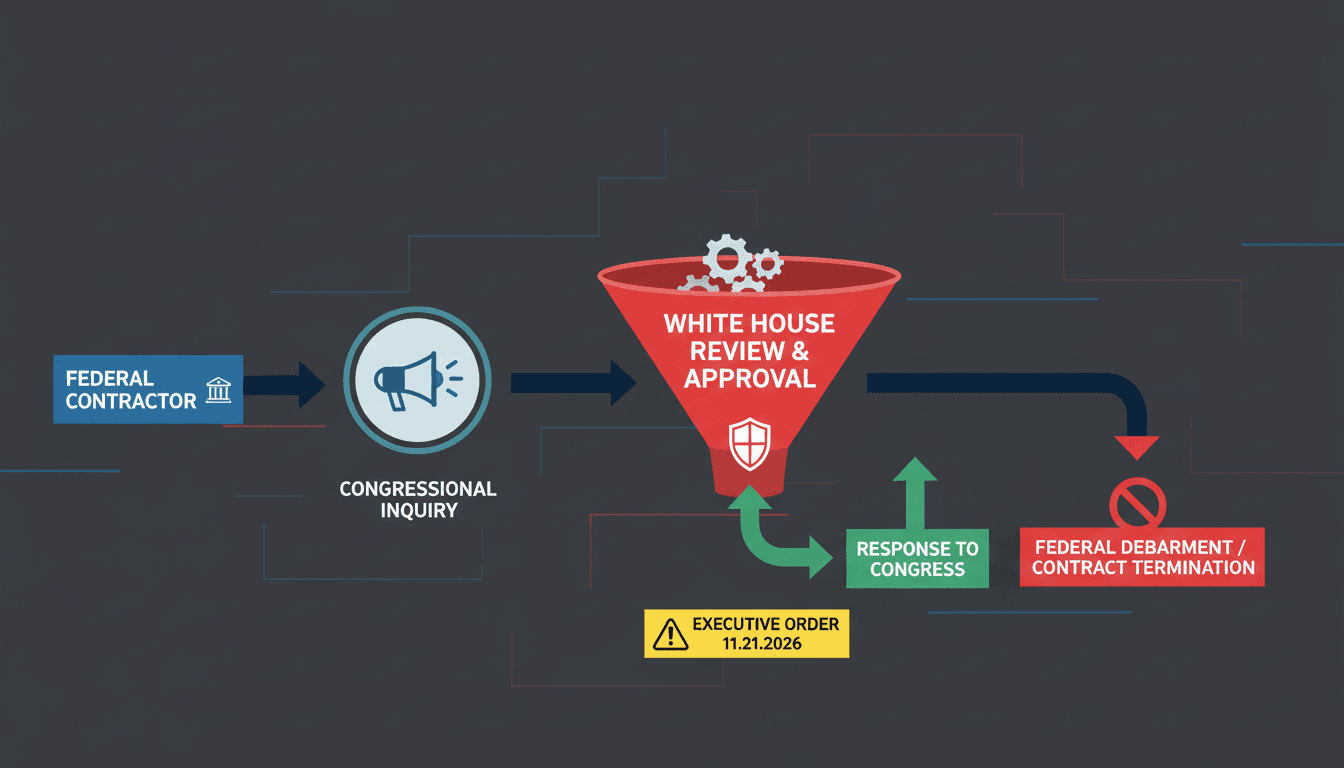
- Strict compliance terms were set: The directive instructs businesses to provide immediate notice of incoming inquiries, coordinate formal responses, and withhold any communications deemed covered by executive privilege.
- Severe business penalties were established: Companies that fail to comply face the immediate suspension of work or permanent debarment from the federal procurement system.
The context you actually need
- A shifting legislative landscape: The order was signed following the 2026 midterm elections, as Democratic majorities prepared to assume control of Congress in January 2027 with stated plans to investigate federal contracts, including Pentagon agreements.
- A pattern of executive protocols: The policy builds on prior administrative directives, including a memo from White House Counsel Will Scharf requiring agency clearance for congressional testimony, alongside letters categorizing early document preservation requests as non-binding.
- A vast corporate footprint: Reporting confirms the policy applies across the entire procurement base, directly impacting tens of thousands of businesses and their subcontracting tiers.
What's really happening
The core mechanism of this executive order shifts the burden of asserting executive privilege from public officials to private commercial partners. Historically, congressional committees gather background details, emails, and financial filings directly from third-party vendors to reconstruct executive branch decisions. By inserting a mandatory White House review pipeline between contractors and Capitol Hill, the executive branch establishes an administrative gatekeeper over the documentation flowing into legislative oversight panels.
The economic incentives driving contractor compliance are absolute. In federal procurement, the threat of debarment represents an existential business risk. By anchoring adherence to this order directly to contract eligibility, the administration leverages procurement authority to prevent leaks or premature record releases. For vendors caught between a congressional subpoena and an executive order, non-cooperation with the White House risks immediate revenue loss, while non-cooperation with legislative inquiries risks legal friction with congressional committees.
This structural dynamic redefines standard risk analysis for corporate legal teams. Legislative oversight targeting executive actions frequently centers on defense procurement, technology implementations, and administrative spending. Prior to this order, private firms maintained independent counsel to negotiate production scopes directly with committee staff, frequently complying voluntarily to preserve legislative goodwill. Under the new rules, independent disclosure is explicitly prohibited whenever materials touch executive communications.
Furthermore, extending the rule down through supply chains via subcontractors broadens administrative control across commercial sectors that do not typically interface with executive legal frameworks. Subcontractors supplying components, consulting services, or logistics to prime federal contractors must now implement tracking mechanisms to intercept congressional outreach. This centralized coordination mechanism ensures that document productions across tens of thousands of corporate entities align with the administration's legal boundaries regarding executive privilege before lawmakers ever inspect them.
Who feels it first (and how)
- Prime federal defense and technology contractors: General counsels must immediately update internal disclosure protocols to route congressional requests to White House oversight teams.
- Lower-tier commercial subcontractors: Small to mid-sized suppliers face increased overhead costs to verify whether technical specifications, emails, or delivery data fall under executive privilege protections.
- Congressional oversight committees: Legislative investigators will encounter procedural delays and formal withholdings when seeking operational records directly from corporate entities.
- Corporate compliance officers: In-house risk officers must resolve contractual tensions between statutory legislative disclosure demands and executive branch debarment penalties.
What to watch next
- Legal challenges from incoming committee chairs: Watch for federal lawsuits testing whether the executive branch can restrict voluntary private-sector responses to congressional oversight through procurement clauses.
- Contract clause modifications across procurement agencies: Watch for standardized administrative amendments appearing in federal defense and civilian acquisition contracts detailing the White House coordination protocol.
- Subpoena enforcement proceedings: Watch for early committee enforcement measures against non-compliant contractors, which will test whether corporate boards prioritize procurement standing or legislative contempt risks.
The executive order was signed in late November 2026, applies to tens of thousands of contractors and subcontractors, and mandates response coordination and the withholding of privileged documents under threat of debarment.
The directive will cause friction between incoming congressional leaders, such as Representative Robert Garcia, and private contractors attempting to navigate conflicting legal duties starting in January 2027.
It remains undetermined whether federal courts will uphold contract termination or debarment if a vendor complies with a valid congressional subpoena over White House objections.
Frequently Asked Questions
- Why it matters?
- The mandate alters operational risk for tens of thousands of vendors by turning routine legislative document requests into potential triggers for contract termination or debarment.
- What happened (in 30 seconds)?
- A sweeping mandate took effect: On November 21, 2026, President Donald Trump issued an executive order requiring federal contractors and subcontractors to consult the White House before answering congressional inquiries. Strict compliance terms were set: The directive instructs businesses to provide immediate notice of incoming inquiries, coordinate formal responses, and withhold any communications deemed covered by executive privilege. Severe business penalties were established: Companies that
- What's really happening?
- The core mechanism of this executive order shifts the burden of asserting executive privilege from public officials to private commercial partners. Historically, congressional committees gather background details, emails, and financial filings directly from third-party vendors to reconstruct executive branch decisions. By inserting a mandatory White House review pipeline between contractors and Capitol Hill, the executive branch establishes an administrative gatekeeper over the documentation flo
- Who feels it first (and how)?
- Prime federal defense and technology contractors: General counsels must immediately update internal disclosure protocols to route congressional requests to White House oversight teams. Lower-tier commercial subcontractors: Small to mid-sized suppliers face increased overhead costs to verify whether technical specifications, emails, or delivery data fall under executive privilege protections. Congressional oversight committees: Legislative investigators will encounter procedural delays and formal
- What to watch next?
- Legal challenges from incoming committee chairs: Watch for federal lawsuits testing whether the executive branch can restrict voluntary private-sector responses to congressional oversight through procurement clauses. Contract clause modifications across procurement agencies: Watch for standardized administrative amendments appearing in federal defense and civilian acquisition contracts detailing the White House coordination protocol. Subpoena enforcement proceedings: Watch for early committee en
Policy, elections, and government reporting.
"NPR is an American public media organization known for thoughtful reporting and a slightly left-leaning editorial tone."
— A47 Editor
Trump orders federal contractors to check with White House before responding to Congress
President Trump has directed federal contractors to consult the White House before responding to congressional inquiries and to withhold communications the administration considers privileged, according to NPR's reporting on the executive order.
Macro commentary, policy analysis, growth/inflation themes, and global outlooks.
"Contextual macro coverage that complements day-to-day market headlines."
— A47 Editor
Trump orders contractors to report Congress inquiries
Trump orders contractors to report Congress inquiries, according to a report published by Investing.com on November 21, 2026. The story, categorized under markets, centers on a directive involving federal contractors and their communications with Con...
News from the United States including domestic politics, society, and culture.
"The Guardian is known for its progressive editorial stance and in-depth analysis, often advocating for social justice, environmental issues, and liberal values."
— A47 Editor
Trump orders contractors to check with White House over any congressional inquiries
Donald Trump has issued an executive order directing federal contractors and subcontractors to consult with the White House about inquiries they receive from Congress, to withhold communications the administration deems privileged, and to coordinate ...
International coverage from The Guardian's global desks.
"The Guardian is known for its progressive editorial stance and in-depth analysis."
— A47 Editor
Trump orders contractors to check with White House over any congressional inquiries
Donald Trump has issued an executive order directing federal contractors and subcontractors to consult with the White House about inquiries they receive from Congress, to withhold communications the administration deems privileged, and to coordinate ...
Right-of-center views on political news.
"The Washington Times is a conservative-leaning newspaper known for its political coverage and advocacy of right-of-center viewpoints."
— A47 Editor
Trump to contractors: Get approval before giving congressional Dems information
President Donald Trump signed an order on Friday requiring government contractors to coordinate with the White House before providing sensitive information to congressional Democrats, according to The Washington Times. The directive is aimed at preve...
Conservative-leaning coverage of current events.
"Fox News is a highly influential conservative news outlet known for right-leaning political commentary and coverage."
— A47 Editor
Trump orders federal contractors to alert White House on congressional record requests
President Donald Trump has signed an executive order directing federal contractors to alert the White House when they receive requests from Congress for records, and to withhold material deemed privileged, according to reporting by Fox News.