
Amazon Enlists Customers Against NYC Delivery Protection Act Through Package Stickers
Why it matters
When platforms weaponize fulfillment hardware to resist direct-employment legislation, it reveals how fragile the economics of third-party contractor models become under local regulatory pressure.
What happened (in 30 seconds)
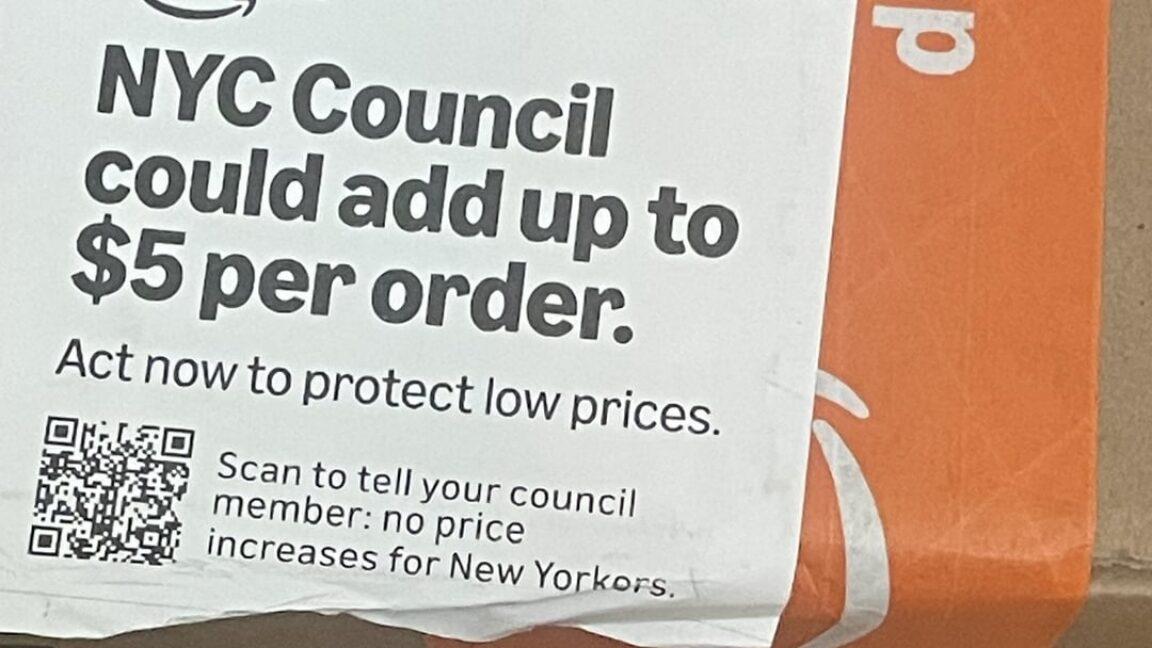
- Physical packaging turned into advocacy: Around November 23, 2026, Amazon began affixing QR-code stickers directly onto packages delivered in New York City, prompting shoppers to petition their local council members.
- The policy trigger: The campaign targets the proposed Delivery Protection Act (Intro 0518-2026), which would compel companies operating last-mile delivery hubs to classify delivery workers as direct employees rather than third-party contractors.
- Rapid consumer mobilization: Prior to physical labels, Amazon tested in-app alerts and web banners warning of potential $5 surcharges per order, generating more than 60,000 opposing emails to the New York City Council by November 22, 2026.
The context you actually need
- The Delivery Service Partner model: Since 2018, Amazon has handled urban last-mile distribution primarily through independent third-party Delivery Service Partners (DSPs), shielding the enterprise from direct payroll obligations, fleet liabilities, and direct unionization pressures.
- Political backing behind the bill: Introduced in February 2026 and endorsed by Mayor Zohran Mamdani in August, Intro 0518-2026 aims to secure labor protections, wage floors, and workplace safety by eliminating the contractor intermediary layer.
- Digital mobilization reached its ceiling: After in-app pop-ups and site banners exhausted initial outreach, the enterprise moved downstream into the physical box itself, betting that doorstep interactions carry higher conversion rates than digital notifications.
What's really happening
The conflict in New York City is not a standard municipal dispute; it is an economic defense of the decentralized fulfillment architecture that underpins modern hyper-scale logistics.
Since establishing its Delivery Service Partner (DSP) framework in 2018, Amazon has insulated its core unit economics from the operating overhead of fleet ownership and workforce administration. Under this structure, thousands of independent business owners contract with the platform, assuming the operational responsibilities of scheduling, driver hiring, and fleet compliance. In exchange, the platform retains algorithmic scheduling, routing authority, and delivery rate parameters.
Intro 0518-2026 directly attacks this architectural boundary. By proposing that firms operating last-mile facilities must directly employ delivery couriers, the New York City Council seeks to legally collapse the distinction between logistics platforms and contractor fleets. For the enterprise, the shift represents an acute structural cost escalation. Direct employment triggers statutory benefits, workers' compensation liabilities, overtime compliance, and direct exposure to organizing efforts by groups like the International Brotherhood of Teamsters.
To quantify this risk to consumers, Amazon warned shoppers of potential order price hikes reaching up to $5 per delivery, alongside warnings that operational hubs might be forced outside municipal borders. Yet the escalation from digital software banners to adhesive package stickers highlights an underlying structural friction: digital notices are easily dismissed, whereas an unboxing interaction is an unavoidable physical touchpoint.
By weaponizing physical distribution assets, the enterprise creates a direct friction loop between municipal lawmakers and retail shoppers. Generating over 60,000 constituent emails in days demonstrates that consumer convenience can be mobilized as political capital. The operational calculation is straightforward: the cost of printing and applying millions of physical labels is nominal compared to the capital expenditure required to absorb tens of thousands of delivery couriers onto direct corporate payrolls.
If Intro 0518-2026 passes, the direct-employment mandate could create an operational precedent for other densely populated metropolitan markets, eroding the unit margins of asset-light urban logistics.
Who feels it first (and how)
- New York City e-commerce consumers: Shoppers face immediate politicization of regular doorstep deliveries, alongside prospective cost adjustments of up to $5 per order if fulfillment networks restructure.
- Third-party Delivery Service Partner owners: DSP small-business operators in New York City face potential contract nullification or forced structural absorption if the direct-employment mandate becomes law.
- Urban delivery couriers: Last-mile drivers stand between two institutional forces: the immediate backing of labor unions like the Teamsters pushing for corporate benefits, and the platform warning of reduced local capacity.
- Municipal policymakers: New York City Council members face targeted constituent pressure, fielding tens of thousands of auto-generated emails originating directly from residential living rooms.
What to watch next
- City Council committee scheduling: Watch whether the Committee on Consumer and Worker Protection schedules a formal vote on Intro 0518-2026, which indicates whether the 60,000 opposing emails altered legislative timelines.
- Expansion of physical packaging campaigns: Track whether physical lobbying stickers spread beyond New York City into other metropolitan areas reviewing gig-economy and independent contractor statutes.
- Retail conversion metrics: Observe whether consumer irritation over unsolicited package politics translates into churn or reduced prime subscription renewals within dense urban zip codes.
Amazon applied physical stickers with QR codes to New York City customer deliveries in late November 2026 to oppose Intro 0518-2026, generating more than 60,000 constituent emails to the City Council.
The enterprise will continue using customer touchpoints—both software applications and physical packaging—to fight similar municipal labor classifications across high-density markets.
Whether the City Council's Committee on Consumer and Worker Protection will advance the legislation to a floor vote, or amend the bill to carve out exceptions for existing delivery partner frameworks.
Frequently Asked Questions
- Why it matters?
- When platforms weaponize fulfillment hardware to resist direct-employment legislation, it reveals how fragile the economics of third-party contractor models become under local regulatory pressure.
- What happened (in 30 seconds)?
- Physical packaging turned into advocacy: Around November 23, 2026, Amazon began affixing QR-code stickers directly onto packages delivered in New York City, prompting shoppers to petition their local council members. The policy trigger: The campaign targets the proposed Delivery Protection Act (Intro 0518-2026), which would compel companies operating last-mile delivery hubs to classify delivery workers as direct employees rather than third-party contractors. Rapid consumer mobilization: Prior to
- What's really happening?
- The conflict in New York City is not a standard municipal dispute; it is an economic defense of the decentralized fulfillment architecture that underpins modern hyper-scale logistics. Since establishing its Delivery Service Partner (DSP) framework in 2018, Amazon has insulated its core unit economics from the operating overhead of fleet ownership and workforce administration. Under this structure, thousands of independent business owners contract with the platform, assuming the operational res
- Who feels it first (and how)?
- New York City e-commerce consumers: Shoppers face immediate politicization of regular doorstep deliveries, alongside prospective cost adjustments of up to $5 per order if fulfillment networks restructure. Third-party Delivery Service Partner owners: DSP small-business operators in New York City face potential contract nullification or forced structural absorption if the direct-employment mandate becomes law. Urban delivery couriers: Last-mile drivers stand between two institutional forces: the i
- What to watch next?
- City Council committee scheduling: Watch whether the Committee on Consumer and Worker Protection schedules a formal vote on Intro 0518-2026, which indicates whether the 60,000 opposing emails altered legislative timelines. Expansion of physical packaging campaigns: Track whether physical lobbying stickers spread beyond New York City into other metropolitan areas reviewing gig-economy and independent contractor statutes. Retail conversion metrics: Observe whether consumer irritation over unsolici
In-depth reporting on tech, policy, and science including AI.
"Respected analysis for technically savvy readers, including AI topics."
— A47 Editor
Amazon fights Delivery Protection Act by putting stickers on its packages
Amazon has begun placing warning stickers on its packages and displaying banners and in-app pop-ups to oppose New York City's proposed Delivery Protection Act, which would effectively ban the third-party delivery arrangements the company relies on. T...
In-depth coverage of hardware, software, science, and policy.
"Ars Technica provides expert technology news, hardware reviews, and analysis for a technically savvy audience."
— A47 Editor
Amazon fights Delivery Protection Act by putting stickers on its packages
Amazon has begun placing warning stickers on its packages and displaying banners and in-app pop-ups to oppose New York City's proposed Delivery Protection Act, which would effectively ban the third-party delivery arrangements the company relies on. T...
Consumer technology news with AI coverage.
"Gadget and tech site reporting on AI in products."
— A47 Editor
Amazon resorts to package stickers in its fight against NYC's proposed delivery law
Amazon has turned to package stickers as its latest tactic against New York City's proposed Delivery Protection Act, which would effectively ban the third-party delivery arrangements the company relies on. The labels warn that the Council could add u...
Covers consumer technology, electronics, gadgets, and product reviews.
"Engadget is a trusted source for gadget reviews and consumer tech news, known for its hands-on analysis and industry coverage."
— A47 Editor
Amazon resorts to package stickers in its fight against NYC's proposed delivery law
Amazon has turned to package stickers as its latest tactic against New York City's proposed Delivery Protection Act, which would effectively ban the third-party delivery arrangements the company relies on. The labels warn that the Council could add u...
Consumer tech and culture with frequent AI coverage.
"Influential tech outlet covering AI products and policy."
— A47 Editor
Amazon is complaining about NYC Council on shipping labels, too
Amazon is escalating its opposition to the New York City Council's Delivery Protection Act by placing labels on shipments warning that the Council could add up to $5 to any Amazon order. The Act would effectively ban the third-party delivery arrangem...
Tech news, reviews, and analysis of consumer electronics, science, art, and culture.
"The Verge is a technology-focused media outlet known for in-depth reporting, product reviews, and coverage of the intersection between technology and culture."
— A47 Editor
Amazon is complaining about NYC Council on shipping labels, too
Amazon is escalating its opposition to the New York City Council's Delivery Protection Act by placing labels on shipments warning that the Council could add up to $5 to any Amazon order. The Act would effectively ban the third-party delivery arrangem...