
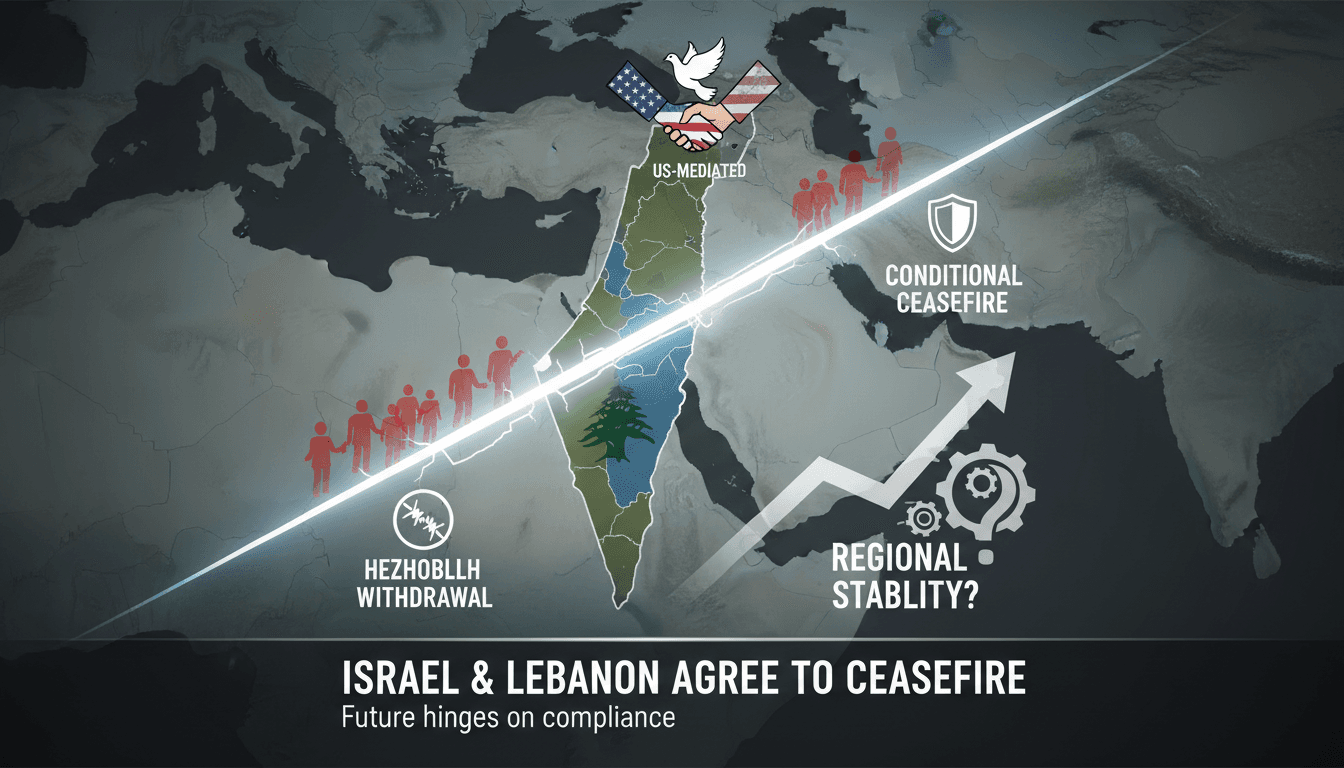
Israel and Lebanon agree to conditional ceasefire mediated by US
Here's what it means for you.
The recent conditional ceasefire agreement between Israel and Lebanon, facilitated by US mediation, signals a critical moment in Middle Eastern diplomacy. The success of this ceasefire hinges on Hezbollah's compliance, which could have significant implications for regional stability and international relations. Stakeholders in the oil markets and global diplomacy will be closely monitoring developments as tensions evolve. The fragile nature of this agreement underscores the complexities of the ongoing conflict, with potential repercussions for both local and international actors. As the situation unfolds, the focus will be on how effectively the ceasefire can be maintained.
What happened
Israel and Lebanon have reached a conditional ceasefire agreement following US-brokered talks in Washington, DC. This ceasefire is contingent upon Hezbollah ceasing its attacks and withdrawing from the area south of the Litani River. Despite the announcement of the ceasefire, ongoing clashes have been reported, indicating that tensions remain high.
The agreement was reached without direct involvement from Hezbollah in the negotiations, raising questions about the group's willingness to comply with the terms. Israeli officials have expressed support for the ceasefire, emphasizing its importance in the current geopolitical climate.
The Context
The ceasefire agreement marks a significant diplomatic effort in a region long plagued by conflict. The requirement for Hezbollah to halt its attacks and withdraw from key areas highlights the challenges of enforcing peace in such a volatile environment. The timing of this agreement comes amid escalating tensions, making it a pivotal moment for both Israel and Lebanon.
The US's role as a mediator underscores its ongoing interest in stabilizing the region and fostering diplomatic relations. However, the absence of Hezbollah from the negotiations raises concerns about the sustainability of the ceasefire and the potential for renewed violence.
Takeaway
The conditional ceasefire presents an opportunity for de-escalation in the region, but its success will largely depend on Hezbollah's actions in the coming days. Observers should monitor Hezbollah's response to the ceasefire conditions, as any failure to comply could reignite hostilities.
Additionally, the potential impacts on oil markets and broader regional stability will be critical to watch as the situation develops. The fragile nature of this agreement serves as a reminder of the complexities involved in achieving lasting peace in the Middle East.
Pan-Arab news coverage spanning politics, business, sports, and regional affairs.
"Asharq Al-Awsat reflects a broad Arab editorial perspective with strong attention to regional geopolitics."
— A47 Editor
ترحيب إسرائيلي بنتائج الاتفاق مع لبنان
Israeli officials have largely welcomed the results of the ceasefire agreement with Lebanon, defending it as a significant step forward despite some signs of dissent. This agreement marks a pivotal moment in Israeli-Lebanese relations, reflecting a s...
Global business headlines with AI angles.
"General business outlet that frequently covers AI."
— A47 Editor
Israel And Lebanon Agree On Ceasefire Conditional On Hezbollah Halting Attacks, Withdrawing From Key Area
Israel and Lebanon have reached an agreement to implement a ceasefire, contingent upon Hezbollah ceasing its attacks and withdrawing from the area south of the Litani River. This development marks a significant step towards reducing hostilities in a ...
Global news coverage with extensive reporting on Middle Eastern conflicts and geopolitics.
"Al Jazeera is a Qatar-based broadcaster known for wide regional coverage and alternative perspectives."
— A47 Editor
Israel and Lebanon agree to conditional ceasefire
Israel and Lebanon have reached a conditional ceasefire agreement following US-mediated talks in Washington, DC, aimed at reducing hostilities between the two nations. This agreement notably excludes Hezbollah from the discussions, which has been a s...
Comprehensive coverage of Middle Eastern and global issues.
"Al Jazeera is a prominent voice from the Global South, especially the Middle East, with an emphasis on underreported stories."
— A47 Editor
Israel and Lebanon agree to conditional ceasefire
Israel and Lebanon have reached a conditional ceasefire agreement following US-mediated talks in Washington, DC, aimed at reducing hostilities between the two nations. This agreement notably excludes Hezbollah from the discussions, which has been a s...
Pan-Arab news coverage spanning politics, business, sports, and regional affairs.
"Asharq Al-Awsat reflects a broad Arab editorial perspective with strong attention to regional geopolitics."
— A47 Editor
الخارجية الأميركية تعلن توصل لبنان وإسرائيل إلى وقف لإطلاق النار
The U.S. State Department announced that Lebanon and Israel have reached a ceasefire agreement following negotiations held in Washington. This development marks a significant step towards reducing tensions in the region and fostering dialogue between...
Global markets, investing, and macroeconomics from a premier financial newsroom.
"Bloomberg is respected for in-depth financial reporting and data-driven analysis."
— A47 Editor
Oil Dips After Israel-Lebanon Ceasefire Even as Clashes Persist
Oil prices have dipped following a conditional ceasefire agreement between Israel and Lebanon, which aims to reduce hostilities in the region. Despite this truce, clashes have continued, raising concerns about the stability of the ceasefire. The U.S....