
Republic of Ireland Football Team Protests Against Israel During UEFA Nations League Matches
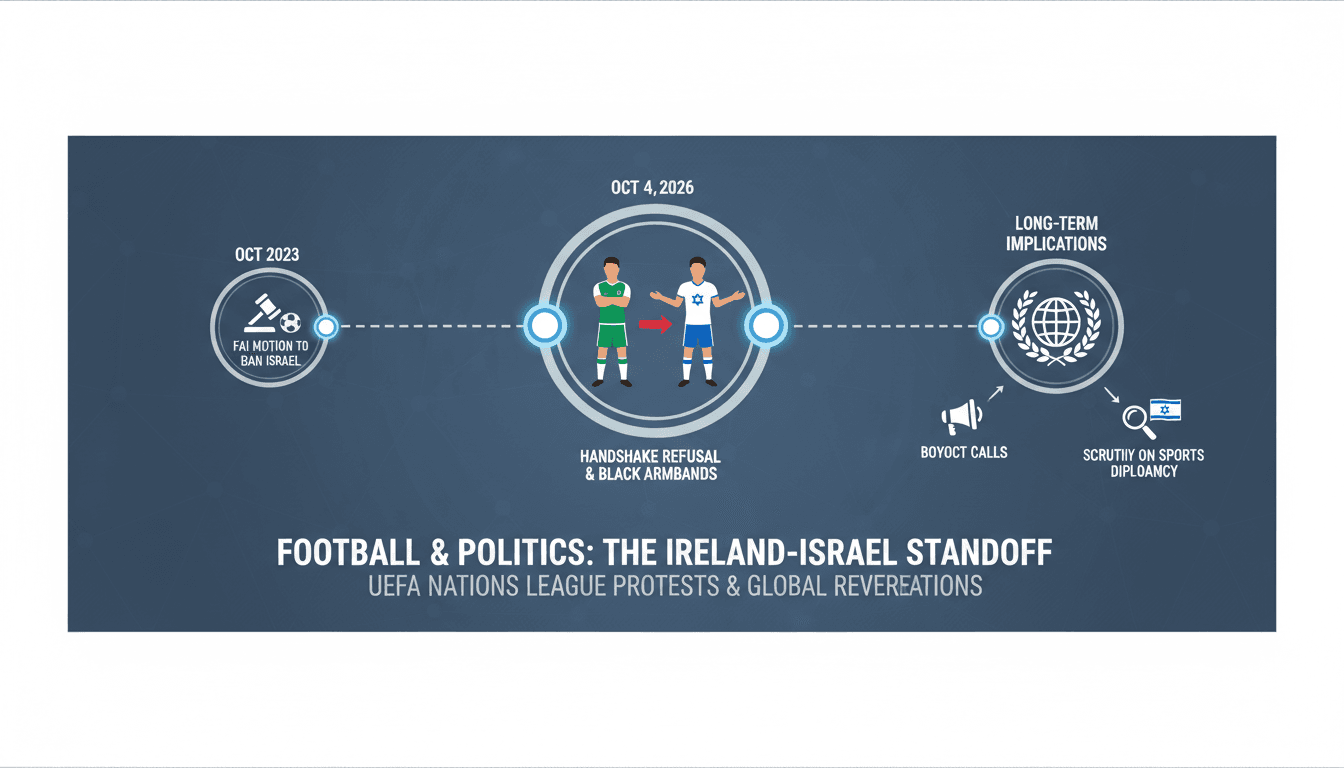
Why it matters
This incident highlights the intersection of sports and politics, affecting public sentiment and international relations.
What happened (in 30 seconds)
- Ireland's national team refused handshakes with Israel during their UEFA Nations League match on October 4, 2026.
- Players wore black armbands to honor lives lost in Gaza, reflecting strong domestic support for Palestinians.
- The match ended in a 1-1 draw, concluding a contentious series of fixtures amid protests and heightened tensions.
The context you actually need
- Ireland's Football Association had previously urged UEFA to ban Israel from competitions, reflecting widespread domestic calls for a boycott.
- Both matches were relocated to neutral venues to mitigate potential sanctions risks tied to Euro 2028 co-hosting.
- Irish player Gavin Bazunu withdrew from the squad, citing personal beliefs against the ongoing conflict.
What's really happening
The refusal of the Republic of Ireland national football team to engage in pre-match handshakes with their Israeli counterparts and their decision to wear black armbands during UEFA Nations League fixtures are emblematic of a broader cultural and political stance. This action is rooted in Ireland's strong domestic support for the Palestinian cause, which has intensified in light of the ongoing Gaza conflict. The Football Association of Ireland (FAI) has been vocal in its criticism of Israel's military actions, culminating in a November 2025 motion that urged UEFA to reconsider Israel's participation in international competitions.
The decision to relocate the matches to neutral venues was a strategic move by the FAI to avoid potential sanctions from UEFA, especially considering Ireland's role as a co-host for Euro 2028. This relocation, however, did not diminish the emotional weight of the fixtures, as evidenced by the players' actions on the field. The black armbands worn by the Irish team served as a poignant reminder of the lives lost in Gaza, while the bowing of heads during the Israeli anthem signified a moment of respect amidst the ongoing tensions.
The matches themselves were fraught with tension, culminating in a 1-1 draw that saw both teams embroiled in disputes and confrontations. The Irish players' refusal to shake hands with Israel's captain, Dor Peretz, was a clear statement of solidarity with the Palestinian cause, further complicating the already charged atmosphere. The aftermath of the matches saw reactions from both sides, with Ireland's coach calling for UEFA to avoid future draws between the teams, while Israeli officials accused the Irish players of moral blindness.
This incident is not just about football; it reflects a growing trend where sports are increasingly intertwined with political statements. The actions taken by the Irish team resonate beyond the pitch, influencing public opinion and potentially impacting future international sporting events. As the world becomes more polarized, the role of sports as a platform for political expression is likely to grow, leading to further complexities in international relations.
Who feels it first (and how)
- Athletes: Players may face increased scrutiny and pressure regarding their political beliefs and actions.
- Sports Associations: Organizations like the FAI must navigate the delicate balance between sports and politics, impacting their operational decisions.
- Fans: Supporters may experience divided sentiments, affecting attendance and engagement with the sport.
- Geopolitical Analysts: Experts will need to reassess the implications of sports diplomacy on international relations.
What to watch next
- Future UEFA fixtures: Monitor how UEFA responds to calls for boycotts and the potential impact on team matchups.
- Public sentiment in Ireland: Watch for shifts in public opinion regarding the Palestinian cause and its influence on sports.
- International reactions: Observe how other nations respond to similar political expressions in sports, which could set precedents for future events.
The FAI's stance on Israel reflects a significant domestic political sentiment in Ireland.
Increased scrutiny on international sports events as platforms for political expression will continue.
The long-term impact on Ireland's international sporting relations and potential sanctions from UEFA remains uncertain.
Frequently Asked Questions
- Why it matters?
- This incident highlights the intersection of sports and politics, affecting public sentiment and international relations.
- What happened (in 30 seconds)?
- Ireland's national team refused handshakes with Israel during their UEFA Nations League match on October 4, 2026. Players wore black armbands to honor lives lost in Gaza, reflecting strong domestic support for Palestinians. The match ended in a 1-1 draw, concluding a contentious series of fixtures amid protests and heightened tensions.
- What's really happening?
- The refusal of the Republic of Ireland national football team to engage in pre-match handshakes with their Israeli counterparts and their decision to wear black armbands during UEFA Nations League fixtures are emblematic of a broader cultural and political stance. This action is rooted in Ireland's strong domestic support for the Palestinian cause, which has intensified in light of the ongoing Gaza conflict. The Football Association of Ireland (FAI) has been vocal in its criticism of Israel's mi
- Who feels it first (and how)?
- Athletes: Players may face increased scrutiny and pressure regarding their political beliefs and actions. Sports Associations: Organizations like the FAI must navigate the delicate balance between sports and politics, impacting their operational decisions. Fans: Supporters may experience divided sentiments, affecting attendance and engagement with the sport. Geopolitical Analysts: Experts will need to reassess the implications of sports diplomacy on international relations.
- What to watch next?
- Future UEFA fixtures: Monitor how UEFA responds to calls for boycotts and the potential impact on team matchups. Public sentiment in Ireland: Watch for shifts in public opinion regarding the Palestinian cause and its influence on sports. International reactions: Observe how other nations respond to similar political expressions in sports, which could set precedents for future events.
Global news coverage with extensive reporting on Middle Eastern conflicts and geopolitics.
"Al Jazeera is a Qatar-based broadcaster known for wide regional coverage and alternative perspectives."
— A47 Editor
Ireland refuse handshake with Israel and don armbands in Nations League tie
The Republic of Ireland football team wore black armbands and refused to shake hands with the Israeli team during their UEFA Nations League match, reflecting their stance on the ongoing violence in Gaza. This gesture is part of a broader movement adv...
Comprehensive coverage of Middle Eastern and global issues.
"Al Jazeera is a prominent voice from the Global South, especially the Middle East, with an emphasis on underreported stories."
— A47 Editor
Ireland refuse handshake with Israel and don armbands in Nations League tie
The Republic of Ireland football team wore black armbands and refused to shake hands with the Israeli team during their UEFA Nations League match, reflecting their stance on the ongoing violence in Gaza. This gesture is part of a broader movement adv...
Regional coverage and analysis focused on politics, diplomacy, and business across the Middle East.
"Al-Monitor is known for analytical reporting on Middle East politics and policy developments."
— A47 Editor
Israel wear black armbands in Ireland tie over Hamas attack
In a recent UEFA Nations League match, Israel's national football team wore black armbands to honor the victims of the October 7, 2023 Hamas attack during their game against Ireland, who previously donned similar armbands to protest the ongoing viole...
Conservative-leaning coverage of current events.
"Fox News is a highly influential conservative news outlet known for right-leaning political commentary and coverage."
— A47 Editor
Israeli soccer players wear armbands to remember terror attack victims as Irish opponents pull stunt again
Israeli soccer players donned black armbands inscribed with "7.10" to honor the victims of a recent terror attack, a tribute sanctioned by UEFA. Meanwhile, Irish players once again opted to forgo handshakes prior to their match, continuing a pattern ...
International sporting events, tournament updates, and athlete profiles.
"France 24 is viewed as a globally focused outlet with balanced coverage, offering a European perspective on international sports."
— A47 Editor
Ireland–Israel nations League clash overshadowed by political tensions
The Nations League match between Ireland and Israel is set against a backdrop of heightened political tensions, particularly regarding the ongoing conflict in Gaza. Irish players have shown solidarity with Gaza by wearing black armbands and lowering ...