
FIFA Abandons Scrapped $20 Billion FIFA Forward Enterprise Plan to Transfer World Cup Commercial Rights for Up to 96 Years
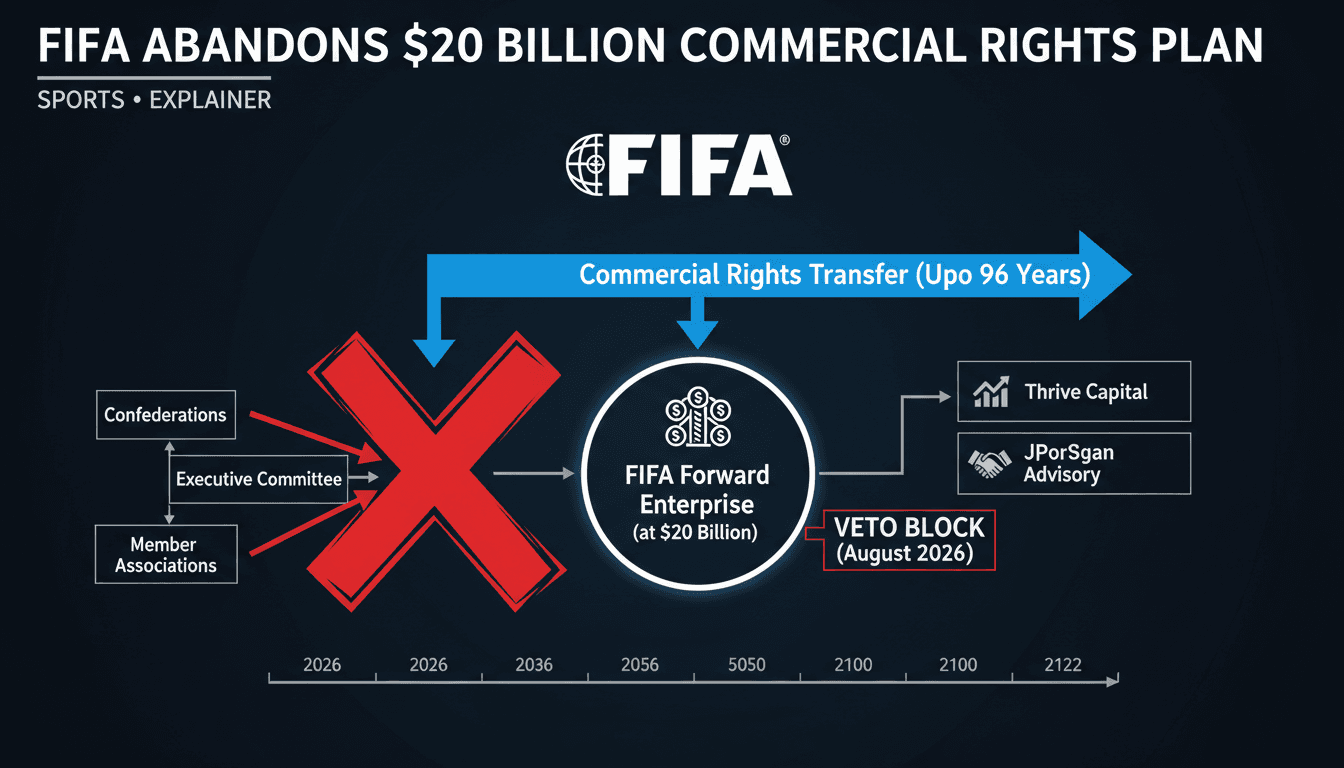
Institutional sports capital faces hard governance ceilings when commercial restructuring attempts bypass established confederation stakeholders.
Why it matters
The collapse of a $20 billion commercial vehicle reveals the structural limits of monetizing legacy sports assets through private equity without decentralized stakeholder consent.
What happened (in 30 seconds)
* The proposal surfaced: In July 2026, FIFA President Gianni Infantino advanced the FIFA Forward Enterprise (FFE), a plan to transfer tournament commercial rights to an external for-profit entity valued at $20 billion for up to 96 years. * The private vehicle formed: Backed by Thrive Capital without a competitive bidding process and advised by JPMorgan, the structure proposed rolling 12-year licenses, an 8-year IPO window, a 5% management bonus pool, and 51% retained ownership under FIFA board control. * The initiative collapsed: Following an approval vote at the Waldorf Astoria on July 18, 2026, immediate backlash from continental confederations like UEFA forced Infantino to scrap the initiative by August 2026, with full terms leaking on November 23, 2026.
The context you actually need
* Monetization pressures accelerated: Surging broadcasting and sponsorship revenues from the expanded 2022 and 2026 World Cups drove leadership to seek private equity mechanisms to capitalize on global tournament cash flows. * Internal governance was bypassed: FIFA's Chief Financial Officer was excluded from deliberations prior to the New York vote, generating acute administrative resistance alongside external confederation pushback. * Private equity access was concentrated: The deal structure relied on direct relationships with U.S. investment firms rather than an open tender, centralizing operational control and management incentives within executive leadership.
What's really happening
The mechanics of the FIFA Forward Enterprise reflect an effort to solve a specific structural constraint: converting cyclical, four-year tournament cash flows into liquid, upfront enterprise value. Under traditional governance, global sports federations distribute revenues directly through continental confederations and national associations. By shifting commercial exploitation into a corporate subsidiary, FIFA aimed to separate commercial upside from regulatory oversight.
The chosen architecture relied on rolling 12-year licensing windows that could extend to 96 years. This multi-generational runway was calibrated to provide private equity investors the predictable horizon required to underwrite a $20 billion valuation. The 51% equity stake retained by FIFA ensured formal control on paper, with the FIFA president chairing the board. However, operational autonomy would have shifted toward commercial operators focused on aggressive yield extraction through digital, broadcast, and sponsorship inventory.
Incentives were aligned around rapid equity scaling. Leaked documents detailed a 5% management bonus pool alongside a mandate targeting an initial public offering (IPO) after eight years. For private capital partners like Thrive Capital, an eventual public listing represented a clear liquidity pathway, mitigating the risk of long-term lockups in non-profit sports entities. For executive leadership, creating a standalone for-profit subsidiary concentrated commercial decision-making outside the cumbersome council structure.
The effort failed because sports federations operate as political coalitions rather than pure corporations. UEFA and peer confederations derive their financial power from controlling regional media rights and club ecosystems. Transferring core World Cup rights to an external corporate vehicle directly threatened the confederations' leverage over calendar planning, revenue distributions, and institutional checks.
Because the initiative avoided competitive bidding and omitted the CFO from initial review, it triggered swift resistance across institutional lines. Wall Street advisory support from JPMorgan provided transaction credibility, but it could not overcome the political veto held by confederation leaders. When key regional bodies signaled absolute resistance, the commercial trade-off inverted, forcing executive leadership to withdraw the proposal entirely before capital could be committed.
Who feels it first (and how)
* Sports private equity desks: Funds targeting tier-one athletic IP face prolonged due diligence hurdles, as internal stakeholder approvals now outweigh executive-level handshakes. * Continental soccer confederations: Regional governing bodies gain immediate political leverage to enforce document transparency and demand stricter limits on centralized dealmaking. * Media and commercial rights holders: Broadcasters and corporate sponsors avoid fragmented licensing structures, preserving existing tender mechanisms for upcoming international cycles. * Institutional sports advisors: Investment banks and legal advisors must navigate heightened governance scrutiny when structuring carve-outs for federations operating under non-profit charters.
What to watch next
* FIFA governance reviews: Demands from member associations for formalized internal audit procedures will signal whether executive authority over future commercial transactions is permanently curtailed. * Wall Street sports allocation trends: Private equity flows redirecting toward club-level minority equity or peripheral tournament rights will indicate risk aversion toward central federation IP. * Alternative commercial restructurings: Any revised proposals from FIFA that attempt to monetize digital or gaming rights under shorter 4-year to 8-year terms without diluting core event control.
The FFE plan proposed a 96-year commercial rights transfer valued at $20 billion, involved Thrive Capital and JPMorgan, excluded the FIFA CFO from early discussions, and was cancelled in August 2026.
Scrutiny over the Waldorf Astoria deliberations will weaken executive unilateralism across future commercial negotiations leading into the next tournament cycle.
Whether institutional capital will return to bid on segmented FIFA commercial assets without broad-based, pre-negotiated support from European and South American confederations.
Frequently Asked Questions
- Why it matters?
- The collapse of a $20 billion commercial vehicle reveals the structural limits of monetizing legacy sports assets through private equity without decentralized stakeholder consent.
- What happened (in 30 seconds)?
- The proposal surfaced: In July 2026, FIFA President Gianni Infantino advanced the FIFA Forward Enterprise (FFE), a plan to transfer tournament commercial rights to an external for-profit entity valued at $20 billion for up to 96 years. The private vehicle formed: Backed by Thrive Capital without a competitive bidding process and advised by JPMorgan, the structure proposed rolling 12-year licenses, an 8-year IPO window, a 5% management bonus pool, and 51% retained ownership under FIFA board contr
- What's really happening?
- The mechanics of the FIFA Forward Enterprise reflect an effort to solve a specific structural constraint: converting cyclical, four-year tournament cash flows into liquid, upfront enterprise value. Under traditional governance, global sports federations distribute revenues directly through continental confederations and national associations. By shifting commercial exploitation into a corporate subsidiary, FIFA aimed to separate commercial upside from regulatory oversight. The chosen architectu
- Who feels it first (and how)?
- Sports private equity desks: Funds targeting tier-one athletic IP face prolonged due diligence hurdles, as internal stakeholder approvals now outweigh executive-level handshakes. Continental soccer confederations: Regional governing bodies gain immediate political leverage to enforce document transparency and demand stricter limits on centralized dealmaking. Media and commercial rights holders: Broadcasters and corporate sponsors avoid fragmented licensing structures, preserving existing tender
- What to watch next?
- FIFA governance reviews: Demands from member associations for formalized internal audit procedures will signal whether executive authority over future commercial transactions is permanently curtailed. Wall Street sports allocation trends: Private equity flows redirecting toward club-level minority equity or peripheral tournament rights will indicate risk aversion toward central federation IP. Alternative commercial restructurings: Any revised proposals from FIFA that attempt to monetize digital
Breaking news, scores, player stats, and analysis across all major sports.
"Yahoo Sports is a comprehensive digital sports destination known for stats, fantasy sports, and real-time updates."
— A47 Editor
'Commercial exploitation for the next 96 years' - Leaked documents reveal scale of Gianni Infantino's scrapped $20bn World Cup sell-off plan
Leaked documents seen by reporters show that Gianni Infantino's abandoned plan to sell a stake in World Cup commercial rights, valued at about $20bn, would have handed those rights to a new for-profit company for up to 96 years. The scheme, led by Jo...
UK and international business news, economics, and corporate coverage.
"The Guardian’s business section covers finance and markets with a progressive editorial tone."
— A47 Editor
Infantino’s $20bn World Cup sell-off plan was to run for up to 96 years, documents show
Documents seen by the Guardian show that Gianni Infantino's failed Fifa Forward Enterprise plan, a proposal to sell off stakes in World Cup revenues worth about $20bn, could have run for up to 96 years while paying management up to 5% of the scheme's...
Covers global sporting events, athlete news, and cultural perspectives on sports.
"The Guardian is known for progressive editorial analysis, often exploring social and cultural dimensions of sports."
— A47 Editor
Infantino’s $20bn World Cup sell-off plan was to run for up to 96 years, documents show
Documents seen by the Guardian show that Gianni Infantino's failed Fifa Forward Enterprise plan, a proposal to sell off stakes in World Cup revenues worth about $20bn, could have run for up to 96 years while paying management up to 5% of the scheme's...
Top international stories selected by The Guardian editors.
"The Guardian is known for its progressive editorial stance and in-depth analysis."
— A47 Editor
Infantino’s $20bn World Cup sell-off plan was to run for up to 96 years, documents show
Documents seen by the Guardian show that Gianni Infantino's failed Fifa Forward Enterprise plan, a proposal to sell off stakes in World Cup revenues worth about $20bn, could have run for up to 96 years while paying management up to 5% of the scheme's...
Breaking news, politics, business, and entertainment from the U.S. and around the world.
"The New York Post is a tabloid-format newspaper known for its sensationalist headlines and conservative-leaning editorial tone."
— A47 Editor
FIFA boss Gianni Infantino pushed $20B ‘96-year’ World Cup selloff that left his own CFO in the dark
Confidential papers obtained by the New York Post reveal that FIFA President Gianni Infantino pushed a no-bid plan worth about $20 billion to spin off World Cup commercial rights to Josh Kushner's Thrive Capital, while FIFA's own chief financial offi...