
Total solar eclipse to occur on August 12, 2026
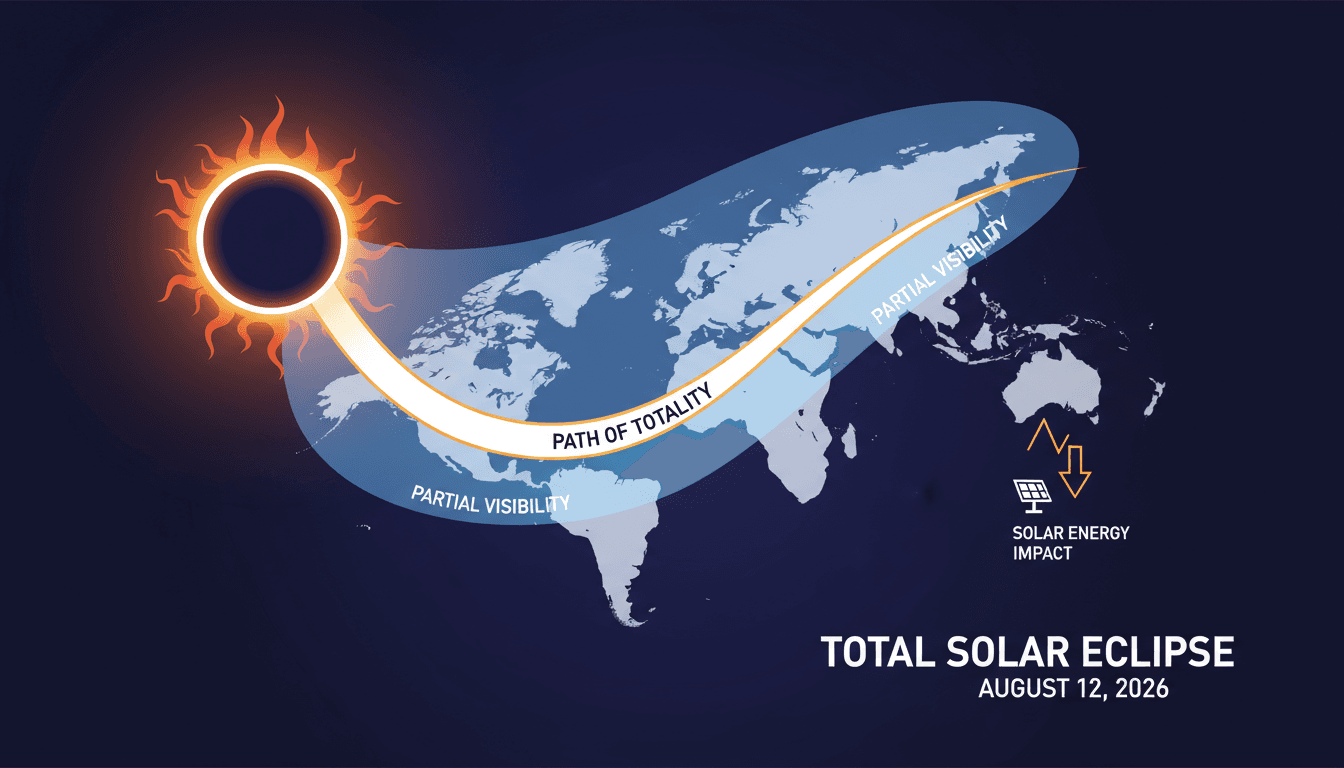
Here's what it means for you.
The total solar eclipse on August 12, 2026, presents a unique opportunity for public engagement with astronomy. As millions prepare to witness this celestial event, educational initiatives may rise, fostering a deeper understanding of solar phenomena. Additionally, the eclipse's potential impact on solar energy generation could prompt discussions on energy management during such occurrences. This event is not just a spectacle; it serves as a reminder of the intricate relationship between natural events and human activities. As interest grows, stakeholders in education and energy sectors may find new avenues for collaboration.
What happened
A rare total solar eclipse is set to occur on August 12, 2026, crossing parts of Europe and the Arctic. This celestial event will cause day to briefly turn to night in northern Spain, where totality will be visible. Meanwhile, millions across Europe, Canada, and the northern United States will experience a partial eclipse, making this a significant astronomical occasion.
The eclipse is expected to last only a few minutes in totality, but its effects will be felt across a wide geographic area. As the moon obscures the sun, observers will witness a dramatic transformation in the sky, enhancing the experience for those in the path of totality.
The Context
The total solar eclipse will be a remarkable event for northern Spain, where the phenomenon will be fully visible. This occurrence is significant not only for astronomy enthusiasts but also for the general public, as millions will have the chance to observe a partial eclipse. The timing of the eclipse aligns with a growing interest in solar phenomena, which may lead to increased educational programs and public engagement.
Moreover, the eclipse's potential impact on solar energy generation in affected regions highlights its practical implications. As solar panels may experience reduced efficiency during the eclipse, energy stakeholders will need to consider strategies for managing energy production during this time.
Takeaway
As the date approaches, public interest in the total solar eclipse is expected to grow, potentially leading to increased educational initiatives surrounding astronomy. This event offers a unique opportunity for communities to engage with science and explore the wonders of the universe.
The eclipse may also prompt discussions about solar energy production and its vulnerabilities during such astronomical events. Observers and stakeholders alike should prepare for a surge in interest and participation as the eclipse draws near.
Global news coverage with extensive reporting on Middle Eastern conflicts and geopolitics.
"Al Jazeera is a Qatar-based broadcaster known for wide regional coverage and alternative perspectives."
— A47 Editor
Rare solar eclipse to sweep across Europe and the Arctic
A rare total solar eclipse is set to occur on August 12, 2026, sweeping across Europe and the Arctic, with the Moon completely obscuring the Sun. This astronomical event will create a brief period of darkness, particularly noticeable in northern Spai...
Comprehensive coverage of Middle Eastern and global issues.
"Al Jazeera is a prominent voice from the Global South, especially the Middle East, with an emphasis on underreported stories."
— A47 Editor
Rare solar eclipse to sweep across Europe and the Arctic
A rare total solar eclipse is set to occur on August 12, 2026, sweeping across Europe and the Arctic, with the Moon completely obscuring the Sun. This astronomical event will create a brief period of darkness, particularly noticeable in northern Spai...
UAE-based English-language newspaper covering regional politics, economics, and global affairs.
"The National reflects Emirati policy perspectives while maintaining international editorial standards."
— A47 Editor
Rare total eclipse set to block solar generation across parts of Europe
A rare total solar eclipse is set to occur on August 12, 2026, sweeping across parts of Europe, including northern Spain, Iceland, and Britain, where the Moon will completely obscure the Sun, creating a brief period of darkness. This astronomical eve...
24/7 international news from a French perspective in multiple languages.
"France 24 is viewed as a globally focused outlet with balanced coverage and a European perspective."
— A47 Editor
Rare total solar eclipse to cross Europe
A rare total solar eclipse is set to occur on August 12, 2026, when the Moon will completely obscure the Sun, creating a brief period of darkness across northern Spain and a partial eclipse visible across Europe, Canada, the northern United States, a...