
Nepal Faces Humanitarian Crisis After Catastrophic Glacial Collapse Floods
Here's what it means for you.
The catastrophic floods in Nepal highlight the urgent need for global climate action, impacting water security and international cooperation.
Why it matters
The Himalayan glaciers are critical water sources for nearly two billion people, and their instability poses risks to ecosystems and economies worldwide.
What happened (in 30 seconds)
- On August 26, 2026, a glacial collapse near the Nepal-China border triggered devastating flash floods, killing hundreds and leaving thousands missing.
- Nepal's Foreign Minister Shisir Khanal warned of escalating climate threats, urging global cooperation to address the crisis.
- China provided crucial support, including satellite imagery and hydrological data, to aid in rescue efforts and enhance data sharing.
The context you actually need
- Himalayan glaciers are melting at accelerated rates due to global warming, increasing the risk of glacial lake outburst floods and landslides.
- Nepal contributes only 0.01% of global greenhouse gas emissions but faces disproportionate climate vulnerability as a landlocked nation.
- Previous climate-related disasters in the region have raised concerns about ecosystem instability and the need for international collaboration.
What's really happening
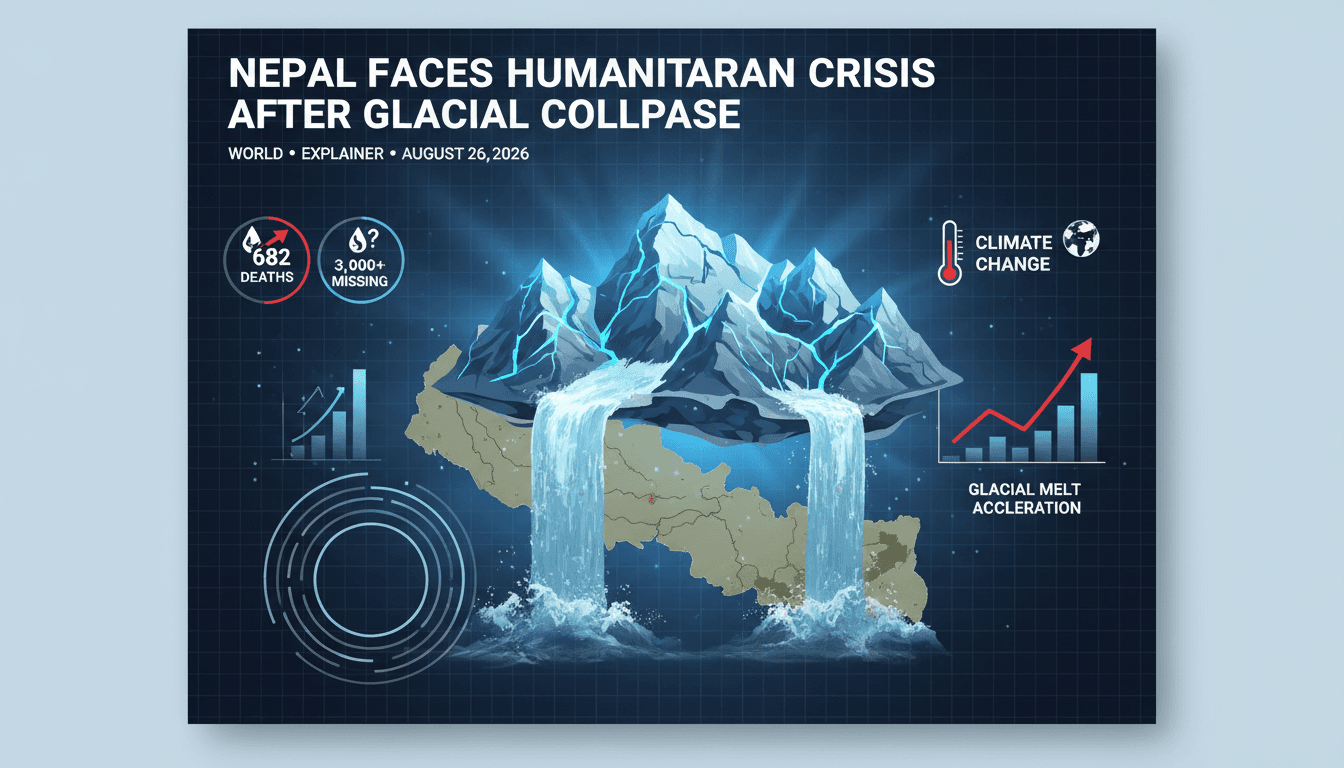
On August 26, 2026, a significant section of a glacier near the Nepal-China border collapsed, generating a seismic signal that was initially mistaken for an earthquake. This event unleashed a torrent of ice, rock, and sediment into nearby rivers, leading to catastrophic flash floods that devastated communities and infrastructure. The floods particularly affected high-altitude regions, including Nepal's Nuwakot district and adjacent Tibetan areas, where the impact was felt most acutely.
By August 29, the confirmed death toll had reached approximately 682, with nearly 3,000 individuals reported missing, including foreign nationals and workers. The scale of the disaster prompted Nepal's Foreign Minister Shisir Khanal to publicly address the escalating climate risks following discussions with Chinese Foreign Minister Wang Yi. China committed to providing satellite data and early warnings regarding barrier lakes, which are critical for preventing further flooding.
The ongoing rescue and recovery operations are complicated by fears of secondary flooding from newly formed lakes, which could exacerbate the situation. Local authorities are coordinating with international partners to manage the crisis, but the long-term implications for Nepal's infrastructure, particularly its hydropower projects, raise significant economic concerns.
Nepal's government has emphasized the need for enhanced research on Himalayan dynamics and international support for ecosystem preservation. Despite contributing minimally to global emissions, Nepal is facing the brunt of climate change impacts, highlighting the urgent need for global action. The event serves as a stark reminder of the interconnectedness of climate systems and the necessity for collaborative efforts to mitigate risks.
Who feels it first (and how)
- Local communities in Nepal and Tibet, facing immediate threats to safety and livelihoods.
- International aid organizations mobilizing resources for rescue and recovery efforts.
- Hydropower sector stakeholders concerned about infrastructure damage and economic viability.
- Global climate policy advocates pushing for stronger international cooperation on climate action.
What to watch next
- Rescue and recovery operations: Monitoring the effectiveness and speed of ongoing efforts will indicate the immediate humanitarian response's success.
- International climate agreements: Watch for potential shifts in global climate policy discussions, particularly regarding Himalayan ecosystem preservation.
- Hydropower project assessments: Evaluating the damage to infrastructure will provide insights into long-term economic impacts and energy security in the region.
The confirmed death toll stands at approximately 682, with nearly 3,000 missing.
Increased international collaboration on climate data sharing and disaster preparedness in the region.
The full extent of long-term economic impacts on Nepal's hydropower sector and local communities.
Frequently Asked Questions
- Why it matters?
- The Himalayan glaciers are critical water sources for nearly two billion people, and their instability poses risks to ecosystems and economies worldwide.
- What happened (in 30 seconds)?
- On August 26, 2026, a glacial collapse near the Nepal-China border triggered devastating flash floods, killing hundreds and leaving thousands missing. Nepal's Foreign Minister Shisir Khanal warned of escalating climate threats, urging global cooperation to address the crisis. China provided crucial support, including satellite imagery and hydrological data, to aid in rescue efforts and enhance data sharing.
- What's really happening?
- On August 26, 2026, a significant section of a glacier near the Nepal-China border collapsed, generating a seismic signal that was initially mistaken for an earthquake. This event unleashed a torrent of ice, rock, and sediment into nearby rivers, leading to catastrophic flash floods that devastated communities and infrastructure. The floods particularly affected high-altitude regions, including Nepal's Nuwakot district and adjacent Tibetan areas, where the impact was felt most acutely. By Augus
- Who feels it first (and how)?
- Local communities in Nepal and Tibet, facing immediate threats to safety and livelihoods. International aid organizations mobilizing resources for rescue and recovery efforts. Hydropower sector stakeholders concerned about infrastructure damage and economic viability. Global climate policy advocates pushing for stronger international cooperation on climate action.
- What to watch next?
- Rescue and recovery operations: Monitoring the effectiveness and speed of ongoing efforts will indicate the immediate humanitarian response's success. International climate agreements: Watch for potential shifts in global climate policy discussions, particularly regarding Himalayan ecosystem preservation. Hydropower project assessments: Evaluating the damage to infrastructure will provide insights into long-term economic impacts and energy security in the region.
Regional and international reporting focused on Middle Eastern politics, diplomacy, and economics.
"Asharq Al-Awsat is a Saudi-owned international newspaper reflecting mainstream Gulf political perspectives."
— A47 Editor
Nepal Warns of Climate Threat After Deadly Floods
Catastrophic floods along the Nepal-Tibet border have resulted in a rising death toll, with at least 626 confirmed deaths and over 2,426 individuals reported missing. Triggered by a significant collapse of mud and rock into a river, the disaster has ...
UAE-based English-language newspaper covering regional politics, economics, and global affairs.
"The National reflects Emirati policy perspectives while maintaining international editorial standards."
— A47 Editor
Nepal-Tibet floods add to the world's growing natural disaster economic bill
Catastrophic floods along the Nepal-Tibet border have resulted in a rising death toll, surpassing 500, with over 1,500 individuals reported missing. Triggered by a significant collapse of mud and rock into a river, the disaster has led to widespread ...
UAE-based English-language newspaper covering regional politics, economics, and global affairs.
"The National reflects Emirati policy perspectives while maintaining international editorial standards."
— A47 Editor
Nepali group in UAE expresses sorrow at loss of life from devastating flood
A Nepali group in the UAE has expressed deep sorrow over the tragic loss of life caused by devastating floods along the Nepal-Tibet border, which have resulted in over 160 confirmed deaths and many missing. The floods have significantly impacted the ...