
BRICS Summit in New Delhi Marks Shift to Practical Cooperation Mechanisms
Why it matters
This shift signifies a growing influence of emerging economies in global trade, potentially reshaping market dynamics.
What happened (in 30 seconds)
- The 18th BRICS Summit took place in New Delhi on September 12-13, 2026, marking a pivotal change in the group's focus.
- The New Delhi Declaration was adopted, emphasizing national currency settlements and supply chain resilience.
- China will assume the presidency in 2027, indicating a continued commitment to enhancing cooperation among member states.
The context you actually need
- BRICS expanded to 11 members in 2024, including Egypt, Ethiopia, Iran, and the UAE, reflecting a broader coalition of emerging economies.
- Previous summits focused on symbolic calls for multipolarity, but geopolitical pressures have driven a need for practical solutions.
- Internal divergences among members have prompted a shift towards cooperation in finance and logistics, particularly in response to sanctions and trade restrictions.
What's really happening
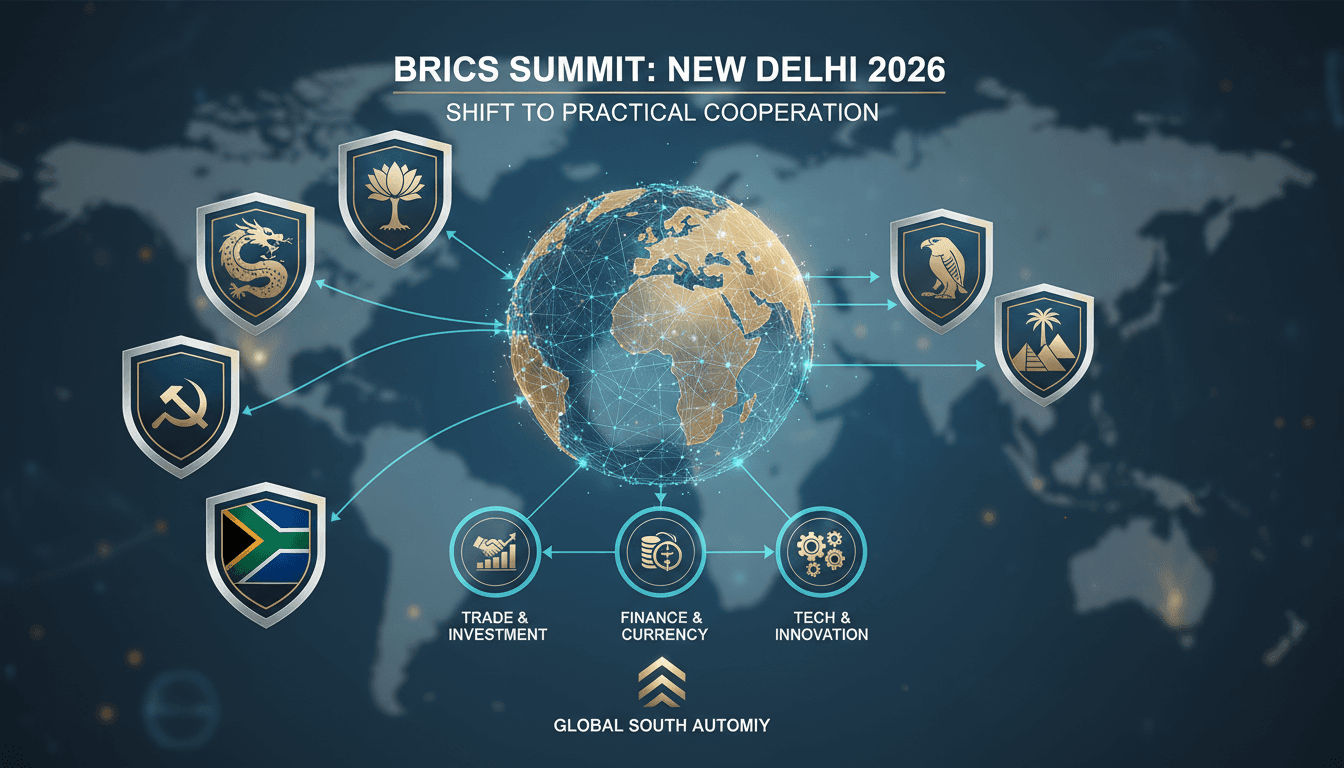
The 2026 BRICS Summit in New Delhi marked a significant transition from a symbolic forum to a practical cooperation mechanism among emerging economies. The adoption of the New Delhi Declaration reflects a collective desire to enhance strategic autonomy in the face of shifting global dynamics. With the bloc now comprising 11 members, including major players like India, China, and Russia, the focus has shifted towards actionable initiatives in trade, finance, and technology.
During the summit, leaders engaged in bilateral discussions, notably between Indian Prime Minister Narendra Modi and Russian President Vladimir Putin, who set ambitious trade targets of $100 billion by 2030. This target underscores the bloc's commitment to fostering economic ties and reducing reliance on traditional Western financial systems. The emphasis on national currency settlements and payment system interoperability is particularly noteworthy, as it indicates a move away from dollar dominance in international trade.
The summit also addressed the International North-South Transport Corridor and initiatives from the New Development Bank, which aim to facilitate infrastructure development and enhance connectivity among member states. These initiatives are crucial for improving supply chain resilience, especially in light of recent global disruptions.
Despite internal differences, leaders reached a consensus on various issues, including cooperation in artificial intelligence and health surveillance. Xi Jinping's proposals for open-source AI and trade facilitation highlight the bloc's intent to leverage technology for economic growth. The establishment of a BRICS Continuity and Implementation Mechanism aims to ensure that the commitments made during the summit are tracked and realized, signaling a shift towards accountability and follow-through.
This transition is not just about enhancing cooperation among BRICS members; it also reflects a broader trend of emerging economies seeking to assert their influence on the global stage. As these countries collaborate more closely, they may create alternative frameworks for trade and finance that challenge existing power structures.
Who feels it first (and how)
- Businesses in emerging markets: They may find new opportunities for trade and investment as BRICS enhances economic ties.
- Logistics and transport sectors: Increased focus on supply chain resilience could lead to new infrastructure projects and partnerships.
- Financial institutions: Banks and financial services may need to adapt to new payment systems and currency settlements.
What to watch next
- Implementation of the New Delhi Declaration: Monitoring how quickly and effectively the proposed mechanisms are put into practice will be crucial for assessing the bloc's impact.
- Trade volume growth among BRICS members: Tracking the progress towards the $100 billion trade target will indicate the success of bilateral agreements.
- Geopolitical responses from Western nations: Observing how Western countries react to BRICS' growing influence will provide insights into potential shifts in global power dynamics.
The BRICS bloc has expanded to 11 members, reflecting a coalition of emerging economies.
There will be increased cooperation in trade and finance among BRICS members, leading to new economic opportunities.
The long-term effectiveness of the New Delhi Declaration and its impact on global trade dynamics remains to be seen.
Frequently Asked Questions
- Why it matters?
- This shift signifies a growing influence of emerging economies in global trade, potentially reshaping market dynamics.
- What happened (in 30 seconds)?
- The 18th BRICS Summit took place in New Delhi on September 12-13, 2026, marking a pivotal change in the group's focus. The New Delhi Declaration was adopted, emphasizing national currency settlements and supply chain resilience. China will assume the presidency in 2027, indicating a continued commitment to enhancing cooperation among member states.
- What's really happening?
- The 2026 BRICS Summit in New Delhi marked a significant transition from a symbolic forum to a practical cooperation mechanism among emerging economies. The adoption of the New Delhi Declaration reflects a collective desire to enhance strategic autonomy in the face of shifting global dynamics. With the bloc now comprising 11 members, including major players like India, China, and Russia, the focus has shifted towards actionable initiatives in trade, finance, and technology. During the summit, le
- Who feels it first (and how)?
- Businesses in emerging markets: They may find new opportunities for trade and investment as BRICS enhances economic ties. Logistics and transport sectors: Increased focus on supply chain resilience could lead to new infrastructure projects and partnerships. Financial institutions: Banks and financial services may need to adapt to new payment systems and currency settlements.
- What to watch next?
- Implementation of the New Delhi Declaration: Monitoring how quickly and effectively the proposed mechanisms are put into practice will be crucial for assessing the bloc's impact. Trade volume growth among BRICS members: Tracking the progress towards the $100 billion trade target will indicate the success of bilateral agreements. Geopolitical responses from Western nations: Observing how Western countries react to BRICS' growing influence will provide insights into potential shifts in global powe
RT is a Russian state-funded network covering global events from a Russian perspective.
"RT is widely criticized for promoting pro-Kremlin narratives and is considered by many to be a state propaganda outlet."
— A47 Editor
BRICS is no longer just a slogan
The recent BRICS summit in New Delhi marked a significant shift from rhetoric to practical initiatives, focusing on enhancing trade, payment systems, and strategic autonomy among member nations. Leaders emphasized the importance of economic cooperati...
24/7 international news from a French perspective in multiple languages.
"France 24 is viewed as a globally focused outlet with balanced coverage and a European perspective."
— A47 Editor
BRICS summit: What came out of the New Delhi meeting
The BRICS summit held in New Delhi concluded with a joint declaration emphasizing the need for increased influence of the Global South in global governance and calling for restraint in the ongoing Middle East conflict. This gathering facilitated bila...
Regional coverage and analysis focused on politics, diplomacy, and business across the Middle East.
"Al-Monitor is known for analytical reporting on Middle East politics and policy developments."
— A47 Editor
China, Russia, India seek economic cooperation at BRICS
BRICS leaders, including China, Russia, and India, concluded their summit in New Delhi, focusing on economic cooperation and advocating for calm in the Middle East amid ongoing conflicts. Indian Prime Minister Narendra Modi emphasized the bloc's sign...
International stories from NPR’s global desk.
"NPR is an American public media organization known for thoughtful reporting and a slightly left-leaning editorial tone."
— A47 Editor
'BRICS' forum brings together emerging economies, aimed at countering western dominance
The 18th BRICS summit is currently taking place in New Delhi, India, where leaders from major emerging economies are convening to discuss strategies aimed at enhancing economic cooperation and countering Western dominance. This summit focuses on link...
24/7 international news from a French perspective in multiple languages.
"France 24 is viewed as a globally focused outlet with balanced coverage and a European perspective."
— A47 Editor
BRICS leaders meet in India as wars and US tensions test the bloc
Leaders of the BRICS nations convened in New Delhi for their 18th summit, focusing on trade, investment, and global conflicts, amidst rising tensions involving the U.S. and ongoing wars in the Middle East and Ukraine. The summit aims to enhance econo...