
UK Declines Membership in Canada-Led Defence Security and Resilience Bank and Pursues Separate Multilateral Mechanism
Why it matters
The divergence fragments allied sovereign debt strategies, turning a planned single institutional lender into parallel financing vehicles with competing governance, treasury terms, and national industrial priorities.
What happened (in 30 seconds)
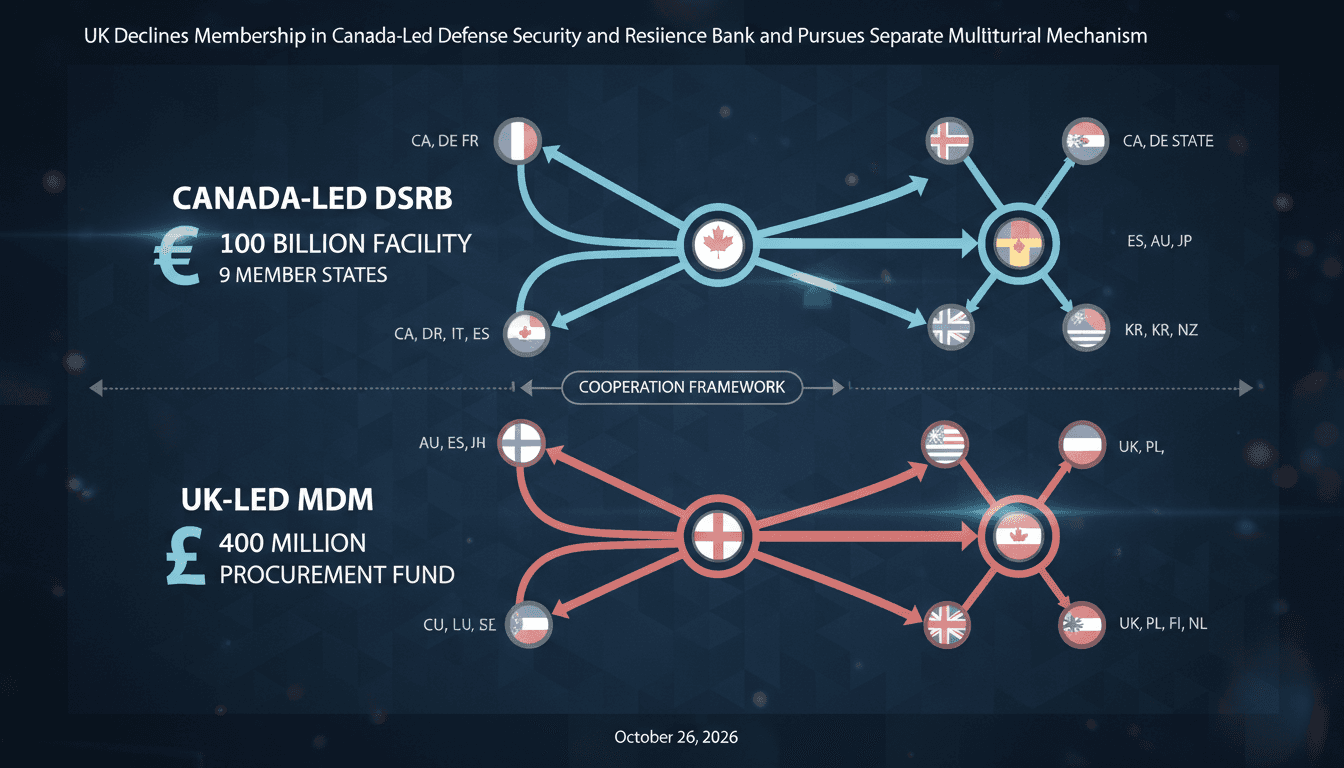
* Talks officially ended: The United Kingdom announced on October 26, 2026, that it will not join the Canada-led Defence, Security and Resilience Bank (DSRB), choosing instead to establish an inter-institution cooperation framework. * Structural negotiations collapsed: Bilateral talks between UK Prime Minister Andy Burnham and Canadian Prime Minister Mark Carney broke down over headquarters placement, lending rules, joint procurement quotas, and membership terms. * Dual tracks are advancing: Canada will proceed with nine founding members to sign the DSRB charter on November 30, 2026, in Luxembourg, while the UK scales its own Multilateral Defence Mechanism (MDM) backed by an initial £400 million commitment.
The context you actually need
* A post-2024 spending push: Canada originally proposed the DSRB in 2024 to pool sovereign credit, mobilize private capital, and supply low-cost loans to satisfy NATO capital expenditure targets following Russia's invasion of Ukraine. * Parallel UK industrial architecture: Instead of backing an external balance sheet, London developed the Multilateral Defence Mechanism (MDM) to retain direct control over joint procurement pipelines alongside regional partners including Poland, the Netherlands, and Finland. * Continental hesitation remains broad: The UK’s formal departure mirrors earlier institutional resistance across Europe, with Germany maintaining only observer status and France refusing to commit capital to the Canadian model.
What's really happening
The breakdown between London and Ottawa is not a diplomatic rift; it is an architectural clash over sovereign industrial control versus pooled balance-sheet efficiency.
Canada designed the DSRB to operate like an international financial institution, targeting an eventual €100 billion capital pool to issue low-cost loans for defence readiness. Under the leadership of Prime Minister Mark Carney and Finance Minister Francois-Philippe Champagne, Ottawa positioned the institution to attract private debt markets by distributing sovereign risk across NATO members. The headquarters would sit in Canada, supported by an operational hub in Luxembourg to serve European allies such as Belgium, Romania, Latvia, Albania, Turkey, and Ukraine.
However, sovereign financing mechanisms inherently distribute control over procurement. For the United Kingdom, Prime Minister Andy Burnham and Chancellor John Healey operated under domestic fiscal incentives that prioritize direct industrial policy. Entering the DSRB meant subordinating British capital to an independent board that dictates procurement standards, lending eligibility, and headquarters governance outside of London.
The UK’s counter-strategy—the Multilateral Defence Mechanism (MDM)—is built around equipment syndication rather than pure banking. By seeding the MDM with an initial £400 million, the UK preserves domestic supply-chain sovereignty while executing targeted joint purchases with key allies along Europe’s eastern and northern flanks, specifically Poland, Finland, and the Netherlands. Under this structure, UK-allocated funds directly serve contracts tied to preferred British and partner-state industrial bases, avoiding the shared credit risk and distributed procurement rules required by the DSRB charter.
This institutional split also highlights the limits of multilateral capital pooling in modern defence statecraft. When a bank controls procurement terms, smaller members like Albania or Latvia gain access to cheaper debt, but larger military producers risk underwriting projects that do not prioritize their domestic defense manufacturers. Because Germany remains an uncommitted observer and France remains disengaged, the DSRB loses the critical mass needed to establish a single standard for Western defence bonds.
The resulting compromise—a bilateral cooperation framework between the DSRB and the MDM—is a pragmatic mechanism to prevent open friction. Yet, it formally locks in institutional fragmentation. Instead of a consolidated global entity capable of issuing sovereign-backed security bonds at scale, private markets and procurement directors must now navigate two separate financing tracks with different underwriting criteria, divergent legal structures, and split geographic mandates.
Who feels it first (and how)
* European defence contractors: Bidders across the UK, Netherlands, Poland, and Finland must tailor contracting to MDM procurement guidelines, while suppliers in DSRB founding states like Belgium, Luxembourg, and Turkey will align projects with Luxembourg-based loan terms. * Sovereign debt syndicates and institutional investors: Asset managers targeting sovereign-backed security vehicles will see Canadian-led DSRB bond issuances proceed without British sovereign capital backing the underlying credit pool. * Procurement directors in Eastern European NATO members: States like Romania, Latvia, and Ukraine must manage two separate multilateral interfaces—accessing DSRB facilities for structural financing while tapping the UK's MDM for targeted operational procurement partnerships.
What to watch next
* The Luxembourg charter execution: The November 30, 2026, formal signing by Canada and its eight founding partners will establish the DSRB's initial paid-in capital and define the operational terms of its European hub. * UK budget allocations for the MDM: Subsequent financial statements from UK Chancellor John Healey will reveal whether London increases the MDM’s initial £400 million facility to match partner needs in Northern and Eastern Europe. * French and German posture indicators: Monitor whether Berlin ends its observer status or if Paris develops an independent EU-restricted financing vehicle, which would further segment the European defence-debt ecosystem.
The UK will not join the DSRB; Canada and nine founding member states will sign the DSRB charter in Luxembourg on November 30, 2026; the UK is backing its separate MDM with an initial £400 million commitment.
The DSRB will take longer to achieve its target €100 billion lending envelope without the direct balance-sheet contribution of major G7 defence spenders like the UK, Germany, and France.
The exact operational structure of the cooperation framework connecting the DSRB and MDM, and whether non-DSRB partners will be permitted to bid on contracts financed through DSRB loan facilities.
Frequently Asked Questions
- Why it matters?
- The divergence fragments allied sovereign debt strategies, turning a planned single institutional lender into parallel financing vehicles with competing governance, treasury terms, and national industrial priorities.
- What happened (in 30 seconds)?
- Talks officially ended: The United Kingdom announced on October 26, 2026, that it will not join the Canada-led Defence, Security and Resilience Bank (DSRB), choosing instead to establish an inter-institution cooperation framework. Structural negotiations collapsed: Bilateral talks between UK Prime Minister Andy Burnham and Canadian Prime Minister Mark Carney broke down over headquarters placement, lending rules, joint procurement quotas, and membership terms. Dual tracks are advancing: Canada wi
- What's really happening?
- The breakdown between London and Ottawa is not a diplomatic rift; it is an architectural clash over sovereign industrial control versus pooled balance-sheet efficiency. Canada designed the DSRB to operate like an international financial institution, targeting an eventual €100 billion capital pool to issue low-cost loans for defence readiness. Under the leadership of Prime Minister Mark Carney and Finance Minister Francois-Philippe Champagne, Ottawa positioned the institution to attract private
- Who feels it first (and how)?
- European defence contractors: Bidders across the UK, Netherlands, Poland, and Finland must tailor contracting to MDM procurement guidelines, while suppliers in DSRB founding states like Belgium, Luxembourg, and Turkey will align projects with Luxembourg-based loan terms. Sovereign debt syndicates and institutional investors: Asset managers targeting sovereign-backed security vehicles will see Canadian-led DSRB bond issuances proceed without British sovereign capital backing the underlying credit
- What to watch next?
- The Luxembourg charter execution: The November 30, 2026, formal signing by Canada and its eight founding partners will establish the DSRB's initial paid-in capital and define the operational terms of its European hub. UK budget allocations for the MDM: Subsequent financial statements from UK Chancellor John Healey will reveal whether London increases the MDM’s initial £400 million facility to match partner needs in Northern and Eastern Europe. French and German posture indicators: Monitor whethe
Macro commentary, policy analysis, growth/inflation themes, and global outlooks.
"Contextual macro coverage that complements day-to-day market headlines."
— A47 Editor
Britain will not join Canada-led defence bank initiative
Britain will not join Canada's proposed global defence bank, according to a source cited by Investing.com, a neutral development that follows earlier reports that UK officials had been in talks with Canada over the initiative, which is aimed at givin...
International coverage of politics, security, and social issues.
"Global News is a mainstream Canadian outlet with a centrist editorial stance, focusing on factual reporting."
— A47 Editor
U.K. won’t join Canada-led defence bank, but pledges cooperation
The United Kingdom has declined to join a defence bank led by Canada, but the two countries have pledged to "work in close partnership" on investment opportunities and challenges, according to a joint media statement.
Macro commentary, policy analysis, growth/inflation themes, and global outlooks.
"Contextual macro coverage that complements day-to-day market headlines."
— A47 Editor
Canada, UK to develop separate defense financing institutions
Canada and the United Kingdom have announced plans to develop separate defense financing institutions, according to a report published by Investing.com. The base coverage is brief and does not detail the structure, funding size, or timeline of either...
Macro commentary, policy analysis, growth/inflation themes, and global outlooks.
"Contextual macro coverage that complements day-to-day market headlines."
— A47 Editor
Britain will not join Canada’s defence bank, source says
Britain will not join Canada's proposed global defence bank, according to a source cited by Investing.com, marking a neutral development in the base story's account of the initiative. Earlier reporting indicated that UK officials had been in talks wi...