
Spanish High-Speed Rail Collision Near Urda Kills 69 as Signaling Failure and Erroneous Control Order Under Investigation
Why it matters
The failure of redundant rail controls across Europe’s most extensive high-speed network exposes systemic friction between legacy signaling systems and multi-operator route capacity.
What happened (in 30 seconds)
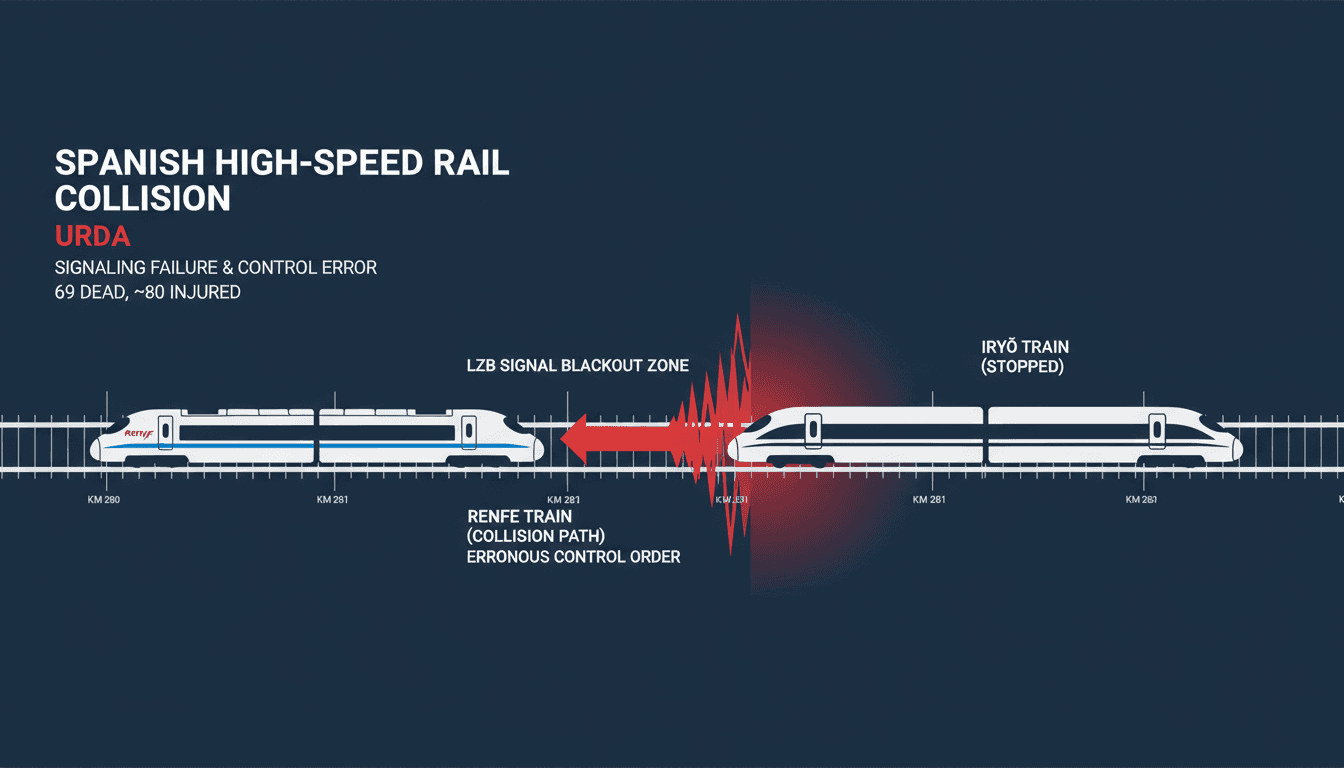
- A fatal collision occurred near Urda: Shortly after 9:00 a.m. on October 28, 2026, a Renfe-operated train carrying 397 passengers rear-ended a stationary Iryo service carrying 147 passengers on the Madrid-Seville high-speed line.
- Casualties climbed rapidly: The crash resulted in at least 69 confirmed fatalities and approximately 80 injuries, sending two Iryo carriages down an embankment.
- A control override compound: Investigators point to a computer failure in the LZB signaling system, which brought multiple trains to a standstill, followed by an operational order authorizing the trailing train to advance at normal speed.
The context you actually need
- This is the corridor’s second major failure this year: In January 2026, a separate collision on the exact same Madrid-Seville line claimed 46 lives, involving the same pair of public and private operators.
- Network density stresses legacy safeguards: Spain operates Europe’s most extensive high-speed rail footprint, balancing high-frequency departures across liberalized lines where state-owned Renfe and private operator Iryo share physical tracks.
- Labor mobilization has already begun: Train drivers launched strike actions immediately following the incident to demand immediate capital allocations for infrastructure maintenance and modernized traffic-control safety layers.
What's really happening
The incident near Urda illustrates the mechanical and organizational limits of legacy rail safety architecture under modern capacity pressures. At the heart of the collision is the LZB (Linienzugbeeinflussung) signaling system—a continuous transmission track-to-train supervision mechanism designed to enforce automated braking distances. When a systemic computer malfunction incapacitated the LZB network on the Madrid-Seville corridor, it established an immediate fail-safe state: halting rail traffic, including the stationary Iryo service.
The critical breakdown occurred in the procedural protocol deployed to resolve that automated halt. With automated signaling dark, control center operators transitioned to manual dispatch procedures. Personnel issued an explicit clearance allowing the approaching Renfe train to proceed down the sector at standard operating velocity, overriding the spatial separation protocols that prevent two convoys from occupying a single block section. Moving at speed into an occupied section, the Renfe train struck the rear of the stationary Iryo train, displacing two passenger carriages down an embankment.
This collision highlights an operational vulnerability common to shared, liberalized rail corridors across Europe. European infrastructure guidelines encourage open-access competition, mixing state incumbents like Renfe with private entrants like Iryo on identical physical lines. This commercial structure maximizes track occupancy and passenger density. However, when automated signaling fails, human dispatch systems must manage high-frequency corridors without the software barriers designed to prevent track conflict.
The structural impact extends into labor agreements and capital expenditure allocations. With 69 fatalities and 80 injuries, rail unions have initiated strikes, withdrawing labor to force infrastructure managers to accelerate spending on baseline signaling redundancies rather than capacity expansions. These union walkouts introduce structural friction to regional movement, grounding business travel and shifting corporate logistics onto motorways and regional air networks just weeks before Spain's November 29 national elections.
Who feels it first (and how)
- European corporate travelers: Professionals commuting between Madrid, Seville, and secondary business hubs face corridor shutdowns, mandatory transfers to slower regional lines, and ongoing strike-related cancellations.
- Multi-national logistics and fleet planners: Supply chain coordinators who route intermediate freight or personnel across central Spain face immediate surface-transport bottlenecks and elevated ground transport premiums.
- Cross-border rail operators: Private and state-backed transport consortia across France, Italy, and Germany face accelerated regulatory compliance checks and costly protocol updates for mixed-operator corridor access.
- Foreign diplomatic and consular offices: With 42 foreign nationals from seven countries involved in the Urda collision, consular desks are processing complex cross-border family support and forensic identification requirements.
What to watch next
- European rail regulatory audits: Watch whether the European Union Agency for Railways mandates emergency reviews of LZB manual override protocols across all mixed-operator high-speed lines.
- Infrastructure capital reallocation: Monitor whether the Transport Ministry formally diverts network expansion budgets into immediate signaling upgrades and digital interlocking overhauls.
- Driver union strike extensions: Track labor negotiation deadlines between rail operator management and driver syndicates, which will signal the duration of travel disruptions through the November 29 election window.
At least 69 people died and approximately 80 were injured when a Renfe train struck a stationary Iryo train near Urda on October 28, following an LZB signaling failure and an instruction to advance at normal speed.
The combination of trade union strikes and heightened safety inspections will suppress capacity on Spain’s high-speed rail lines through the remainder of the quarter.
Whether investigators will identify a software defect within the central LZB server architecture or determine that the disaster was entirely caused by manual dispatch error during fail-safe recovery.
Frequently Asked Questions
- Why it matters?
- The failure of redundant rail controls across Europe’s most extensive high-speed network exposes systemic friction between legacy signaling systems and multi-operator route capacity.
- What happened (in 30 seconds)?
- A fatal collision occurred near Urda: Shortly after 9:00 a.m. on October 28, 2026, a Renfe-operated train carrying 397 passengers rear-ended a stationary Iryo service carrying 147 passengers on the Madrid-Seville high-speed line. Casualties climbed rapidly: The crash resulted in at least 69 confirmed fatalities and approximately 80 injuries, sending two Iryo carriages down an embankment. A control override compound: Investigators point to a computer failure in the LZB signaling system, which bro
- What's really happening?
- The incident near Urda illustrates the mechanical and organizational limits of legacy rail safety architecture under modern capacity pressures. At the heart of the collision is the LZB (Linienzugbeeinflussung) signaling system—a continuous transmission track-to-train supervision mechanism designed to enforce automated braking distances. When a systemic computer malfunction incapacitated the LZB network on the Madrid-Seville corridor, it established an immediate fail-safe state: halting rail traf
- Who feels it first (and how)?
- European corporate travelers: Professionals commuting between Madrid, Seville, and secondary business hubs face corridor shutdowns, mandatory transfers to slower regional lines, and ongoing strike-related cancellations. Multi-national logistics and fleet planners: Supply chain coordinators who route intermediate freight or personnel across central Spain face immediate surface-transport bottlenecks and elevated ground transport premiums. Cross-border rail operators: Private and state-backed trans
- What to watch next?
- European rail regulatory audits: Watch whether the European Union Agency for Railways mandates emergency reviews of LZB manual override protocols across all mixed-operator high-speed lines. Infrastructure capital reallocation: Monitor whether the Transport Ministry formally diverts network expansion budgets into immediate signaling upgrades and digital interlocking overhauls. Driver union strike extensions: Track labor negotiation deadlines between rail operator management and driver syndicates,
European current affairs, EU politics, and regional developments.
"France 24 is viewed as a globally focused outlet with balanced coverage and a European perspective."
— A47 Editor
Spain working to identify train crash dead as relatives' anguish grows
Spain entered three days of mourning after a high-speed train operated by Renfe collided with the rear of a stopped Iryo train on the Madrid-Seville line near Urda in Toledo province, killing at least 68 to 69 people and injuring more than 100, with ...
International coverage of politics, culture, and current affairs.
"BBC News is widely regarded as a reputable international news organization, known for its impartial tone and public service mandate."
— A47 Editor
Spain transport minister says he won't resign over high-speed rail disaster
Spanish Transport Minister Óscar Puente has faced calls to resign after a high-speed train collision on the Madrid-Seville line near Urda in Toledo province on Wednesday, October 28, 2026, in which a Renfe train struck the rear of a stationary Iryo t...
European current affairs, EU politics, and regional developments.
"France 24 is viewed as a globally focused outlet with balanced coverage and a European perspective."
— A47 Editor
Spanish transport minister faces calls to quit after deadly train crash
Spanish Transport Minister Oscar Puente faced calls to resign on Friday but ruled out stepping down, following Wednesday's high-speed train collision in Toledo province that killed 69 people and injured around 100. A Renfe train struck the rear of a ...
News and current affairs from across Europe.
"The Guardian is known for its progressive editorial stance and in-depth analysis."
— A47 Editor
Spain’s trust in high-speed rail ‘broken’ after second deadly crash this year, says PM
On Wednesday, October 28, 2026, a high-speed train operated by Renfe struck the rear of a stationary Iryo train on the Madrid-Seville line near Urda in Toledo province after a signalling failure had halted both services, killing at least 68 to 69 peo...
Comprehensive coverage of Middle Eastern and global issues.
"Al Jazeera is a prominent voice from the Global South, especially the Middle East, with an emphasis on underreported stories."
— A47 Editor
Spain’s deadly train crash redraws electoral battle lines
Spain entered three days of mourning after a high-speed Renfe train struck the rear of a stopped Iryo train on the Madrid-Seville line near Urda in Toledo province on Wednesday, October 28, 2026, derailing several carriages. Reports indicate at least...