
Qatari Mediators Return to Tehran as US-Iran De-escalation Talks Stall Over Nuclear Sequencing
Why it matters
The sequencing of sanctions relief versus nuclear monitoring directly governs maritime throughput in the Strait of Hormuz, dictating baseline insurance premiums and trade continuity across regional logistics hubs.
What happened (in 30 seconds)
- Mediators returned to Tehran: Qatari envoys arrived in Iran on October 30, 2026, launching a second phase of coordinated diplomacy after Tehran rejected an initial draft peace framework presented on October 26.
- Direct channels engaged: Washington communicated terms coordinated via Vice President JD Vance and presidential directives, while Iranian officials reviewed an outreach framework ostensibly linked to medical supplies amid broader security negotiations.
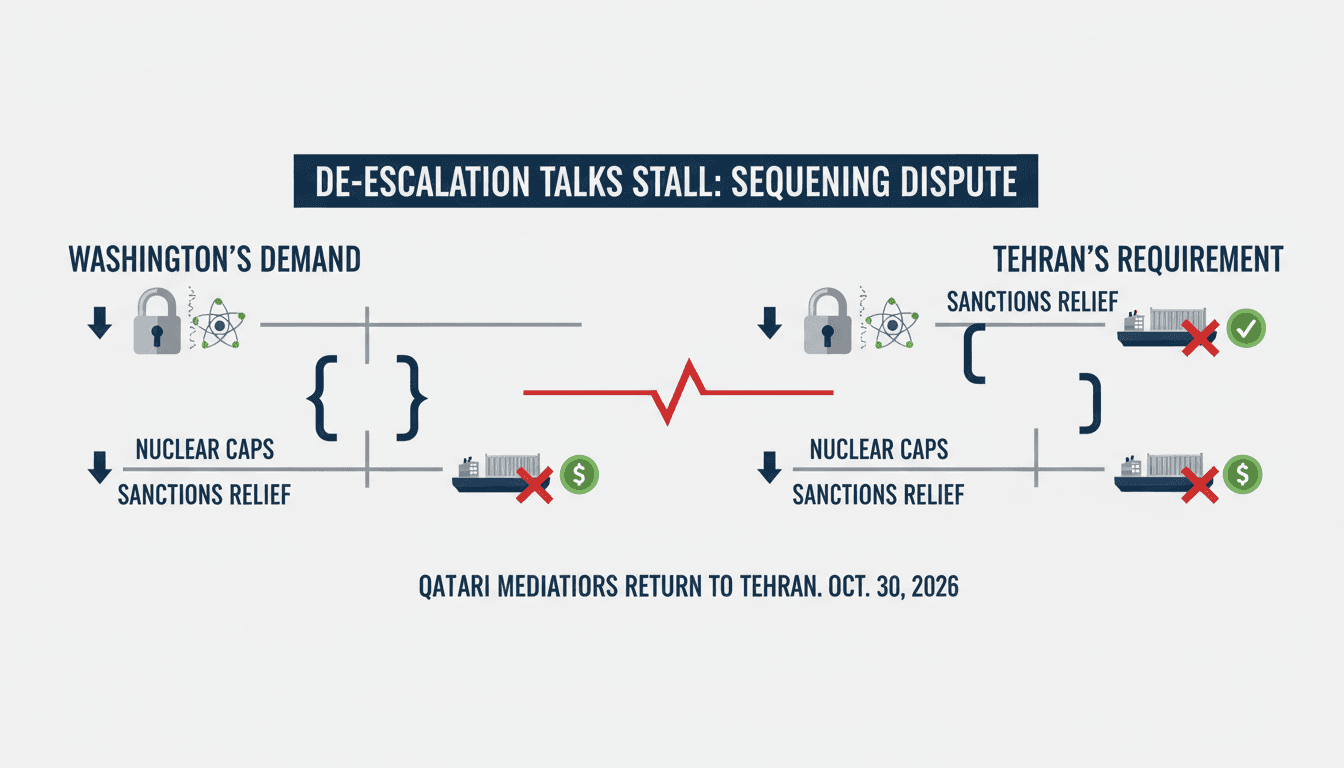
- Sequencing demands stalled progress: Iranian leadership, including Mohsen Rezaei, reiterated seven mandatory conditions, demanding immediate relief from port blockades and oil export sanctions before addressing core nuclear parameters.
The context you actually need
- An ongoing eight-month confrontation: The diplomatic shuttle follows eight months of active friction featuring naval port blockades, strict energy sanctions, and reciprocal threats of force along critical waterways.
- The 440 kg enrichment benchmark: Central to US calculations is Iran's reported stockpile of 440 kilograms of highly enriched uranium, a material threshold that Washington insists must be factored into any preliminary settlement.
- The UN proposal benchmark: Negotiations build on a prior Iranian diplomatic maneuver at the UN General Assembly that pitched an initial seven-day ceasefire to freeze hostilities.
What's really happening
The core friction in Tehran is an irreconcilable difference in tactical sequencing. Washington's strategy seeks to bundle maritime de-escalation, port access, and uranium enrichment limitations into a single comprehensive baseline. Tehran’s counter-strategy focuses entirely on sequential decoupling: demanding an immediate lifting of energy sanctions and the dissolution of maritime port blockades prior to discussing technical limits on its nuclear program.
Iran’s leverage rests heavily on regional logistics. After eight months of conflict, the threat of sustained friction along the Strait of Hormuz operates as an economic pressure point. By putting forward a seven-day ceasefire proposal alongside seven non-negotiable demands, Iranian negotiators aim to neutralize operational isolation while keeping their nuclear assets intact. The 440-kilogram stockpile of highly enriched uranium serves as their primary bargaining chip; trading it away or freezing it without prior, tangible economic guarantees would deplete their diplomatic leverage.
For the United States, allowing economic relief before establishing nuclear boundaries presents a strategic risk. The White House has maintained military options while framing official communications as pathways for humanitarian and medical supply delivery. This posture reflects a deliberate effort to manage domestic expectations while keeping diplomatic channels viable via Doha. Washington’s engagement through Vice President JD Vance demonstrates a coordinated administrative line, yet the refusal to lift maritime pressure prematurely highlights an awareness that port blockades are the principal mechanism forcing Tehran to negotiate.
Qatar’s role is purely mechanical. By shuttling modified drafts within a four-day window between October 26 and October 30, Doha is attempting to identify terms that bridge Washington's demand for early nuclear constraints with Tehran's demand for economic relief. However, Iranian officials, including parliament speaker Mohammad Bagher Ghalibaf and foreign minister Abbas Araqchi, have rejected traditional incentive-based diplomacy, describing standard conditional proposals as unacceptable.
This standoff affects the operational environment of regional trade centers like Dubai. The real tension is not whether both sides want to avoid open conflict, but who absorbs the economic cost while talks drag on. As long as port blockades and oil export controls remain active leverage tools, commercial supply chains through the Gulf will continue operating under baseline risk pricing.
Who feels it first (and how)
- Commercial maritime operators: Fleet managers navigating the Strait of Hormuz face persistent war-risk insurance premiums as long as port blockades and military enforcement actions remain active.
- Regional logistics firms in Dubai: Supply chain directors must manage fluctuating transit timelines and fuel surcharge adjustments linked to persistent friction across nearby waterways.
- Energy trading desks: Commodity analysts tracking physical crude volumes must factor in the potential return—or prolonged restriction—of Iranian barrels subject to ongoing export sanctions.
- Industrial import/export businesses: Gulf-based manufacturing and retail operations relying on timely ocean freight face continued exposure to sudden schedule alterations.
What to watch next
- Response to the Vance channel: Whether Iranian leadership issues an official counter-proposal to the communication delivered by the US Vice President will signal whether technical negotiations can proceed.
- Status of the seven-day ceasefire proposal: Any formal implementation of Tehran’s temporary pause framework will offer immediate clarity on whether naval operations at regional ports are easing.
- Post-midterm diplomatic shifts: Statements from Washington following the US midterm cycle will clarify whether current military contingencies transition into intensified enforcement or sustained mediation.
Qatari mediators held talks in Tehran on October 30, 2026, following the rejection of an October 26 peace plan; Iran possesses 440 kg of highly enriched uranium; Washington communicated terms via Vice President JD Vance.
Neither side will accept a full settlement without measurable concessions on either the lifting of naval blockades or verifiable nuclear inventory commitments.
Whether Iran’s leadership will modify its seven demands to permit parallel discussions on sanctions relief and nuclear monitoring before active hostilities escalate.
Frequently Asked Questions
- Why it matters?
- The sequencing of sanctions relief versus nuclear monitoring directly governs maritime throughput in the Strait of Hormuz, dictating baseline insurance premiums and trade continuity across regional logistics hubs.
- What happened (in 30 seconds)?
- Mediators returned to Tehran: Qatari envoys arrived in Iran on October 30, 2026, launching a second phase of coordinated diplomacy after Tehran rejected an initial draft peace framework presented on October 26. Direct channels engaged: Washington communicated terms coordinated via Vice President JD Vance and presidential directives, while Iranian officials reviewed an outreach framework ostensibly linked to medical supplies amid broader security negotiations. Sequencing demands stalled progress:
- What's really happening?
- The core friction in Tehran is an irreconcilable difference in tactical sequencing. Washington's strategy seeks to bundle maritime de-escalation, port access, and uranium enrichment limitations into a single comprehensive baseline. Tehran’s counter-strategy focuses entirely on sequential decoupling: demanding an immediate lifting of energy sanctions and the dissolution of maritime port blockades prior to discussing technical limits on its nuclear program. Iran’s leverage rests heavily on region
- Who feels it first (and how)?
- Commercial maritime operators: Fleet managers navigating the Strait of Hormuz face persistent war-risk insurance premiums as long as port blockades and military enforcement actions remain active. Regional logistics firms in Dubai: Supply chain directors must manage fluctuating transit timelines and fuel surcharge adjustments linked to persistent friction across nearby waterways. Energy trading desks: Commodity analysts tracking physical crude volumes must factor in the potential return—or prolon
- What to watch next?
- Response to the Vance channel: Whether Iranian leadership issues an official counter-proposal to the communication delivered by the US Vice President will signal whether technical negotiations can proceed. Status of the seven-day ceasefire proposal: Any formal implementation of Tehran’s temporary pause framework will offer immediate clarity on whether naval operations at regional ports are easing. Post-midterm diplomatic shifts: Statements from Washington following the US midterm cycle will clar
Jordanian news and regional updates.
"Roya News is a Jordanian outlet focused on breaking news and local affairs."
— A47 Editor
رويترز: الوسطاء القطريون يعودون إلى إيران الجمعة في إطار مساعي التوصل إلى اتفاق بين واشنطن وطهران
Qatari mediators are set to return to Iran on Friday as part of efforts to reach an agreement between Washington and Tehran, according to a Reuters report carried by Royanews, which cites comments from Iranian official Qalibaf stressing that Iran has...
Arabic-language coverage of political affairs and current events.
"Okaz political coverage typically follows mainstream Saudi framing on national and regional affairs."
— A47 Editor
مساع قطرية جديدة لعودة الحوار بين واشنطن وطهران
Qatari mediators have returned to Tehran in renewed diplomatic efforts to reach an agreement between the United States and Iran, according to a source familiar with the negotiations speaking to Reuters. The mediation is reportedly being coordinated w...
Arabic-language coverage of international news and geopolitics.
"RT Arabic is a Russian state-funded outlet often criticized for promoting Kremlin-aligned narratives."
— A47 Editor
رويترز: عودة الوسطاء القطريين إلى إيران لاستئناف مفاوضات واشنطن وطهران
Reuters reported, citing a informed official, that Qatari mediators have returned to Tehran as part of efforts to reach an agreement between the United States and Iran, with the move aimed at resuming negotiations between Washington and Tehran.