
COP31 Leaders Summit Exposes Divergent National Priorities on Emissions Electrification and Finance
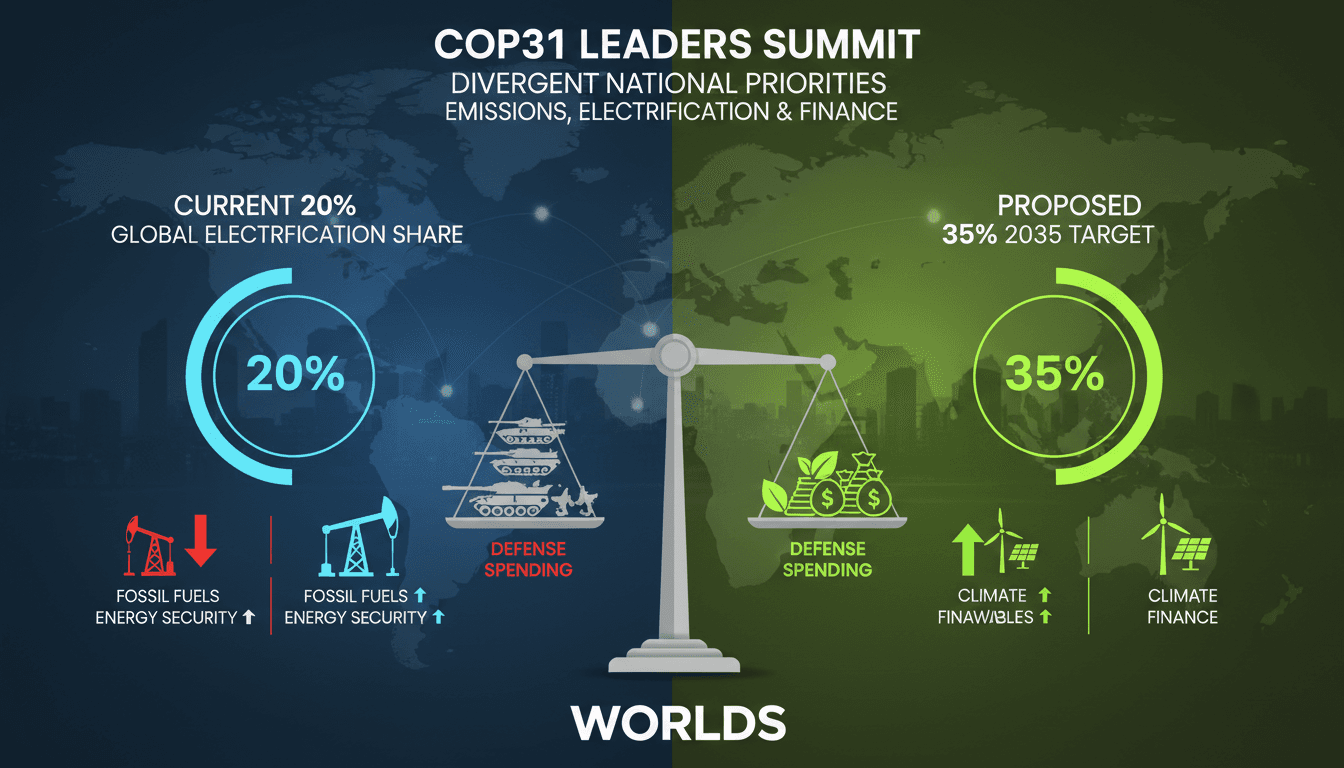
Shifting global capital toward a 35% electrification benchmark alters long-term infrastructure allocations while ongoing geopolitical friction keeps immediate energy security tied to fossil baseloads.
Why it matters
Competing national priorities are forcing climate negotiations to prioritize existing pledge delivery and grid capacity over binding fossil fuel phase-outs.
What happened (in 30 seconds)
- World leaders clashed in Antalya: Over 70 national leaders gathered on 11–12 November 2026 at the COP31 summit in Türkiye, exposing deep rifts between small island states demanding faster emissions cuts, developing nations seeking capital, and hydrocarbon producers defending resource development.
- Electrification took center stage: European leaders backed a proposal by host Türkiye to raise electricity’s share of global final energy consumption to 35% by 2035, up from just over 20% currently.
- Security pressures sidelined new pledges: With negotiations led by Australia extending through 20 November 2026, diplomatic talks pivoted toward reconciling national energy security and defense budgets rather than establishing aggressive new phase-out treaties.
The context you actually need
- Record warming collides with conflict: COP31 follows COP30 in Belém, arriving as a United Nations report confirms the planet remains on track to surpass the 1.5°C Paris Agreement threshold, even as defense spending and inflation pull fiscal focus away from multilateral climate funds.
- Active regional hostilities strain priorities: Ongoing wars involving the United States, Israel, and Iran, alongside Russia’s war with Ukraine, have forced energy-importing states to prioritize near-term supply resilience over long-horizon decarbonization commitments.
- The dual presidency structure: With Türkiye serving as host at the Antalya Expo Center and Australian Minister Chris Bowen presiding over negotiations, the leadership team faces the task of uniting disparate blocs into a consensus text by 20 November 2026.
What's really happening
The diplomatic tension at COP31 is driven by competing economic incentives. Capital-exporting and industrialized countries are framing climate action around power infrastructure and technological deployment. This focus is encapsulated in the target to expand electricity to 35% of global energy consumption by 2035, compared to just over 20% today. For European economies, this target creates export markets for grid equipment, storage technology, and renewables while systematically reducing structural exposure to imported hydrocarbons.
Conversely, fossil fuel-producing states operate on distinct balance-sheet realities. Leaders from producing nations, including Venezuela, explicitly affirmed their sovereign mandate to monetize domestic oil, gas, and coal reserves. For these economies, hydrocarbon revenues underwrite national budgets, state operations, and domestic social spending. Phasing down upstream capital expenditures without guaranteed, non-debt transition financing creates fiscal exposure that domestic authorities are unwilling to absorb.
Simultaneously, small island states—such as Tuvalu, the Bahamas, the Solomon Islands, and Saint Lucia—face existential risks from rising sea levels and weather volatility. These vulnerable states are demanding immediate, deep greenhouse gas reductions from major industrial powers, arguing that target dates set for 2035 or 2050 do not match the velocity of ecological change. Yet developing nations broadly maintain that substantial emissions cuts remain impossible without rapid, unconditional financial transfers from the developed world.
These opposing incentives are magnified by the current macro environment. With high global inflation and active geopolitical hostilities involving the United States, Israel, Iran, Russia, and Ukraine, national governments face intense domestic pressure to secure cheap, reliable baseload power. As a result, negotiations president Chris Bowen and host President Recep Tayyip Erdoğan are working within narrow boundaries. Rather than crafting novel treaties to shut down fossil assets, the conference mechanics are defaulting to realistic implementation: funding grid capacity, expanding baseline electrification, and monitoring prior commitments. The structural result is an energy transition governed by the limits of energy security rather than ecological timelines.
Who feels it first (and how)
- Energy Infrastructure Developers: Grid operators and utility-scale renewable firms gain clear investment visibility from the European-backed 35% electrification mandate by 2035.
- Gulf and Emerging Market Asset Allocators: Institutional operators in energy hubs like Dubai face a double-sided market—navigating heightened volatility in existing hydrocarbon assets while accelerating domestic capital deployment into regional diversification and heat adaptation.
- Vulnerable Island Economies: Sovereignties like Tuvalu and Saint Lucia absorb direct climate impact costs without the financial pipelines needed to protect local infrastructure.
- Sovereign Debt Managers in Developing States: Finance ministries navigating capital constraints face sustained resistance from developed states on fast-tracked, non-debt climate transfers, limiting balance-sheet flexibility.
What to watch next
- The Final Text Language on 20 November 2026: Watch whether Australian negotiations president Chris Bowen can secure consensus language regarding fossil fuel transition timelines or if text defaults purely to electrification benchmarks.
- Financing Mechanism Clarifications: Track whether developed economies outline concrete, simplified capital delivery systems to replace slow-moving climate finance architectures for emerging markets.
- Grid Capital Expenditure Announcements: Monitor whether multilateral development banks scale balance-sheet guarantees to support the proposed 15 percentage-point increase in global electrification.
More than 70 world leaders set out clashing priorities at the Antalya Expo Center during the 11–12 November 2026 summit; the world is currently on track to overshoot the 1.5°C threshold; and electricity accounts for just over 20% of global final energy consumption.
Negotiators will prioritize actionable implementation targets like grid modernization and electrification over mandatory fossil fuel extraction caps to preserve consensus before 20 November 2026.
Whether developing states and small island nations will sign off on a final consensus text that fails to establish simplified, significantly enlarged capital disbursement mechanisms.
Frequently Asked Questions
- Why it matters?
- Competing national priorities are forcing climate negotiations to prioritize existing pledge delivery and grid capacity over binding fossil fuel phase-outs.
- What happened (in 30 seconds)?
- World leaders clashed in Antalya: Over 70 national leaders gathered on 11–12 November 2026 at the COP31 summit in Türkiye, exposing deep rifts between small island states demanding faster emissions cuts, developing nations seeking capital, and hydrocarbon producers defending resource development. Electrification took center stage: European leaders backed a proposal by host Türkiye to raise electricity’s share of global final energy consumption to 35% by 2035, up from just over 20% currently. Sec
- What's really happening?
- The diplomatic tension at COP31 is driven by competing economic incentives. Capital-exporting and industrialized countries are framing climate action around power infrastructure and technological deployment. This focus is encapsulated in the target to expand electricity to 35% of global energy consumption by 2035, compared to just over 20% today. For European economies, this target creates export markets for grid equipment, storage technology, and renewables while systematically reducing structu
- Who feels it first (and how)?
- Energy Infrastructure Developers: Grid operators and utility-scale renewable firms gain clear investment visibility from the European-backed 35% electrification mandate by 2035. Gulf and Emerging Market Asset Allocators: Institutional operators in energy hubs like Dubai face a double-sided market—navigating heightened volatility in existing hydrocarbon assets while accelerating domestic capital deployment into regional diversification and heat adaptation. Vulnerable Island Economies: Sovereignti
- What to watch next?
- The Final Text Language on 20 November 2026: Watch whether Australian negotiations president Chris Bowen can secure consensus language regarding fossil fuel transition timelines or if text defaults purely to electrification benchmarks. Financing Mechanism Clarifications: Track whether developed economies outline concrete, simplified capital delivery systems to replace slow-moving climate finance architectures for emerging markets. Grid Capital Expenditure Announcements: Monitor whether multilate
English-language news from Qatar covering domestic and regional affairs.
"Gulf Times reflects Qatari perspectives on regional developments."
— A47 Editor
World leaders set out clashing priorities as COP31 turns to negotiations
World leaders at the COP31 climate talks in Turkiye have set out competing positions and clashing demands during two days of speeches, leaving negotiators with a difficult task ahead of formal negotiations.
Regional coverage and analysis focused on politics, diplomacy, and business across the Middle East.
"Al-Monitor is known for analytical reporting on Middle East politics and policy developments."
— A47 Editor
COP31 leaders try out new sales pitch for climate action: do it for the economy
COP31 leaders in Antalya, Turkey, are promoting climate action as a way to strengthen economies and reduce the cost of living, according to Reuters reporting carried by Al-Monitor. The message is being repeated in hallways and plenary sessions as org...
Oil, metals, and agriculture: supply/demand headlines, OPEC chatter, inventories, and price action.
"Solid tape for energy and metals traders tracking macro and micro catalysts."
— A47 Editor
World leaders to address COP31 as Turkey pushes for new climate deal
World leaders are set to address the COP31 United Nations climate summit in Antalya, Turkey, as Turkey pushes for a new climate agreement, according to a report from Investing.com. The base report presents the summit as a focal point for internationa...