
US, China and Russia Schedule First Trilateral Leaders Meeting in Shenzhen on APEC Sidelines Without Binding Agenda
Why it matters
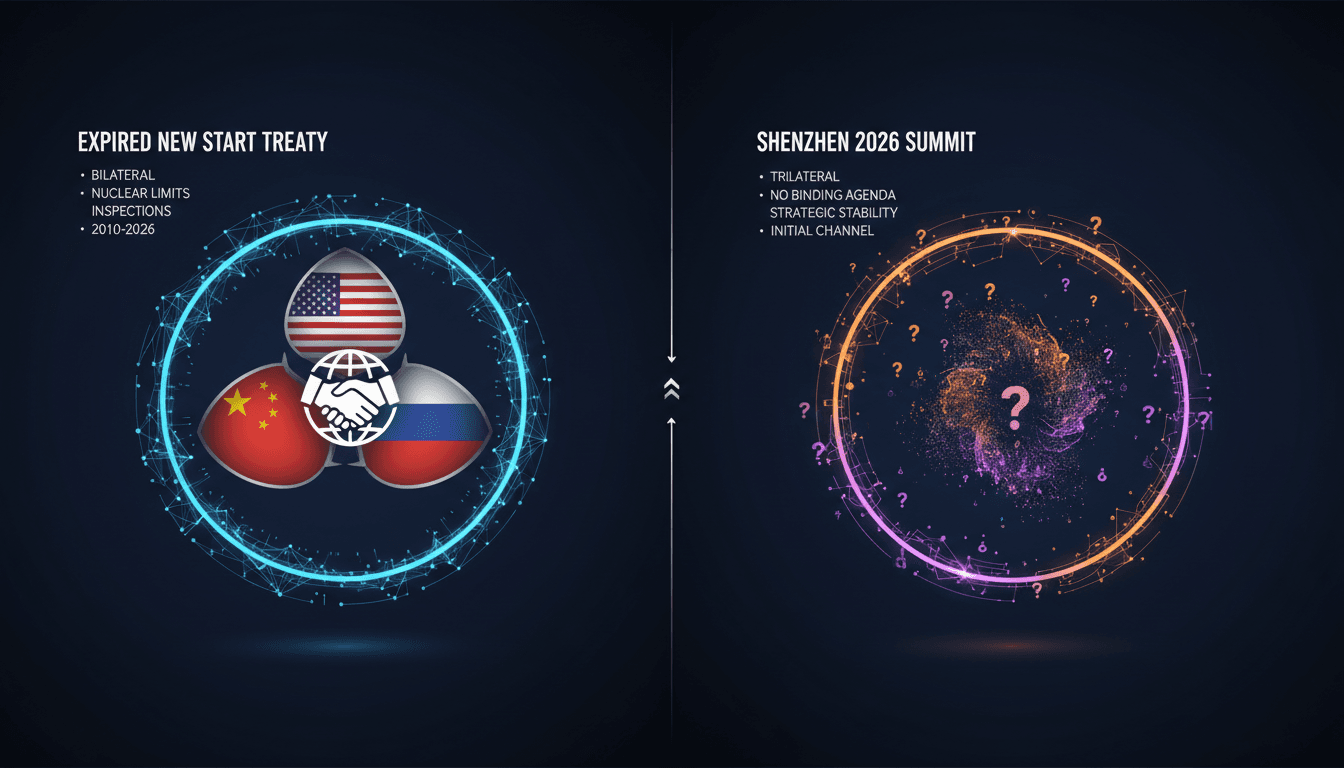
The establishment of the first direct three-way channel among Washington, Beijing, and Moscow sets a structural floor under diplomatic volatility following the expiration of core nuclear arms frameworks.
What happened (in 30 seconds)
* The convening date: U.S. President Donald Trump, Chinese President Xi Jinping, and Russian President Vladimir Putin will meet on November 19, 2026, on the sidelines of the APEC summit in Shenzhen, China. * The structural design: The session marks the first-ever direct trilateral summit among the leaders of these three states, operating without a pre-agreed agenda or binding deliverables. * The agenda boundaries: Talks center broadly on global peace and strategic stability, deliberately avoiding in-depth engagement or mediation on active conflict zones such as Ukraine or Iran.
The context you actually need
* The treaty vacuum: The meeting follows the formal expiration of the New START treaty, removing bilateral caps on deployed strategic arsenals and leaving the major nuclear powers without a verification framework. * The host's deviation: China accepted an unstructured, unscripted meeting format, a notable departure from Beijing’s standard preference for highly choreographed diplomatic engagements. * The diplomatic origin: Russia proposed the tripartite structure by referencing historical cooperation during World War II and the founding of the United Nations, seeking parity in a multipolar framework.
What's really happening
The Shenzhen assembly functions as an exercise in structural de-escalation rather than a treaty-generating summit. By stripping the meeting of a pre-agreed agenda and excluding binding communiqués, all three administrations are creating a low-stakes forum to reopen direct lines of communication without political penalties at home.
For Washington, the incentive rests on establishing a baseline of strategic stability among the three largest nuclear powers. With the expiration of the New START treaty, bilateral arms control between the United States and Russia has dissolved. Bringing China into the conversation addresses long-standing U.S. policy goals of engaging Beijing on nuclear transparency, while signaling to domestic and international markets that lines of communication remain functional despite persistent geopolitical friction.
For Beijing, hosting the summit on the margins of APEC in Shenzhen offers an opportunity to project diplomatic balance without incurring mediation liabilities. China’s Foreign Ministry characterized the talks as carrying groundbreaking significance for global stability, yet Chinese officials deliberately circumscribed the scope. Beijing is reluctant to act as an arbiter for the Russia-Ukraine conflict or security escalations involving Iran. By keeping the session conversational and avoiding detailed negotiation on regional wars, China insulates itself from the reputational exposure of failed peace brokerage while reinforcing its position as an indispensable convener.
For Moscow, securing a seat at an equal-footing trilateral table achieves core geopolitical objectives. Following years of diplomatic isolation from Western capitals, direct engagement alongside the American and Chinese heads of state reasserts Russia's position as a primary global power. Russian Assistant to the President Yuri Ushakov pointed to ongoing drafting work on a potential joint statement, reflecting Moscow’s desire to extract formal recognition of mutual understanding even if operational compromises on Ukraine are deferred.
Because contentious regional wars are explicitly sidelined, the summit operates as an architectural reset. The structural incentive for all three actors is the same: reduce the probability of catastrophic miscalculation among three competing nuclear arsenals without trading away their respective strategic leverage on specific regional frontlines.
Who feels it first (and how)
* Global Energy Traders and Shipping Operators: A preliminary stabilization signal limits sudden geopolitical risk premiums, offering short-term predictability for transit insurance and maritime routing. * Gulf and Dubai Logistics Hubs: Transport and trade networks operating through regional commercial centers face reduced immediate secondary market turbulence, though baseline operations continue unchanged without formal trade deals. * European and Ukrainian Defense Planners: Strategic teams in Kyiv and European capitals face uncertainty regarding whether high-level tripartite discussions could eventually marginalize their security priorities. * Sovereign Debt and FX Desks: Macro portfolio managers evaluate currency baskets and sovereign risk spreads against the reduced probability of immediate superpower military escalation.
What to watch next
* The Joint Statement Baseline: Track whether Yuri Ushakov's draft statement produces a formal tripartite text or yields only separate national readouts, signaling the true level of baseline diplomatic convergence. * Bilateral Side-Meetings: Monitor whether a standalone, private bilateral session between Donald Trump and Vladimir Putin materializes in Shenzhen, which would indicate operational negotiations on specific bilateral disputes. * Nuclear Strategy Follow-Through: Observe whether any post-summit communications mention working-level delegations tasked with replacing expired nuclear caps following New START.
The November 19, 2026, meeting in Shenzhen constitutes the first-ever direct trilateral leaders' summit between the United States, China, and Russia, and is intentionally designed without an expected formal accord.
Sensitive files regarding the Russia-Ukraine conflict and developments in Iran will be de-emphasized during plenary discussions due to Beijing's explicit reluctance to serve as an active mediator.
Whether the initial contact points in Shenzhen will translate into institutional working groups on nuclear risk reduction or remain an isolated, symbolic diplomatic photograph.
Frequently Asked Questions
- Why it matters?
- The establishment of the first direct three-way channel among Washington, Beijing, and Moscow sets a structural floor under diplomatic volatility following the expiration of core nuclear arms frameworks.
- What happened (in 30 seconds)?
- The convening date: U.S. President Donald Trump, Chinese President Xi Jinping, and Russian President Vladimir Putin will meet on November 19, 2026, on the sidelines of the APEC summit in Shenzhen, China. The structural design: The session marks the first-ever direct trilateral summit among the leaders of these three states, operating without a pre-agreed agenda or binding deliverables. The agenda boundaries: Talks center broadly on global peace and strategic stability, deliberately avoiding in-d
- What's really happening?
- The Shenzhen assembly functions as an exercise in structural de-escalation rather than a treaty-generating summit. By stripping the meeting of a pre-agreed agenda and excluding binding communiqués, all three administrations are creating a low-stakes forum to reopen direct lines of communication without political penalties at home. For Washington, the incentive rests on establishing a baseline of strategic stability among the three largest nuclear powers. With the expiration of the New START tre
- Who feels it first (and how)?
- Global Energy Traders and Shipping Operators: A preliminary stabilization signal limits sudden geopolitical risk premiums, offering short-term predictability for transit insurance and maritime routing. Gulf and Dubai Logistics Hubs: Transport and trade networks operating through regional commercial centers face reduced immediate secondary market turbulence, though baseline operations continue unchanged without formal trade deals. European and Ukrainian Defense Planners: Strategic teams in Kyiv a
- What to watch next?
- The Joint Statement Baseline: Track whether Yuri Ushakov's draft statement produces a formal tripartite text or yields only separate national readouts, signaling the true level of baseline diplomatic convergence. Bilateral Side-Meetings: Monitor whether a standalone, private bilateral session between Donald Trump and Vladimir Putin materializes in Shenzhen, which would indicate operational negotiations on specific bilateral disputes. Nuclear Strategy Follow-Through: Observe whether any post-summ
Arabic-language coverage of political affairs and current events.
"Okaz political coverage typically follows mainstream Saudi framing on national and regional affairs."
— A47 Editor
قمة ترمب وشي وبوتين.. تجنب الملفات الساخنة واستبعاد الاتفاق
A summit bringing together U.S. President Donald Trump, Russian President Vladimir Putin and Chinese President Xi Jinping is set to take place in the Chinese city of Shenzhen on Thursday, as Russian presidential aide Yuri Ushakov said difficult diplo...
Arabic-language coverage of international news and geopolitics.
"RT Arabic is a Russian state-funded outlet often criticized for promoting Kremlin-aligned narratives."
— A47 Editor
بيسكوف: لقاء بوتين وترامب وشي "إشارة للبشرية جمعاء"
Kremlin spokesman Dmitry Peskov said that the meeting bringing together Russian President Vladimir Putin, Chinese President Xi Jinping, and US President Donald Trump is a prominent event without precedent, as reported by RT Arabic.
Arabic-language coverage of international news and geopolitics.
"RT Arabic is a Russian state-funded outlet often criticized for promoting Kremlin-aligned narratives."
— A47 Editor
هل تتكرر "يالطا" ويتوصّل زعماء العالم إلى اتفاق؟
RT Arabic reported, citing a commentary by Timofey Bordachev in Valdai's publication, on what the upcoming Apec summit involving Russia, China and the United States could produce, and whether today's leaders might reach an agreement reminiscent of th...
Arabic-language coverage of international news and geopolitics.
"RT Arabic is a Russian state-funded outlet often criticized for promoting Kremlin-aligned narratives."
— A47 Editor
الكرملين: الاجتماع المرتقب بين بوتين وشي وترامب اجتماع بالغ الأهمية
The Kremlin spokesman Dmitry Peskov stated that the upcoming meeting between President Vladimir Putin, Chinese President Xi Jinping, and U.S. President Donald Trump is of great importance. The announcement was reported by RT Arabic, with the Kremlin ...
Arabic-language coverage of international news and geopolitics.
"RT Arabic is a Russian state-funded outlet often criticized for promoting Kremlin-aligned narratives."
— A47 Editor
أوشاكوف: قمة بوتين وترامب وشي ستعقد على أساس التحالف بين الدول الثلاث خلال الحرب العالمية الثانية
Yuri Ushakov, an aide to Russian President Vladimir Putin, announced that a summit bringing together Putin, Donald Trump and Xi Jinping will be held on the basis of the alliance between the three countries during the Second World War. The statement, ...
Jordanian news and regional updates.
"Roya News is a Jordanian outlet focused on breaking news and local affairs."
— A47 Editor
بكين تؤكد عقد أول قمة ثلاثية بين شي وترمب وبوتين في مدينة شينزين الخميس المقبل
Beijing has confirmed that the first trilateral summit between Chinese President Xi Jinping, US President Donald Trump, and Russian President Vladimir Putin will be held in the city of Shenzhen next Thursday, according to a statement issued Monday by...