
ICJ Rules Myanmar Responsible for Genocide Against Rohingya in First State Genocide Finding
Why it matters
For the first time in its history, the International Court of Justice has determined a sovereign state directly responsible for committing genocide, creating an enforceable precedent that shifts state liability frameworks and international sanctions risk.
What happened (in 30 seconds)
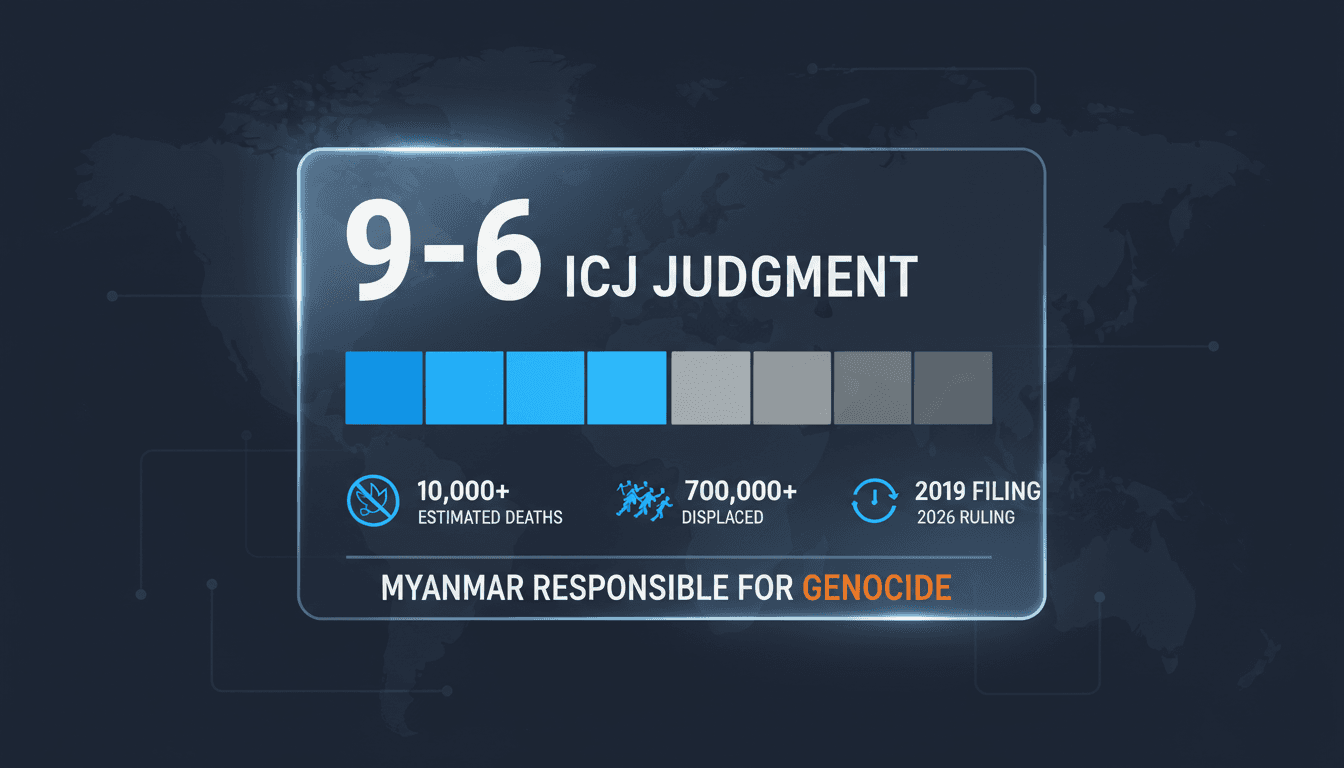
- A historic judgment issued: On November 19, 2026, the International Court of Justice (ICJ) in The Hague delivered a 9-6 merits ruling in *The Gambia v. Myanmar*, finding the state of Myanmar legally responsible for committing genocide against the Rohingya.
- Specific treaty breaches established: The court found Myanmar’s state apparatus violated the 1948 Genocide Convention during 2017 operations in Rakhine State through killings, severe bodily and mental harm, and systemic actions designed to prevent births.
- Remedies and reparations mandated: The ruling requires Myanmar to facilitate the safe, voluntary return of displaced persons, perform internal accountability investigations, and pay financial compensation to victims at amounts to be determined.
The context you actually need
- The origin of the case: The legal action began in November 2019 when The Gambia initiated proceedings under Article IX of the Genocide Convention, addressing the 2017 military operations that displaced over 700,000 Rohingya to Bangladesh.
- The evidentiary baseline: Court findings referenced an estimated 10,000 Rohingya deaths, widespread sexual violence, systemic attacks on children, and comprehensive village burnings, concluding that these patterns negated Myanmar's argument of targeted counter-insurgency operations.
- The procedural timeline: The court previously imposed provisional measures in 2020 requiring preservation of evidence, culminating in the merits judgment under ICJ President Judge Yuji Iwasawa following extensive review of cross-jurisdictional evidence.
What's really happening
The ICJ’s ruling is structurally transformative because international tribunals have historically prosecuted individual actors—via bodies like the International Criminal Tribunal for the former Yugoslavia, the International Criminal Tribunal for Rwanda, or the International Criminal Court—rather than assigning direct state responsibility for the commission of genocide. By ruling that Myanmar’s state organs themselves carried out genocidal acts, the ICJ fundamentally changes the institutional baseline for sovereign accountability.
The 9-6 decision decisively rejected Myanmar’s defense that the 2017 operations were solely directed against insurgent groups. The court concluded that the scale, coordination, and specific patterns of violence—such as targeted destruction of civilian infrastructure, sexual violence, and deliberate conditions preventing reproduction—left genocidal intent as the only reasonable inference. Furthermore, the court found Myanmar in breach of its obligations under the Convention both to prevent and to punish genocidal acts.
For multinational corporations, compliance officers, and foreign ministries, this finding resets the legal foundation of all bilateral and multilateral engagement. State responsibility shifts an issue from discretionary foreign policy or political rhetoric into the realm of binding international treaty violations. While the ICJ lacks independent enforcement divisions or police forces, Article 94 of the United Nations Charter establishes that judgments are legally binding on UN member states, with non-compliance subject to referral directly to the UN Security Council.
This mechanism immediately influences diplomatic interactions and institutional compliance. Sovereign governments operating within bilateral or multilateral treaties face increased legal exposure if their actions appear to aid or abet a state legally designated as a perpetrator of genocide. Rather than negotiating within ambiguous diplomatic frameworks, governments and regulatory bodies will be pressured to re-evaluate diplomatic status, trade benefits, and consular relations to limit their own institutional liability under customary international law and treaty obligations.
Who feels it first (and how)
- Displaced Rohingya communities: Over 700,000 refugees living in camps across Bangladesh receive legal recognition of state-sponsored harm, creating an established baseline for future restitution and formal claims to safe, dignified repatriation.
- Myanmar's military leadership: The ruling heightens pressure on Min Aung Hlaing and state authorities, narrowing their room for international engagement, complicating diplomatic access, and accelerating unilateral diplomatic dismissals.
- Diplomatic and foreign service corps: Ministries worldwide must align their formal protocol with a binding ICJ merits decision, as demonstrated by the United Kingdom's initial move to expel Myanmar's military attaché.
- Global compliance and trade monitors: Financial compliance officers, multilateral development banks, and corporate risk evaluators must reassess any direct or indirect commercial dealings linked to Myanmar state-owned assets or enterprises.
What to watch next
- UN Security Council referral pathways: Watch how the UN Security Council addresses enforcement motions under Article 94(2) of the UN Charter, where permanent member voting positions will dictate the implementation of compulsory measures.
- Reparations assessment proceedings: Track the subsequent ICJ hearings specifically scheduled to evaluate the quantitative reparations and financial compensation Myanmar is ordered to transfer to affected populations.
- Bilateral diplomatic adjustments: Monitor formal state reactions, following the UK's attaché expulsion, as the United States, European Union, and regional blocs review their diplomatic, legal, and economic postures.
The ICJ issued a binding 9-6 judgment ruling that Myanmar committed genocide against the Rohingya, finding state organs responsible for systematic violations of the Genocide Convention involving an estimated 10,000 deaths and the displacement of over 700,000 people.
Western and multilateral institutions will expand targeted sanctions, limit engagement with state-controlled entities, and direct resources toward documented refugee assistance initiatives.
Whether domestic authorities in Myanmar will facilitate safe returns or accept court-mandated reparations, and whether geopolitical divisions inside the UN Security Council will obstruct binding enforcement mechanisms.
Frequently Asked Questions
- Why it matters?
- For the first time in its history, the International Court of Justice has determined a sovereign state directly responsible for committing genocide, creating an enforceable precedent that shifts state liability frameworks and international sanctions risk.
- What happened (in 30 seconds)?
- A historic judgment issued: On November 19, 2026, the International Court of Justice (ICJ) in The Hague delivered a 9-6 merits ruling in *The Gambia v. Myanmar*, finding the state of Myanmar legally responsible for committing genocide against the Rohingya. Specific treaty breaches established: The court found Myanmar’s state apparatus violated the 1948 Genocide Convention during 2017 operations in Rakhine State through killings, severe bodily and mental harm, and systemic actions designed to pre
- What's really happening?
- The ICJ’s ruling is structurally transformative because international tribunals have historically prosecuted individual actors—via bodies like the International Criminal Tribunal for the former Yugoslavia, the International Criminal Tribunal for Rwanda, or the International Criminal Court—rather than assigning direct state responsibility for the commission of genocide. By ruling that Myanmar’s state organs themselves carried out genocidal acts, the ICJ fundamentally changes the institutional bas
- Who feels it first (and how)?
- Displaced Rohingya communities: Over 700,000 refugees living in camps across Bangladesh receive legal recognition of state-sponsored harm, creating an established baseline for future restitution and formal claims to safe, dignified repatriation. Myanmar's military leadership: The ruling heightens pressure on Min Aung Hlaing and state authorities, narrowing their room for international engagement, complicating diplomatic access, and accelerating unilateral diplomatic dismissals. Diplomatic and fo
- What to watch next?
- UN Security Council referral pathways: Watch how the UN Security Council addresses enforcement motions under Article 94(2) of the UN Charter, where permanent member voting positions will dictate the implementation of compulsory measures. Reparations assessment proceedings: Track the subsequent ICJ hearings specifically scheduled to evaluate the quantitative reparations and financial compensation Myanmar is ordered to transfer to affected populations. Bilateral diplomatic adjustments: Monitor for
Arabic-language coverage of Saudi, regional, and international affairs.
"Al Bilad offers mainstream Saudi newspaper coverage across domestic and broader Arab topics."
— A47 Editor
“العدل الدولية” تدين بورما بارتكاب إبادة جماعية بحق “الروهينغا”
The International Court of Justice in The Hague ruled that Myanmar committed genocide against the Muslim Rohingya minority in northern Rakhine State, in a landmark judgment handed down on Thursday. The ruling stems from the military crackdown of 2017...
Arabic-language coverage of international news and geopolitics.
"RT Arabic is a Russian state-funded outlet often criticized for promoting Kremlin-aligned narratives."
— A47 Editor
خبراء: حكم إبادة الروهينغا يفتح أسئلة جديدة بشأن إبادة غزة
The International Court of Justice ruled on Thursday that Myanmar committed genocide against the Rohingya Muslim minority, a judgment that highlights similar issues raised in South Africa's case against Israel concerning Gaza.
Pan-Arab political news and analysis.
"Al-Quds Al-Arabi is a London-based Arabic newspaper known for political coverage."
— A47 Editor
الأمم المتحدة تشيد بحكم محكمة العدل الدولية بشأن الإبادة الجماعية للروهينغا وتؤكد أنه ملزم ونهائي
The Secretary-General of the United Nations welcomed the ruling by the International Court of Justice in the case brought by The Gambia against Myanmar in 2019, concerning alleged violations of the Genocide Convention, describing it as an important a...
Arabic-language reporting on global and regional news.
"BBC Arabic is part of the BBC, generally regarded for editorial standards and broad international coverage."
— A47 Editor
محكمة العدل الدولية تدين ميانمار بارتكاب إبادة جماعية بحق الروهينغا وتأمرها بدفع تعويضات
The International Court of Justice ruled that Myanmar committed genocide against the Rohingya Muslim minority during military operations in 2017, and ordered the country to pay reparations to victims, investigate those suspected of committing the vio...
Algerian and regional news coverage.
"Echorouk is a major Algerian outlet with broad national reporting."
— A47 Editor
الروهينغا.. لاهاي تصدر حكما تاريخيا ضد ميانمار
The International Court of Justice in The Hague issued a landmark ruling on Thursday finding that Myanmar's security forces killed thousands of Rohingya civilians, committed widespread sexual violence, carried out grave violence against children, and...