
Fossil Discoveries Challenge Evolutionary Theories of Vertebrates
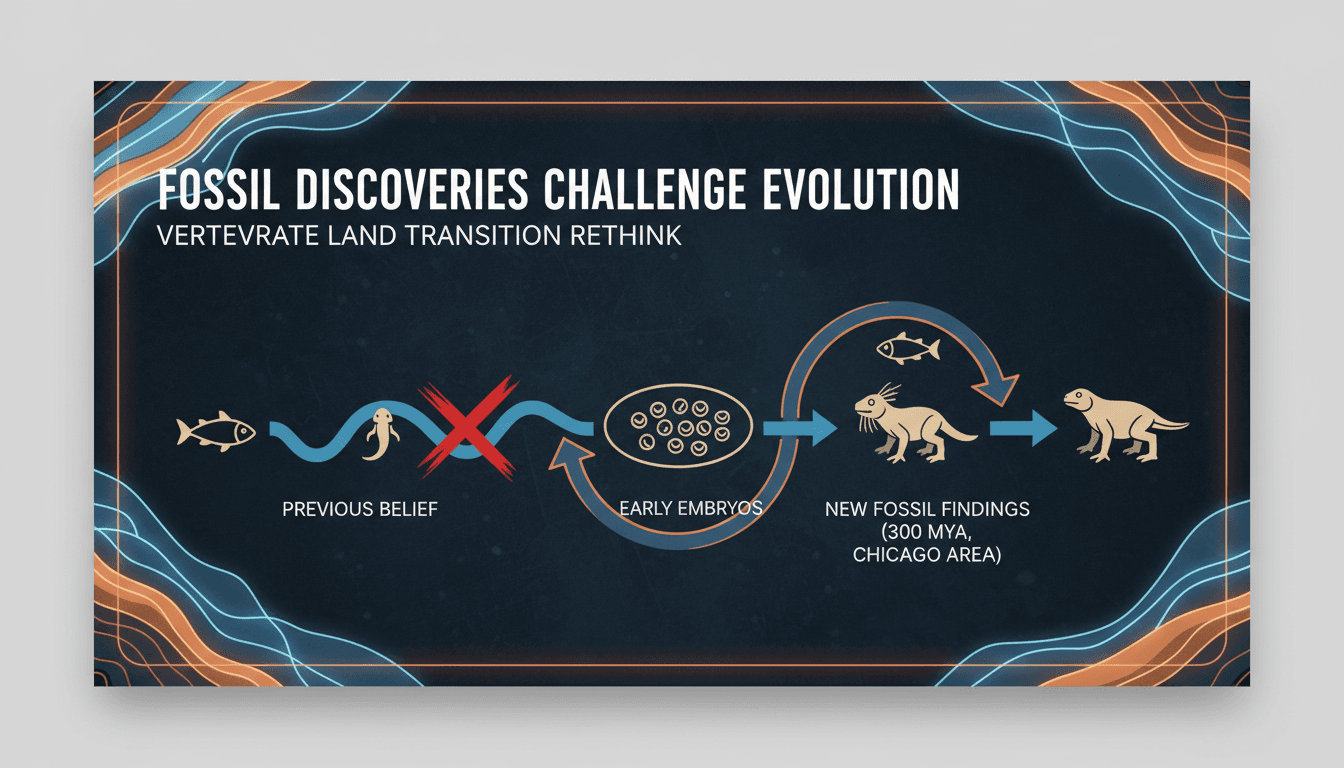
Here's what it means for you.
The recent fossil discoveries near Chicago have significant implications for our understanding of vertebrate evolution. By revealing that early land-dwelling vertebrates did not undergo a tadpole phase, these findings challenge long-held beliefs in evolutionary biology. This shift may prompt researchers to reevaluate existing theories and explore new avenues in the study of vertebrate life cycles. As the scientific community digests these revelations, the potential for groundbreaking research into the origins of land-dwelling species increases. The implications extend beyond paleontology, influencing educational curricula and public understanding of evolutionary processes.
What happened
Recent fossil discoveries near Chicago have overturned traditional views regarding the evolution of vertebrates transitioning from aquatic to terrestrial life. Researchers found that the first land-dwelling vertebrates did not have an amphibian-like life cycle, as previously believed. These fossils, dating back 300 million years, suggest a more complex life cycle for these ancient creatures.
The findings indicate that early vertebrates lacked external gills, further distinguishing them from modern amphibians. This new understanding of their life cycle is reshaping the narrative of vertebrate evolution and prompting further investigation into their transition to land.
The Context
The fossils discovered near Chicago date back 300 million years, a period critical to the evolution of vertebrates. Previous theories posited that these early creatures evolved through a tadpole phase, similar to modern amphibians. The new evidence suggests a more intricate evolutionary history, challenging established scientific paradigms.
This discovery is significant not only for paleontologists but also for educators and policymakers who shape the public's understanding of evolution. As research continues, the implications of these findings may influence how evolutionary biology is taught and perceived in society.
Takeaway
The recent fossil discoveries may lead to a reevaluation of the evolutionary pathways of early vertebrates. As researchers delve deeper into the implications of these findings, further studies are expected to emerge, potentially uncovering additional fossil evidence that could continue to challenge existing theories.
The ongoing research into these fossils will likely provide new insights into the life histories of early land animals, enriching our understanding of vertebrate evolution.
Scientific discoveries, health, technology, and natural phenomena.
"Live Science reports on scientific discoveries, health, technology, and natural phenomena with a popular science tone."
— A47 Editor
'A completely different story': 300 million-year-old fossils reveal the first vertebrate land dwellers weren't what we thought, researchers claim
A recent study of 300 million-year-old fossils discovered near Chicago suggests that the first vertebrate land dwellers did not possess an amphibian-like life cycle, challenging long-held beliefs about early terrestrial vertebrates. Researchers asser...
Discoveries, research, environment, and health innovations.
"New Scientist is a well-respected publication offering accessible science news, commentary, and expert analysis."
— A47 Editor
Remarkable fossils rewrite the story of how animals conquered the land
Recent discoveries by palaeontologists have revealed that the early ancestors of amphibians, reptiles, and mammals did not possess a larval stage with external gills, as seen in modern frogs and salamanders. This finding challenges previous assumptio...
Independent journalism covering technology, AI, and digital culture.
"An independent newsroom by veteran tech reporters known for critical, investigative coverage of AI and tech power."
— A47 Editor
A New Fossil Discovery Just Rewrote 150 Years of Evolutionary Theory
A recent fossil discovery has challenged a long-held belief among paleontologists that the first vertebrates transitioning from sea to land evolved through a tadpole phase, akin to modern frogs. The newly found fossils, which are exceptionally well-p...
News in science and technology, with a focus on consumer and innovation stories.
"Popular Science simplifies complex scientific topics for general audiences and celebrates innovation."
— A47 Editor
Baby crocodile-like fossils just blew up a long-held evolution theory
Recent discoveries of baby crocodile-like fossils have challenged the long-held belief that amphibians were the first animals to walk on land, suggesting that these reptiles may have taken that evolutionary step earlier than previously thought.