
Multiple Earthquakes Strike Venezuela, Japan, and California in Quick Succession
Here's what it means for you.
The recent earthquakes in Venezuela, Japan, and California highlight the critical need for enhanced disaster preparedness and infrastructure in regions prone to seismic activity. As these events unfold, they serve as a stark reminder of the vulnerabilities faced by communities worldwide. Policymakers and stakeholders must prioritize building standards and safety measures to mitigate the impacts of future earthquakes. The independent nature of these seismic events, despite their close timing, underscores the complexity of global seismic activity. Understanding these dynamics is essential for effective response strategies and public safety initiatives.
What happened
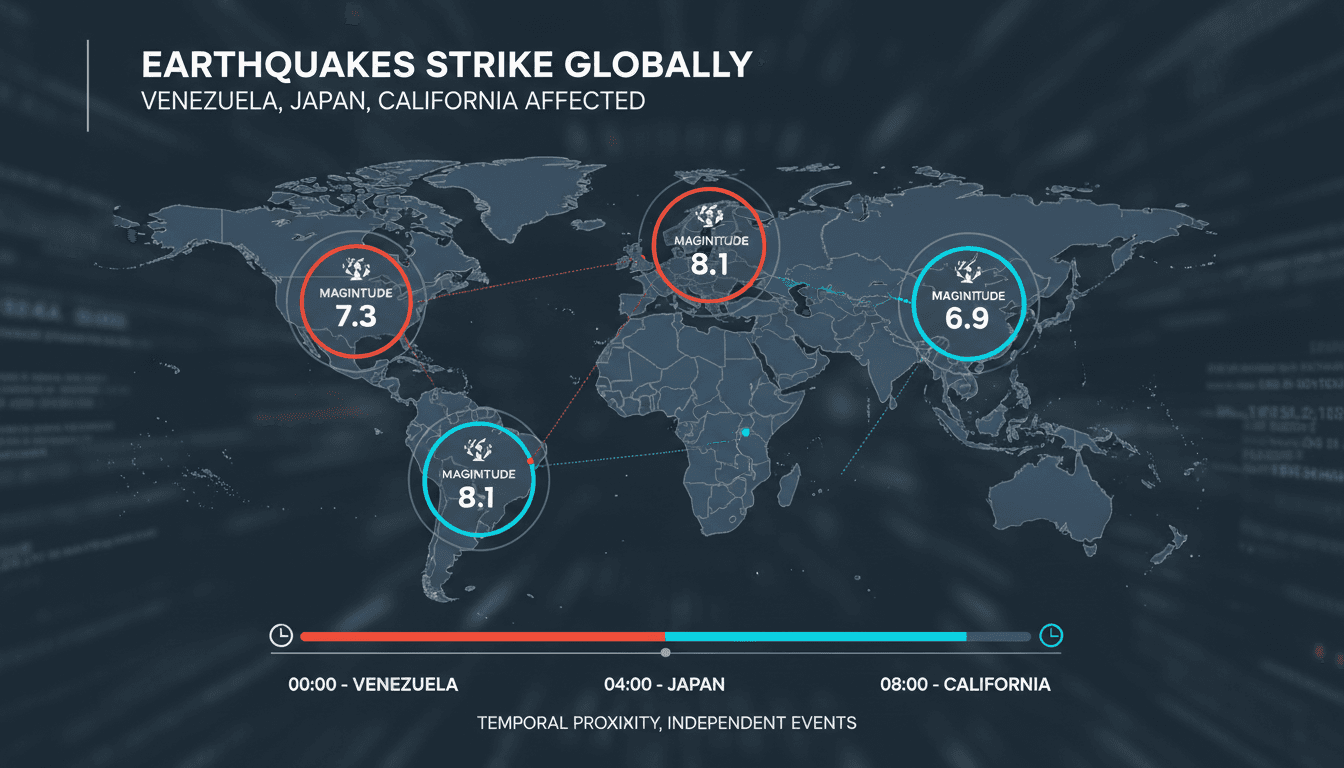
A series of powerful earthquakes struck Venezuela, Japan, and California within an eight-hour timeframe. The most significant of these was a 7.2-magnitude earthquake that hit Japan's northern coast, causing widespread concern. In Venezuela, two notable earthquakes occurred in quick succession, classified as a rare doublet, leading to mass casualties. Meanwhile, California experienced a 5.6-magnitude earthquake in a rural area, adding to the day's seismic events.
Experts have confirmed that these earthquakes are independent of one another, despite their temporal proximity. This clarification is crucial for understanding the nature of seismic activity and its implications for affected regions.
The Context
The earthquakes in Venezuela, Japan, and California occurred on June 25, 2026, raising alarms about global seismic activity. The situation in Venezuela is particularly alarming due to its weaker building standards, which exacerbate the impact of such natural disasters. Japan's robust infrastructure has historically mitigated damage from earthquakes, but the recent 7.2-magnitude event poses significant challenges.
California's rural areas, while less populated, are not immune to the dangers of seismic activity. The timing of these events has prompted discussions among experts regarding the need for improved disaster preparedness and infrastructure in vulnerable regions.
Takeaway
As seismic activity continues to be a global concern, understanding the risks associated with earthquakes remains crucial for preparedness. Monitoring seismic activity in vulnerable regions will be essential in the coming weeks. Stakeholders must stay informed about building standards and safety measures in earthquake-prone areas to enhance community resilience.
The ongoing situation serves as a reminder of the importance of proactive measures to mitigate the effects of future earthquakes. Communities must prioritize disaster preparedness to safeguard lives and infrastructure.
RT is a Russian state-funded network covering global events from a Russian perspective.
"RT is widely criticized for promoting pro-Kremlin narratives and is considered by many to be a state propaganda outlet."
— A47 Editor
From ‘seismic doublets’ to ‘earthquake swarms’ – what do we know about this week’s global tremors?
This week, a series of significant earthquakes struck Venezuela, Japan, and California, with magnitudes reaching 7.5 in Venezuela and 7.2 in Japan, raising concerns about potential connections between these seismic events. Experts are investigating t...
Reports on science policy, discoveries, and public debate in the scientific realm.
"The Guardian’s science section is known for thoughtful and critical reporting on global research, ethics, and public understanding of science."
— A47 Editor
Experts say three recent powerful earthquakes are not related
A series of powerful earthquakes struck various regions on June 24, 2026, including a 5.6-magnitude tremor in California, a 7.2-magnitude quake in Japan, and two significant earthquakes in Venezuela measuring 7.1 and 7.5 in magnitude. The Venezuelan ...
International coverage from The Guardian's global desks.
"The Guardian is known for its progressive editorial stance and in-depth analysis."
— A47 Editor
Experts say three recent powerful earthquakes are not related
A series of powerful earthquakes struck various regions on June 24, 2026, including a 5.6-magnitude tremor in California, a 7.2-magnitude quake in Japan, and two significant earthquakes in Venezuela measuring 7.1 and 7.5 in magnitude. The Venezuelan ...
Global political, business, and cultural coverage from WSJ international desks.
"The Wall Street Journal offers extensive international reporting with a reputation for financial insight and a center-right editorial stance."
— A47 Editor
The Science Behind Venezuela’s Doublet Earthquake
On June 24, 2026, Venezuela experienced a rare doublet earthquake event, with two powerful tremors measuring 7.1 and 7.5 in magnitude striking near the capital, Caracas, within a minute of each other. This phenomenon, characterized by back-to-back se...
Comprehensive coverage of Middle Eastern and global issues.
"Al Jazeera is a prominent voice from the Global South, especially the Middle East, with an emphasis on underreported stories."
— A47 Editor
Venezuela earthquakes: Why is Central America so vulnerable to tremors?
On June 24, 2026, Venezuela was struck by two powerful earthquakes measuring 7.1 and 7.5 in magnitude, leading to significant destruction in the capital city of Caracas, where numerous buildings collapsed and a state of emergency was declared. The ea...