
Anthropic Introduces Dual-Class Share Structure for Supervoting Rights Ahead of IPO
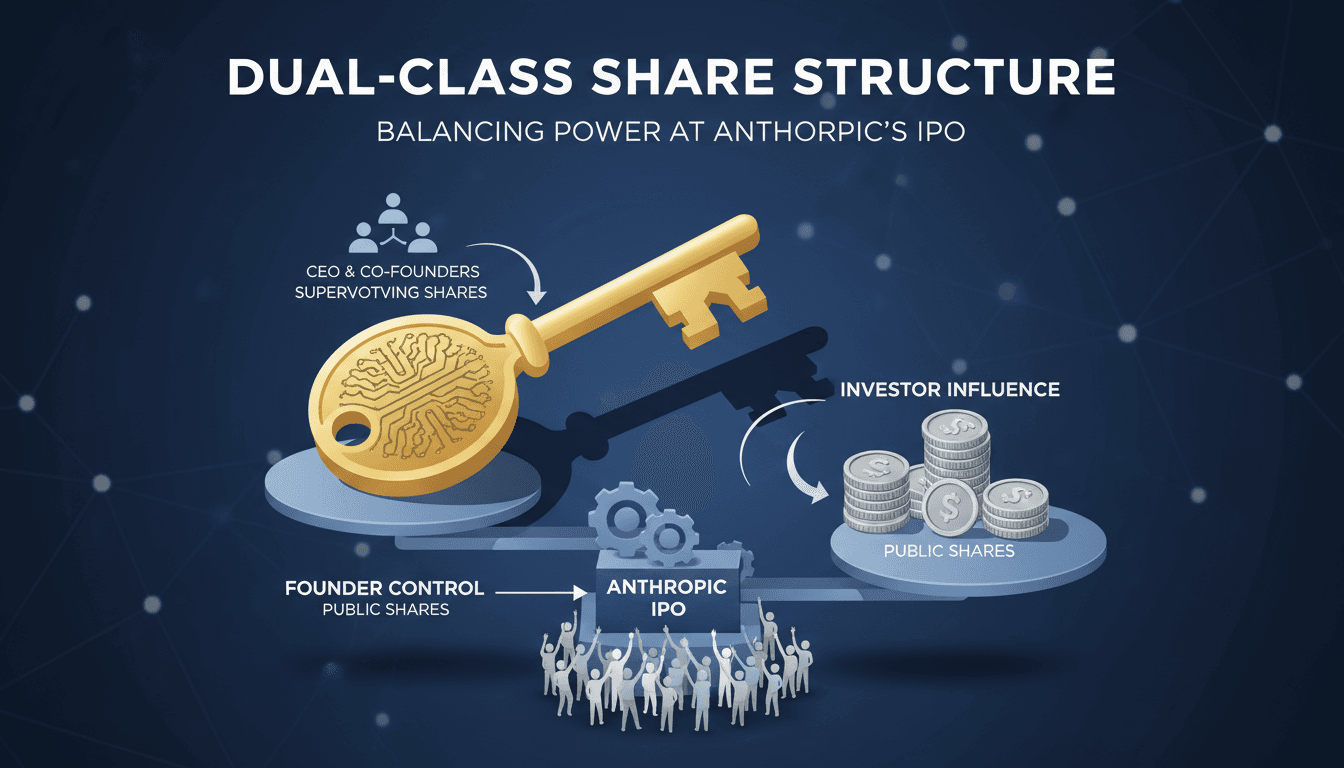
Here's what it means for you.
If you're an investor or tech enthusiast, understanding this move could influence your perception of corporate governance in the AI sector.
Why it matters
This restructuring reflects broader trends in tech governance, impacting how companies balance founder control with shareholder interests.
What happened (in 30 seconds)
- Anthropic announced plans to implement a dual-class share structure on August 18, 2026.
- CEO Dario Amodei and co-founders will receive supervoting shares to maintain control post-IPO.
- This move is designed to counteract founder dilution as the company prepares for a significant public offering.
The context you actually need
- Founded in 2021, Anthropic has rapidly gained traction in the generative AI market with its Claude models, positioning itself as a key player.
- Dario Amodei's ownership is approximately 2%, highlighting the dilution founders face as companies scale and seek external investment.
- Dual-class structures are common in tech, seen in firms like Meta and Snap, allowing founders to retain influence despite reduced equity stakes.
What's really happening
Anthropic's decision to adopt a dual-class share structure is a strategic maneuver aimed at preserving the influence of its founders, particularly CEO Dario Amodei, as the company gears up for its initial public offering (IPO). This approach is not unique to Anthropic; it mirrors a trend among technology firms that seek to insulate their leadership from the pressures of short-term shareholder demands.
As companies grow and attract significant investment, founder equity often diminishes, leading to a potential loss of control over corporate direction. In Anthropic's case, Amodei's ownership is around 2%, which is relatively low for a founder. By introducing supervoting shares, the company aims to ensure that Amodei and his co-founders can still steer the company’s vision and strategy, even if their financial stake is limited.
The dual-class structure allows for different classes of shares, where one class (held by founders) has more voting power than the other (held by public investors). This means that even with a smaller ownership percentage, founders can maintain significant control over decisions that shape the company's future. This is particularly relevant in the fast-evolving AI sector, where strategic direction can have profound implications for innovation and market positioning.
The move also addresses concerns about founder dilution, a common issue as companies scale and seek additional funding. By securing supervoting rights, Anthropic's leadership can focus on long-term goals without the constant pressure to appease shareholders who may prioritize short-term gains. This aligns with a broader trend in the tech industry, where companies are increasingly adopting governance structures that favor founder control to navigate the complexities of rapid growth and market volatility.
However, this strategy is not without its critics. Some argue that dual-class structures can lead to a disconnect between management and shareholders, potentially undermining accountability. Investors may be wary of companies where decision-making power is concentrated in the hands of a few, especially in sectors as impactful as AI. As Anthropic prepares for its IPO, it will need to balance these governance concerns with the need to attract a broad base of investors.
Who feels it first (and how)
- Investors: Those looking to invest in Anthropic may need to reassess the risks associated with dual-class structures.
- Tech Sector Executives: Other tech leaders may consider similar governance models, influencing industry standards.
- Regulators: Increased scrutiny on corporate governance practices could arise, impacting future IPOs in the tech sector.
What to watch next
- Market Reactions: Watch how investors respond to Anthropic's IPO plans and governance structure, as this could set a precedent for future tech IPOs.
- Regulatory Developments: Keep an eye on any regulatory changes regarding dual-class shares, which could affect how companies structure their governance.
- Competitor Moves: Observe if other AI firms adopt similar structures, indicating a shift in governance norms within the industry.
Anthropic is implementing a dual-class share structure to grant supervoting rights to its founders.
This move will influence investor perceptions and could lead to similar actions by other tech companies.
The long-term impact on shareholder relations and company performance remains to be seen.
Frequently Asked Questions
- Why it matters?
- This restructuring reflects broader trends in tech governance, impacting how companies balance founder control with shareholder interests.
- What happened (in 30 seconds)?
- Anthropic announced plans to implement a dual-class share structure on August 18, 2026. CEO Dario Amodei and co-founders will receive supervoting shares to maintain control post-IPO. This move is designed to counteract founder dilution as the company prepares for a significant public offering.
- What's really happening?
- Anthropic's decision to adopt a dual-class share structure is a strategic maneuver aimed at preserving the influence of its founders, particularly CEO Dario Amodei, as the company gears up for its initial public offering (IPO). This approach is not unique to Anthropic; it mirrors a trend among technology firms that seek to insulate their leadership from the pressures of short-term shareholder demands. As companies grow and attract significant investment, founder equity often diminishes, leadin
- Who feels it first (and how)?
- Investors: Those looking to invest in Anthropic may need to reassess the risks associated with dual-class structures. Tech Sector Executives: Other tech leaders may consider similar governance models, influencing industry standards. Regulators: Increased scrutiny on corporate governance practices could arise, impacting future IPOs in the tech sector.
- What to watch next?
- Market Reactions: Watch how investors respond to Anthropic's IPO plans and governance structure, as this could set a precedent for future tech IPOs. Regulatory Developments: Keep an eye on any regulatory changes regarding dual-class shares, which could affect how companies structure their governance. Competitor Moves: Observe if other AI firms adopt similar structures, indicating a shift in governance norms within the industry.
Technology business and AI-related headlines.
"Data-driven tech newsroom with global scope."
— A47 Editor
Anthropic Plans to Give CEO Extra Voting Power, Information Says
Anthropic PBC is reportedly planning to grant Chief Executive Officer Dario Amodei and other co-founders shares with enhanced voting power as the company prepares for its initial public offering (IPO), according to The Information. This move comes as...
Technology business news, market impacts, and innovation trends.
"Bloomberg is a premier financial and tech news provider, respected for its in-depth reporting and analytical rigor."
— A47 Editor
Anthropic Plans to Give CEO Extra Voting Power, Information Says
Anthropic PBC is reportedly planning to grant Chief Executive Officer Dario Amodei and other co-founders shares with enhanced voting power as the company prepares for its initial public offering (IPO), according to The Information. This move comes as...
Curated tech headlines including AI stories.
"Influential aggregator surfacing the day’s top tech/AI links."
— A47 Editor
Sources: Anthropic prepares to give its co-founders shares with extra voting power to help insulate them from outside pressure; Amodei owns ~2% of Anthropic (The Information)
Anthropic is preparing to grant its co-founders, including CEO Dario Amodei, shares with enhanced voting power as part of its strategy ahead of a potential initial public offering (IPO). This move aims to insulate the leadership from external pressur...
Corporate leadership, finance, technology, and market trends.
"Fortune covers financial trends, leadership, and innovation with a pragmatic editorial approach."
— A47 Editor
David Sacks says Anthropic’s Dario Amodei wants a ‘DMV for AI.’ But plenty of industries thrive despite safety regulation
Dario Amodei, CEO of Anthropic, defended his regulatory approach to artificial intelligence (AI) amidst criticism from investor Gavin Baker, who suggested that Amodei's vision resembles a 'DMV for AI.' Amodei's comments on social media aimed to clari...
Daily AI news: models, tools, and policy.
"Independent outlet tracking the fast pace of AI."
— A47 Editor
Anthropic CEO says AI centralizes by nature and open models just shift power to whoever owns the chips
A public debate on AI regulation has intensified, with Anthropic CEO Dario Amodei asserting that AI inherently centralizes power, while critics like investor Gavin Baker and Meta researcher Yann LeCun accuse him of fear-mongering to gain regulatory f...