
DIFC Courts Resolve Major Commercial Disputes Enhancing Investor Confidence
Why it matters
The DIFC Courts enhance Dubai's reputation as a reliable global financial hub, attracting international businesses and investors.
What happened (in 30 seconds)
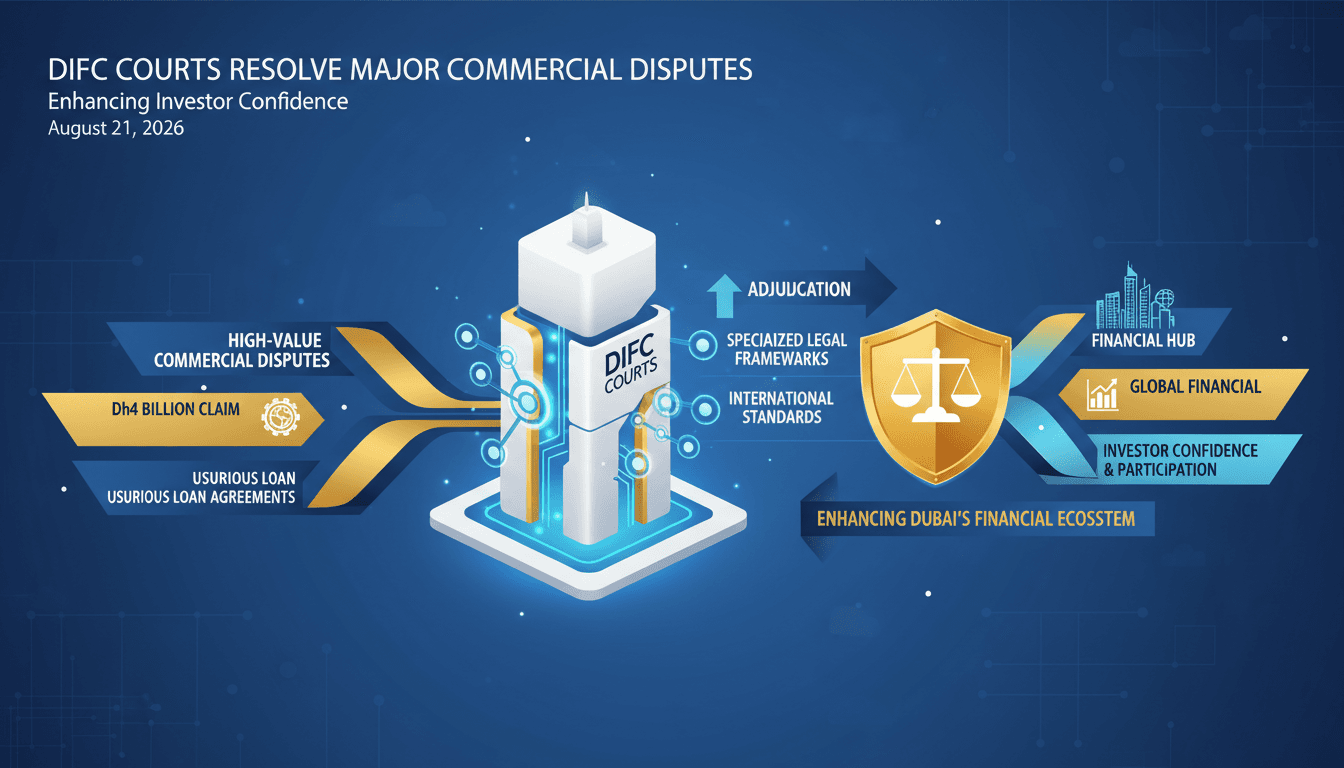
- On August 21, 2026, the DIFC Courts resolved significant commercial disputes, including a claim exceeding Dh4 billion.
- Judge Ali Shams Al Madhani highlighted the complexity of cases, referring to them as disputes between "whales and sharks."
- The court annulled a 16% monthly interest personal loan, emphasizing adherence to UAE public order despite party agreements.
The context you actually need
- Established post-9/11, the DIFC Courts were designed to create a specialized legal framework for international financial transactions.
- Approximately 8,800 licensed companies operate within the DIFC, with over 70,000 daily participants, indicating a vibrant economic ecosystem.
- Jurisdiction is determined by party agreements, allowing for the application of foreign laws while upholding mandatory UAE regulations.
What's really happening
The DIFC Courts are pivotal in shaping Dubai's commercial landscape, particularly in high-stakes financial disputes. Established in response to the need for a specialized legal framework after the September 11 attacks, the courts have evolved to handle complex cases that require a nuanced understanding of international finance and law.
Judge Ali Shams Al Madhani's recent rulings underscore the court's commitment to quality over quantity, focusing on judgments that have significant economic implications rather than merely increasing case volume. The adjudication of a Dh4 billion claim illustrates the scale of disputes being handled, which often involve multinational corporations and high-net-worth individuals.
The annulment of a personal loan agreement with a 16% monthly interest rate highlights the court's role in enforcing UAE public order, even when parties have opted into DIFC jurisdiction. This case serves as a reminder that while the DIFC Courts offer a platform for international legal standards, they remain firmly rooted in the UAE's regulatory framework. The court's decisions can lead to claims for unjust enrichment, reflecting the complexities of financial agreements in a rapidly evolving market.
Moreover, the DIFC Courts' jurisdiction extends through party opt-in agreements, allowing for the application of foreign laws where specified in contracts. This flexibility is crucial for international businesses seeking to navigate the intricacies of cross-border transactions while ensuring compliance with local regulations.
As the DIFC Courts continue to adjudicate high-value disputes, they reinforce investor confidence in Dubai's legal system. The absence of immediate governmental responses or market shifts following these rulings indicates a stable environment that prioritizes reliable dispute resolution. This stability is essential for attracting international institutions and fostering a competitive economic landscape.
Who feels it first (and how)
- International businesses: Companies operating in Dubai or engaging in cross-border transactions will closely monitor DIFC Court rulings for implications on their contracts.
- Investors: High-net-worth individuals and institutional investors will assess the risk associated with financial agreements and the legal protections available in Dubai.
- Legal professionals: Lawyers specializing in commercial law will need to stay updated on DIFC Court precedents to advise clients effectively.
What to watch next
- Increased case volume: Monitor the number of high-value disputes being filed in DIFC Courts, as this could indicate growing investor confidence in Dubai.
- Changes in jurisdictional agreements: Watch for trends in how companies opt into DIFC jurisdiction, which may reflect shifts in international business strategies.
- Regulatory updates: Keep an eye on any changes to UAE laws that could impact the enforcement of financial agreements and the operations of DIFC Courts.
The DIFC Courts are a critical component of Dubai's financial ecosystem, handling complex commercial disputes.
Continued growth in high-value disputes as Dubai attracts more international businesses.
The long-term impact of recent rulings on investor behavior and market dynamics.
Frequently Asked Questions
- Why it matters?
- The DIFC Courts enhance Dubai's reputation as a reliable global financial hub, attracting international businesses and investors.
- What happened (in 30 seconds)?
- On August 21, 2026, the DIFC Courts resolved significant commercial disputes, including a claim exceeding Dh4 billion. Judge Ali Shams Al Madhani highlighted the complexity of cases, referring to them as disputes between "whales and sharks." The court annulled a 16% monthly interest personal loan, emphasizing adherence to UAE public order despite party agreements.
- What's really happening?
- The DIFC Courts are pivotal in shaping Dubai's commercial landscape, particularly in high-stakes financial disputes. Established in response to the need for a specialized legal framework after the September 11 attacks, the courts have evolved to handle complex cases that require a nuanced understanding of international finance and law. Judge Ali Shams Al Madhani's recent rulings underscore the court's commitment to quality over quantity, focusing on judgments that have significant economic imp
- Who feels it first (and how)?
- International businesses: Companies operating in Dubai or engaging in cross-border transactions will closely monitor DIFC Court rulings for implications on their contracts. Investors: High-net-worth individuals and institutional investors will assess the risk associated with financial agreements and the legal protections available in Dubai. Legal professionals: Lawyers specializing in commercial law will need to stay updated on DIFC Court precedents to advise clients effectively.
- What to watch next?
- Increased case volume: Monitor the number of high-value disputes being filed in DIFC Courts, as this could indicate growing investor confidence in Dubai. Changes in jurisdictional agreements: Watch for trends in how companies opt into DIFC jurisdiction, which may reflect shifts in international business strategies. Regulatory updates: Keep an eye on any changes to UAE laws that could impact the enforcement of financial agreements and the operations of DIFC Courts.
English-language coverage focused on UAE news, government updates, and domestic affairs.
"Emirates 24|7 reflects a mainstream UAE editorial perspective with strong emphasis on official and domestic developments."
— A47 Editor
Dubai International Financial Centre Courts resolve major commercial disputes involving ‘sharks and whales’
The Dubai International Financial Centre (DIFC) Courts have recently addressed a significant number of complex commercial disputes, including cases with claims exceeding Dh4 billion and the annulment of a personal loan agreement with a 16% monthly in...
Arabic-language local coverage focused on UAE domestic issues, civic affairs, and community reporting.
"Emarat Al Youm local coverage emphasizes UAE institutions, public services, and community-level developments."
— A47 Editor
محاكم «دبي المالي» تحسم نزاعات «حيتان وقروش» قضايا تجارية كبرى محاكم «دبي المالي» تحسم نزاعات «حيتان وقروش» قضايا تجارية كبرى
The Dubai International Financial Centre Courts have adjudicated a significant number of complex commercial and financial disputes, including a recent case involving a dispute valued at 4 billion dirhams and another concerning a loan with a monthly i...
Business and economy coverage focused on Dubai, the UAE, Saudi Arabia, and the wider Middle East.
"Arabian Business is a well-known regional business outlet with strong focus on Gulf markets, leadership, and investment stories."
— A47 Editor
Global businesses turn to Dubai’s DIFC Courts to resolve disputes outside the UAE
Global businesses are increasingly turning to Dubai's DIFC Courts to resolve disputes outside the UAE, with the courts maintaining the original contractual governing law selected by the parties involved. This trend underscores the growing reputation ...