
Hana Bank Achieves First T+0 Settlement of Digital Bond in South Korea
Why it matters
This transaction represents a significant leap in the adoption of blockchain technology within capital markets, potentially influencing global settlement practices.
What happened (in 30 seconds)
- Hana Bank issued a $100 million digital bond on September 18, 2026, marking a first for South Korea's foreign-currency bond market.
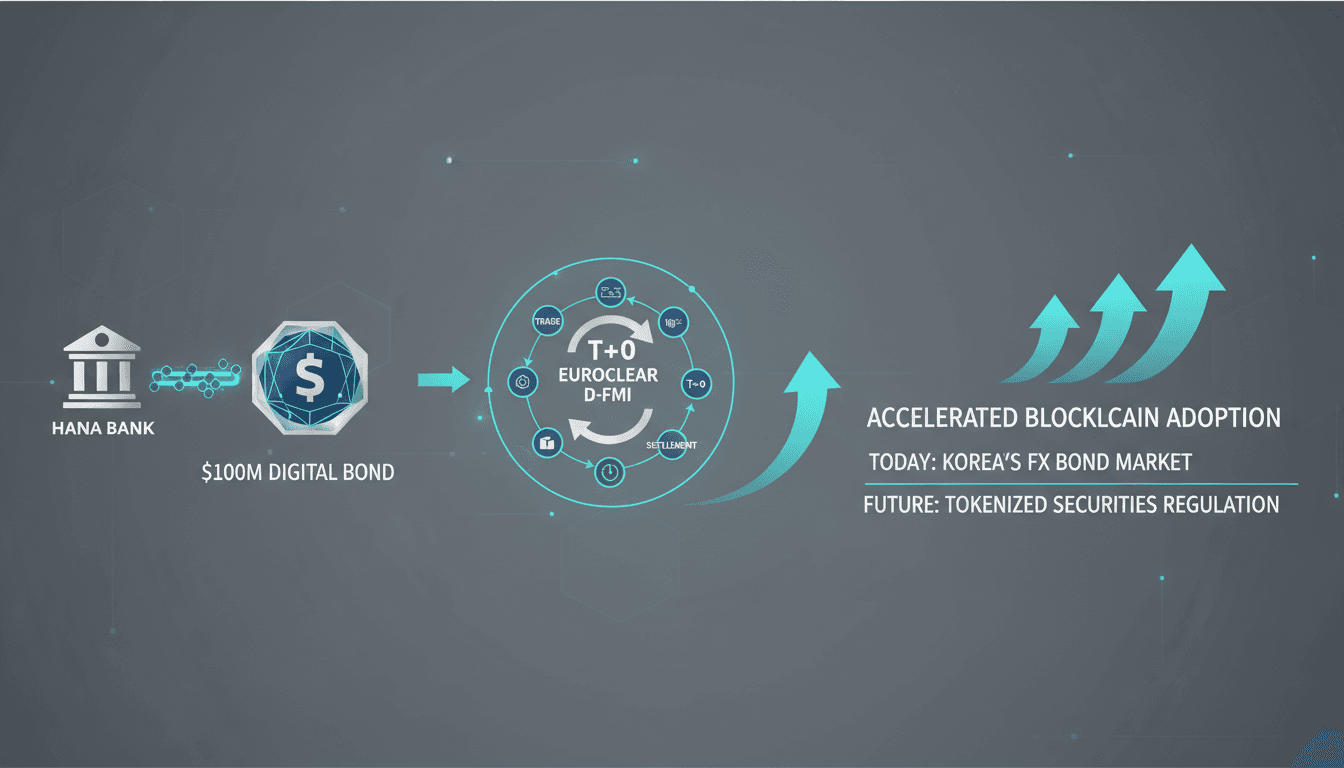
- The bond achieved T+0 settlement through Euroclear’s blockchain-based Digital Financial Market Infrastructure (D-FMI), allowing instantaneous allocation and payment.
- This transaction is a milestone as it is the first direct use of Euroclear’s D-FMI by a Korean financial institution.
The context you actually need
- South Korea's Financial Services Commission is working towards a comprehensive regulatory framework for tokenized securities by February 2027.
- Prior to this, other Korean issuers had utilized alternative infrastructures for digital bonds, indicating a growing interest in blockchain solutions.
- Euroclear launched its D-FMI in October 2023, with cumulative issuance exceeding €1 billion by late 2025, showcasing a trend towards digital financial solutions.
What's really happening
On September 18, 2026, Hana Bank executed a groundbreaking issuance of a $100 million five-year foreign-currency digital bond, utilizing Euroclear’s blockchain-based Digital Financial Market Infrastructure (D-FMI). This transaction is notable not only for its size but also for its innovative settlement process, which compressed the traditional settlement timeline of three to five business days into a same-day T+0 settlement.
The bond was issued under updated Global Medium-Term Note documentation, with Standard Chartered acting as the sole lead manager and bookrunner, while Citi served as the DNN and fiscal agent. The use of Euroclear’s D-FMI allowed for simultaneous processing of issuance, registration, allocation, and cash settlement, enabling investors to access the instrument through their existing Euroclear accounts without the need for new onboarding. This seamless integration represents a significant advancement in the operational efficiency of bond markets.
Hana Bank's officials have characterized this issuance as a meaningful step in applying blockchain technology to capital markets, extending beyond mere funding diversification. The transaction aligns with a broader trend of institutional adoption of distributed ledger technology, which is increasingly seen as a viable solution for enhancing transparency and reducing settlement risks in financial markets.
The implications of this transaction extend beyond Hana Bank and South Korea. As the global financial landscape evolves, the successful implementation of T+0 settlements could set a precedent for other financial institutions worldwide. The ability to settle transactions instantly could attract more investors to digital bonds, potentially increasing liquidity in the market. Furthermore, as regulatory frameworks for tokenized securities develop, we may see a surge in similar transactions, pushing the boundaries of traditional finance.
Who feels it first (and how)
- Financial institutions: Banks and investment firms may need to adapt their operations to accommodate faster settlement processes.
- Investors: Both institutional and retail investors could benefit from improved liquidity and reduced transaction times.
- Regulators: Regulatory bodies will need to monitor and adapt to the implications of blockchain technology in capital markets.
What to watch next
- Regulatory developments: Keep an eye on South Korea's Financial Services Commission as it finalizes its tokenized securities framework in February 2027, which could influence market practices.
- Market adoption: Watch for other financial institutions in South Korea and globally to adopt similar blockchain-based settlement processes, potentially leading to a shift in industry standards.
- Investor response: Monitor how investors react to the increased efficiency and liquidity of digital bonds, which could drive further innovation in the market.
Hana Bank's issuance is the first T+0 settlement in South Korea's foreign-currency bond market.
Other financial institutions will explore similar blockchain-based solutions for bond issuance and settlement.
The long-term impact of this transaction on global bond markets and investor behavior remains to be seen.
Frequently Asked Questions
- Why it matters?
- This transaction represents a significant leap in the adoption of blockchain technology within capital markets, potentially influencing global settlement practices.
- What happened (in 30 seconds)?
- Hana Bank issued a $100 million digital bond on September 18, 2026, marking a first for South Korea's foreign-currency bond market. The bond achieved T+0 settlement through Euroclear’s blockchain-based Digital Financial Market Infrastructure (D-FMI), allowing instantaneous allocation and payment. This transaction is a milestone as it is the first direct use of Euroclear’s D-FMI by a Korean financial institution.
- What's really happening?
- On September 18, 2026, Hana Bank executed a groundbreaking issuance of a $100 million five-year foreign-currency digital bond, utilizing Euroclear’s blockchain-based Digital Financial Market Infrastructure (D-FMI). This transaction is notable not only for its size but also for its innovative settlement process, which compressed the traditional settlement timeline of three to five business days into a same-day T+0 settlement. The bond was issued under updated Global Medium-Term Note documentati
- Who feels it first (and how)?
- Financial institutions: Banks and investment firms may need to adapt their operations to accommodate faster settlement processes. Investors: Both institutional and retail investors could benefit from improved liquidity and reduced transaction times. Regulators: Regulatory bodies will need to monitor and adapt to the implications of blockchain technology in capital markets.
- What to watch next?
- Regulatory developments: Keep an eye on South Korea's Financial Services Commission as it finalizes its tokenized securities framework in February 2027, which could influence market practices. Market adoption: Watch for other financial institutions in South Korea and globally to adopt similar blockchain-based settlement processes, potentially leading to a shift in industry standards. Investor response: Monitor how investors react to the increased efficiency and liquidity of digital bonds, which
Covers Bitcoin plus altcoin news, market updates, and educational resources.
"Bitcoin.com provides news, market data, and guides focused on Bitcoin and the wider crypto industry."
— A47 Editor
Hana Bank Put $100M on Blockchain and Skipped the 5-Day Wait
Hana Bank has successfully issued a $100 million digital bond using Euroclear's blockchain technology, significantly reducing the settlement time from three to five business days to the same day. This marks a significant milestone as it is South Kore...
Covers blockchain, cryptocurrency news, project analysis, and market insights.
"CoinDesk is a well-established cryptocurrency and blockchain news provider, offering comprehensive insights, market data, and industry research."
— A47 Editor
Hana Bank issues South Korea’s first digital bond using Euroclear’s blockchain
Hana Bank has issued South Korea’s first digital bond worth $100 million, utilizing Euroclear’s blockchain technology to streamline the settlement process, reducing it from three to five business days to the same day. This marks a significant milesto...
Real-time updates, analysis, and reports on the blockchain and cryptocurrency sectors.
"Crypto News delivers real-time updates, analysis, and reports on the blockchain and cryptocurrency sectors."
— A47 Editor
Hana Bank issues $100M digital bond on Euroclear
Hana Bank has issued a $100 million five-year digital bond on Euroclear’s D-FMI, marking a significant advancement as it is South Korea's first digital bond utilizing blockchain technology to streamline the settlement process, reducing it from three ...
Covers blockchain, cryptocurrency news, project analysis, and market insights.
"Cointelegraph is a leading crypto-focused media outlet known for timely news, analysis, and educational content related to blockchain and digital assets."
— A47 Editor
Hana Bank taps Euroclear blockchain for $100M bond issuance: Report
Hana Bank has successfully issued a $100 million digital bond utilizing Euroclear's blockchain infrastructure, significantly reducing the settlement time from three to five business days to the same day. This five-year bond marks a notable advancemen...