
OpenAI Seeks $30 Billion Round at $1.25 Trillion Pre-Money Valuation With UAE and Coatue Backing
Why it matters
The repricing of OpenAI’s proposed $30 billion bridge round signals that even the market's primary AI standard must trim valuations when infrastructure capital expenditures collide with investor demands for near-term returns.
What happened (in 30 seconds)
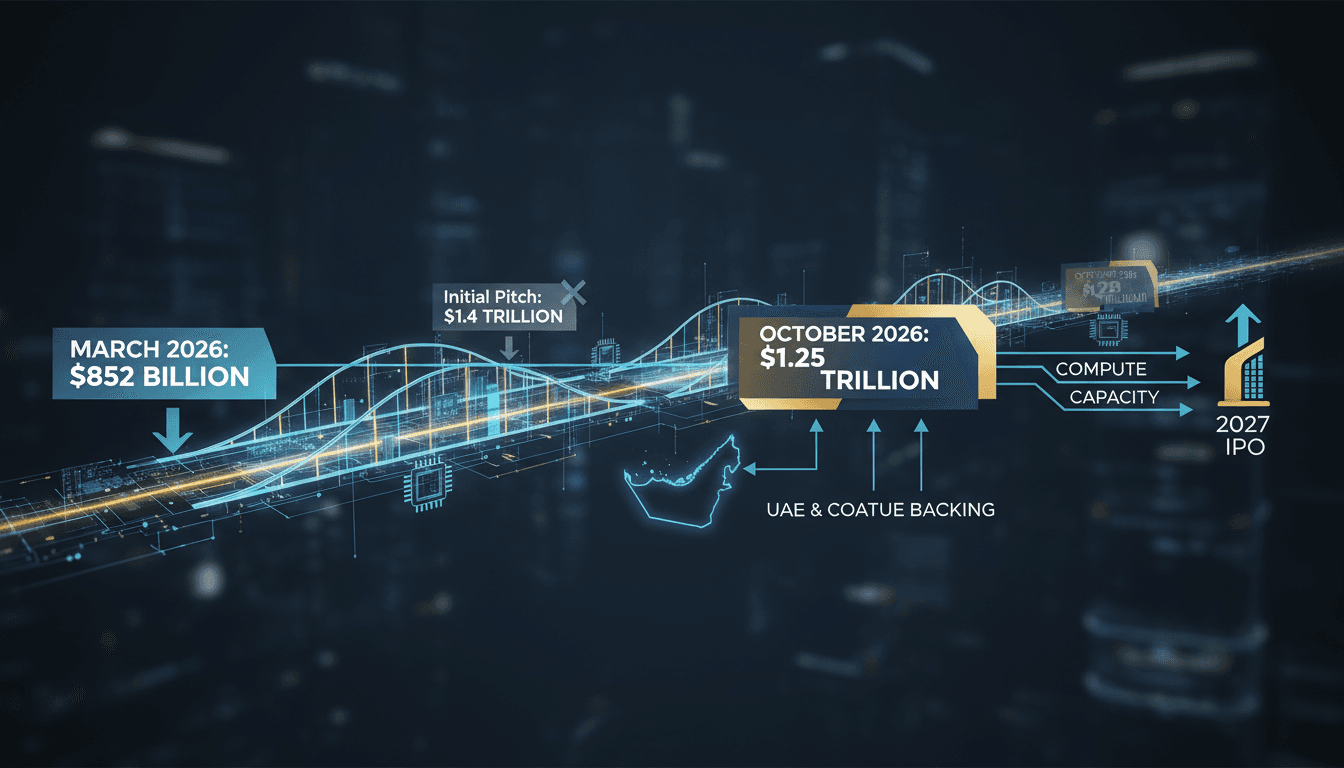
- The valuation trimmed: OpenAI entered final-stage negotiations in October 2026 for a funding round of up to $30 billion at a $1.25 trillion pre-money valuation, down $150 billion from an initial $1.4 trillion pitch.
- The anchor syndicate formed: Coatue Management and UAE-based investment funds, including Abu Dhabi's MGX, emerged to lead discussions ahead of an October 30, 2026 commitment deadline.
- The bridge is set: The transaction functions as liquidity and computing runway bridging OpenAI from its $122 billion round in March 2026 to its anticipated 2027 public market listing.
The context you actually need
- A 47% step-up under scrutiny: While the $1.25 trillion figure is a concession from the $1.4 trillion ask, it still marks a roughly 47% valuation increase over the company’s $852 billion valuation set in March 2026.
- A confidential IPO track: OpenAI confidentially filed for an initial public offering in June 2026, creating a hard calendar timeline where any private equity pricing directly establishes public market expectations.
- Slowing tech momentum: The financing talks unfolded against softening public technology equities, prompted by institutional questions regarding the payback period of global AI compute capacity.
What's really happening
The negotiation dynamics between San Francisco and the UAE illustrate an evolving capital structure in artificial intelligence. This is no longer merely a financial investment; it is a structural swap of equity for computational capacity and sovereign infrastructure.
OpenAI initially sought a $1.4 trillion pre-money valuation in September 2026. Within weeks, pushback from institutional allocators forced a $150 billion cut to $1.25 trillion. Investors, contending with a pullback across public tech stocks, are scrutinizing the return profile of hardware deployments. OpenAI’s business model requires tens of billions of dollars annually to train next-generation models and deliver inferences at scale. Because that burn rate cannot wait for public market liquidity in 2027, the company must access private capital pools capable of writing multi-billion-dollar checks.
This reality explains why UAE-based entities, alongside traditional technology crossover funds like Coatue Management, are positioned at the center of the syndicate. For sovereign-backed vehicles such as Abu Dhabi’s MGX, capital deployment is tied to regional strategic goals: hosting data centers, securing compute access, and anchoring the UAE as the central logistics hub for global compute. In parallel with balance sheet equity, these negotiations encompass commercial agreements granting OpenAI access to computing capacity developed directly within the UAE.
For OpenAI, partnering with Gulf allocators solves two operational hurdles simultaneously: it bridges working capital needs ahead of a 2027 IPO without relying solely on cautious Silicon Valley venture funds, and it locks down physical computing capacity outside domestic constraints. For the UAE, securing an equity stake and commercial computing ties at a $1.25 trillion valuation positions Abu Dhabi and Dubai as essential nodes in global compute logistics.
Simultaneously, OpenAI faces competitive discipline from Anthropic’s planned public listing. By attempting to close up to $30 billion by late October 2026, OpenAI is locking in pre-IPO liquidity, setting its private valuation benchmark, and funding the compute necessary to defend its operational lead before public markets open their order books.
Who feels it first (and how)
- Gulf sovereign funds and infrastructure managers: Entities like MGX gain equity ownership alongside compute hosting opportunities, accelerating regional infrastructure buildouts across Dubai and Abu Dhabi.
- Late-stage enterprise tech investors: Crossover institutions like Coatue and BlackRock face calibrated entry pricing, establishing disciplined multiples ahead of the 2027 IPO window.
- Enterprise software buyers: Technology executives evaluating AI model lock-in can expect OpenAI’s pricing to reflect its capital-intensive compute footprint as margins face scrutiny.
- Rival AI labs (Anthropic and peers): Competitors preparing for public listings must calibrate their own pricing models against OpenAI's $1.25 trillion private benchmark.
What to watch next
- The October 30 commitment tally: Whether OpenAI secures the full $30 billion or accepts a smaller sum clarifies the exact risk appetite of institutional investors at a $1.25 trillion valuation.
- Compute pact disclosures: The details of commercial side agreements between OpenAI and UAE data center projects will show whether physical capacity was a condition for capital.
- Anthropic's IPO filing terms: The initial public pricing metrics set by Anthropic will test whether OpenAI's private step-up holds weight in broader public markets.
OpenAI reduced its valuation target from $1.4 trillion to $1.25 trillion for a round of up to $30 billion, with Coatue and UAE funds in advanced talks ahead of an October 30 deadline.
The round will close at or near $1.25 trillion, but total proceeds could finish below the $30 billion ceiling depending on institutional risk appetite.
The exact ratio of cash investment versus computing capacity allocations provided by UAE partners remains unconfirmed.
Frequently Asked Questions
- Why it matters?
- The repricing of OpenAI’s proposed $30 billion bridge round signals that even the market's primary AI standard must trim valuations when infrastructure capital expenditures collide with investor demands for near-term returns.
- What happened (in 30 seconds)?
- The valuation trimmed: OpenAI entered final-stage negotiations in October 2026 for a funding round of up to $30 billion at a $1.25 trillion pre-money valuation, down $150 billion from an initial $1.4 trillion pitch. The anchor syndicate formed: Coatue Management and UAE-based investment funds, including Abu Dhabi's MGX, emerged to lead discussions ahead of an October 30, 2026 commitment deadline. The bridge is set: The transaction functions as liquidity and computing runway bridging OpenAI from
- What's really happening?
- The negotiation dynamics between San Francisco and the UAE illustrate an evolving capital structure in artificial intelligence. This is no longer merely a financial investment; it is a structural swap of equity for computational capacity and sovereign infrastructure. OpenAI initially sought a $1.4 trillion pre-money valuation in September 2026. Within weeks, pushback from institutional allocators forced a $150 billion cut to $1.25 trillion. Investors, contending with a pullback across public t
- Who feels it first (and how)?
- Gulf sovereign funds and infrastructure managers: Entities like MGX gain equity ownership alongside compute hosting opportunities, accelerating regional infrastructure buildouts across Dubai and Abu Dhabi. Late-stage enterprise tech investors: Crossover institutions like Coatue and BlackRock face calibrated entry pricing, establishing disciplined multiples ahead of the 2027 IPO window. Enterprise software buyers: Technology executives evaluating AI model lock-in can expect OpenAI’s pricing to re
- What to watch next?
- The October 30 commitment tally: Whether OpenAI secures the full $30 billion or accepts a smaller sum clarifies the exact risk appetite of institutional investors at a $1.25 trillion valuation. Compute pact disclosures: The details of commercial side agreements between OpenAI and UAE data center projects will show whether physical capacity was a condition for capital. Anthropic's IPO filing terms: The initial public pricing metrics set by Anthropic will test whether OpenAI's private step-up hold
English-language digital publication covering business, politics, technology, and current affairs.
"The Arabian Post mixes original and syndicated-style coverage with a broad regional and global business-news orientation."
— A47 Editor
OpenAI targets $1.25 trillion valuation for $30 billion round
OpenAI is approaching a funding round of up to $30 billion, targeting a valuation of $1.25 trillion, which is a reduction from the previously discussed $1.4 trillion. This adjustment reflects ongoing negotiations as the company seeks to finalize the ...
Technology business and AI-related headlines.
"Data-driven tech newsroom with global scope."
— A47 Editor
OpenAI Sets Target Valuation of $1.25 Trillion
OpenAI is in the process of raising approximately $30 billion in a new funding round, which could elevate its valuation to $1.25 trillion, according to sources familiar with the matter. This significant financial move is part of OpenAI's strategy to ...
Technology business news, market impacts, and innovation trends.
"Bloomberg is a premier financial and tech news provider, respected for its in-depth reporting and analytical rigor."
— A47 Editor
OpenAI Sets Target Valuation of $1.25 Trillion
OpenAI is in the process of raising approximately $30 billion in a new funding round, which could elevate its valuation to $1.25 trillion, according to sources familiar with the matter. This significant financial move is part of OpenAI's strategy to ...
Daily AI news: models, tools, and policy.
"Independent outlet tracking the fast pace of AI."
— A47 Editor
OpenAI lowers valuation target, raises up to $30 billion
OpenAI is nearing a significant funding round of up to $30 billion, but has adjusted its valuation target down to $1.25 trillion from an earlier estimate of $1.4 trillion. This change comes as the company seeks to secure investor commitments ahead of...