
Apollo Chief Economist Finds No Measurable AI Financial Payoff for S&P 493 Companies Outside Big Tech
Why it matters
Capital allocation across 493 of the S&P 500 corporations is decoupling from tangible productivity, signaling an end to speculative enterprise software deployment without immediate margin expansion.
What happened (in 30 seconds)
- Apollo flagged a performance flatline: On October 24, 2026, Apollo Global Management Chief Economist Torsten Slok published research showing that artificial intelligence has generated zero measurable financial payoff for S&P 500 companies outside the technology sector.
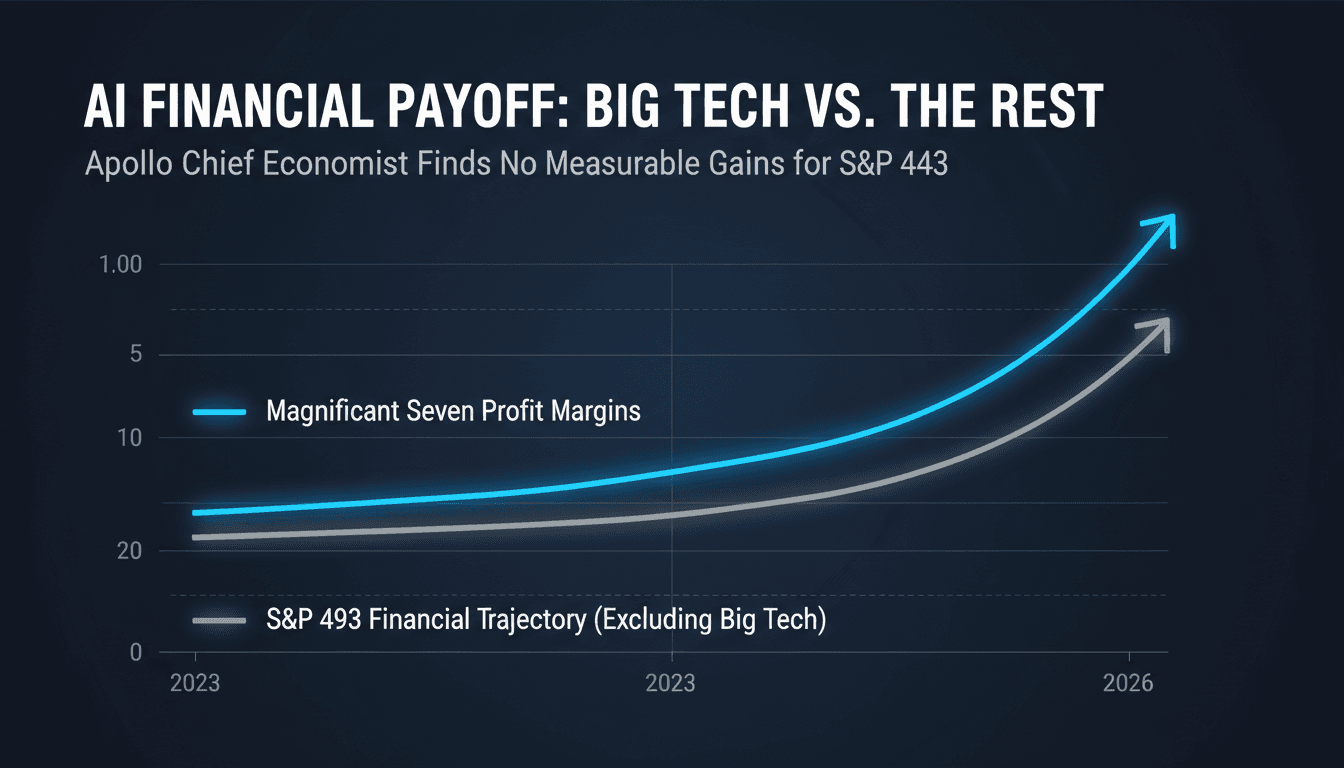
- The index diverged sharply: While the "Magnificent Seven" (Alphabet, Amazon, Apple, Meta, Microsoft, Nvidia, and Tesla) expanded margins and revenue per worker, the remaining S&P 493 exhibited flat financial metrics across the board.
- Software costs shifted categories: Rather than serving as an engine of top-line expansion, ongoing spending on AI API calls and compute tokens is increasingly logged as a recurring operational cost center by mainstream corporate finance teams.
The context you actually need
- Earnings call narratives outpaced data: Mainstream industrial, retail, and financial corporations aggressively referenced artificial intelligence integrations on investor calls throughout preceding quarters without translating those mentions into aggregate operating leverage.
- Underlying economic indicators stalled: Utilization-adjusted total factor productivity data failed to register structural acceleration outside technology manufacturing and cloud infrastructure providers.
- Macroeconomic debates emerged over missing value: In response to the published note, economists including Brad DeLong observed that early economic gains from general-purpose technologies often accrue as unmeasured consumer surplus and new business formation before surfacing in legacy balance sheets.
What's really happening
The structural issue identified across the S&P 493 rests on a fundamental mismatch between artificial intelligence tool capabilities and corporate profit generation. To generate durable operating margins, technology capital expenditures must either reduce headcounts for an equivalent volume of output or scale total output without an equivalent increase in unit costs. Torsten Slok’s aggregate findings reveal that neither condition has occurred outside the Magnificent Seven.
Instead, the economics of mainstream enterprise deployments are constrained by structural limitations. Modern foundational models lack autonomous capacity for institutional judgment, legal accountability, and ethical governance. Because organizations cannot delegate liability or mission-critical oversight to non-deterministic systems, corporate workflows continue to require the same human labor force to verify, edit, and audit machine outputs. The result is an additive operational layer: enterprise software license fees and compute token usage rise, but payrolls and throughput remain static. Consequently, revenue per worker across the S&P 493 remains flat.
Simultaneously, the supplier market captures the existing surplus. The infrastructure layer—specifically the Magnificent Seven companies designing semiconductors, operating hyperscale data centers, and licensing enterprise toolkits—records visible margin expansion and elevated sales per worker. Their customers in traditional enterprise sectors, spanning consumer goods, logistics, regional banking, and legacy manufacturing, bear the capital expenditures without extracting pricing power from their own end clients. When non-tech companies deploy client-facing chatbots or internal document summarization tools, competitors adopt identical off-the-shelf models within weeks. This dynamic neutralizes any competitive moat and eliminates the ability to charge premium prices.
Because efficiency gains do not outpace the recurring costs of deployment, chief financial officers are adjusting internal accounting classifications. AI token consumption, initially defended as an innovative growth driver, is being reassessed as a recurring administrative overhead expense. Until autonomous systems can execute regulated enterprise responsibilities without human supervision, the financial payoff remains confined to the vendors manufacturing the computational hardware.
Who feels it first (and how)
- Enterprise Chief Financial Officers: Face mounting pressure to reduce software experimentation budgets and reclassify artificial intelligence pilots into traditional cost-cutting audits.
- Non-Tech Corporate IT Leaders: Encounter heightened scrutiny on enterprise license agreements, requiring quantitative proof of workforce output before renewals are approved.
- Software Vendors Selling to the Fortune 500: Experience elongated enterprise sales cycles as non-tech buyers demand contractual revenue uplift or verified labor savings before committing funds.
- Mainstream Corporate White-Collar Workers: See an end to passive technology exploration phases, shifting toward demands for measurable administrative output per person.
What to watch next
- Corporate IT Budget Reallocations: Watch subsequent quarterly enterprise software guidance to see whether non-tech firms reduce annual token consumption commitments.
- Utilization-Adjusted Total Factor Productivity Releases: Track aggregate economic productivity prints for the initial signals of non-tech labor efficiency shifts.
- S&P 493 Revenue-Per-Worker Metrics: Monitor trailing enterprise filings to observe whether margin compression forces workforce restructuring or software cancellations.
The S&P 493 has recorded flat profit margins and flat revenue per worker alongside artificial intelligence adoption, while the Magnificent Seven captured nearly all sector financial returns.
Mainstream enterprise management will scale back speculative software pilot programs to curb recurring operational token overhead.
Whether future iterations of artificial intelligence architectures can overcome judgment and accountability barriers to drive measurable corporate productivity.
Frequently Asked Questions
- Why it matters?
- Capital allocation across 493 of the S&P 500 corporations is decoupling from tangible productivity, signaling an end to speculative enterprise software deployment without immediate margin expansion.
- What happened (in 30 seconds)?
- Apollo flagged a performance flatline: On October 24, 2026, Apollo Global Management Chief Economist Torsten Slok published research showing that artificial intelligence has generated zero measurable financial payoff for S&P 500 companies outside the technology sector. The index diverged sharply: While the "Magnificent Seven" (Alphabet, Amazon, Apple, Meta, Microsoft, Nvidia, and Tesla) expanded margins and revenue per worker, the remaining S&P 493 exhibited flat financial metrics across the boa
- What's really happening?
- The structural issue identified across the S&P 493 rests on a fundamental mismatch between artificial intelligence tool capabilities and corporate profit generation. To generate durable operating margins, technology capital expenditures must either reduce headcounts for an equivalent volume of output or scale total output without an equivalent increase in unit costs. Torsten Slok’s aggregate findings reveal that neither condition has occurred outside the Magnificent Seven. Instead, the economic
- Who feels it first (and how)?
- Enterprise Chief Financial Officers: Face mounting pressure to reduce software experimentation budgets and reclassify artificial intelligence pilots into traditional cost-cutting audits. Non-Tech Corporate IT Leaders: Encounter heightened scrutiny on enterprise license agreements, requiring quantitative proof of workforce output before renewals are approved. Software Vendors Selling to the Fortune 500: Experience elongated enterprise sales cycles as non-tech buyers demand contractual revenue upl
- What to watch next?
- Corporate IT Budget Reallocations: Watch subsequent quarterly enterprise software guidance to see whether non-tech firms reduce annual token consumption commitments. Utilization-Adjusted Total Factor Productivity Releases: Track aggregate economic productivity prints for the initial signals of non-tech labor efficiency shifts. S&P 493 Revenue-Per-Worker Metrics: Monitor trailing enterprise filings to observe whether margin compression forces workforce restructuring or software cancellations.
Startup news with frequent AI coverage.
"Covers launches, funding, and product updates in AI."
— A47 Editor
AI delivers ‘zero financial payoff’ to most companies, Apollo economist says
An economist at Apollo, Torsten Slok, has said that artificial intelligence has delivered "zero financial payoff" to most companies in corporate America outside the technology sector, despite massive investment and widespread hype around the technolo...
Business and tech news excluding paywalled content.
"High-volume business/tech outlet with frequent AI coverage."
— A47 Editor
Apollo says AI has delivered 'zero financial payoff' outside the tech industry
Apollo Global Management said that AI has so far delivered "zero financial payoff" outside the technology industry, with only tech companies seeing growth from the AI boom, according to a Business Insider report.
Technology business and AI-related headlines.
"Data-driven tech newsroom with global scope."
— A47 Editor
AI Provides ‘Zero Payoff’ to S&P 493 Outside Tech, Apollo Economist Says
Apollo Global Management Chief Economist Torsten Slok has said that artificial intelligence spending has provided "zero payoff" to companies in the S&P 493 outside the technology sector, according to Bloomberg Technology, despite heavy investment acr...
Technology business news, market impacts, and innovation trends.
"Bloomberg is a premier financial and tech news provider, respected for its in-depth reporting and analytical rigor."
— A47 Editor
AI Provides ‘Zero Payoff’ to S&P 493 Outside Tech, Apollo Economist Says
Apollo Global Management Chief Economist Torsten Slok has said that artificial intelligence spending has provided "zero payoff" to companies in the S&P 493 outside the technology sector, according to Bloomberg Technology, despite heavy investment acr...