
Instacart Explores Potential Sale Amid Preliminary Talks With DoorDash and Uber
Why it matters
A potential consolidation between Instacart and DoorDash would concentrate last-mile digital grocery scale into an integrated platform to counter retail giants like Amazon and Walmart.
What happened (in 30 seconds)
- Instacart retained an investment bank to evaluate strategic exit options, initiating exploratory buyout discussions with DoorDash and Uber around October 23, 2026.
- Uber exited preliminary conversations, leaving DoorDash as the primary interested suitor in early talks, though neither party has formalized a firm bid or binding transaction.
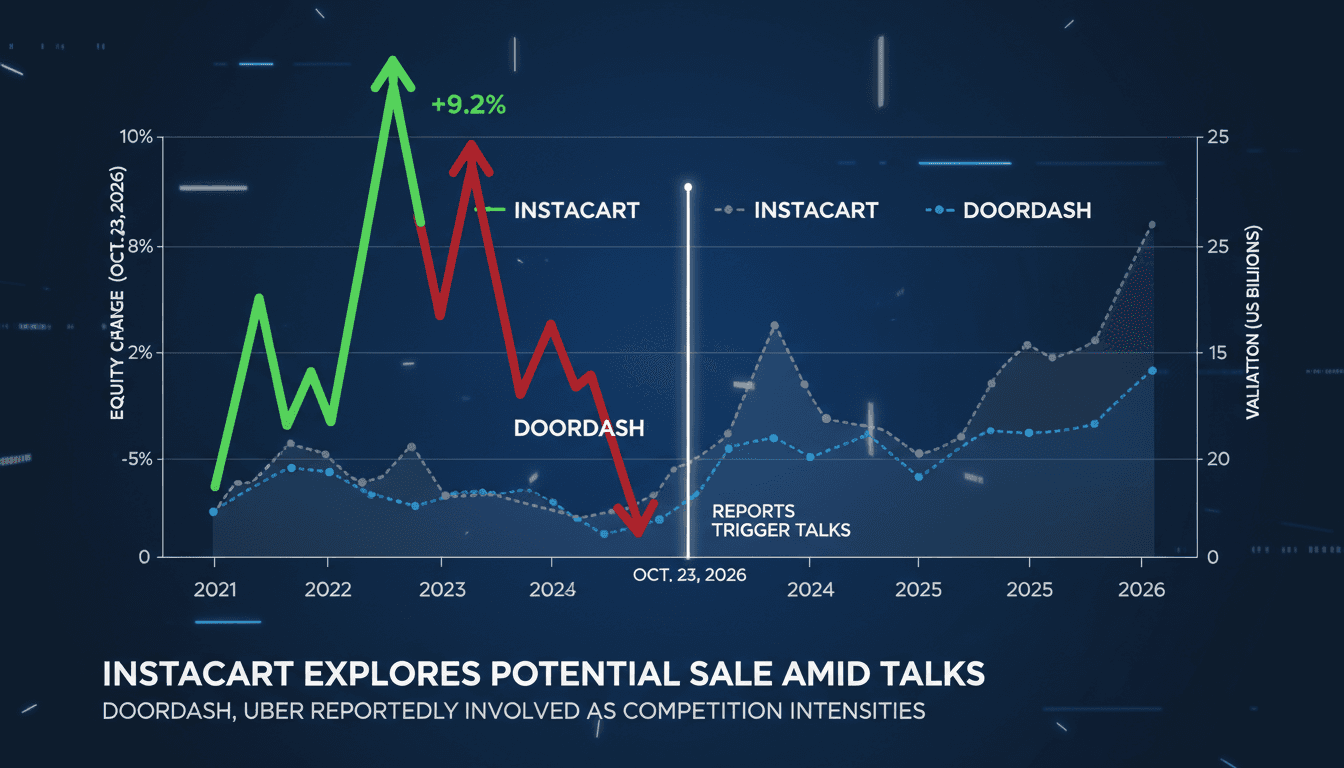
- Equity markets reacted immediately, sending Instacart shares up roughly 9.2% on October 23, while DoorDash and Uber shares dropped as investors weighed potential dilution and acquisition premiums.
The context you actually need
- Standalone growth slowed following public listing: After completing its 2023 initial public offering, Instacart (Maplebear Inc.) faced deceleration in top-line expansion relative to broader delivery peers in the post-pandemic digital grocery environment.
- A multi-year acquisition history exists: DoorDash previously weighed buying Instacart in 2021 at an estimated $40 billion to $50 billion valuation before abandoning discussions over regulatory and antitrust concerns.
- Heavyweight competitors reshaped margins: Amazon and Walmart have rapidly widened their direct-to-consumer grocery fulfillment networks, forcing multi-merchant delivery apps to compete on scale, delivery efficiency, and integrated consumer bundles.
What's really happening
The economic logic driving Instacart’s engagement with an investment bank is structural rather than situational. Instacart operates with a public market capitalization exceeding $12 billion. When incorporating a 30% to 40% acquisition premium based on standard enterprise technology transactions, any successful transaction would reach roughly $16 billion to $17 billion. That figure sits far below the $40 billion to $50 billion valuation considered during DoorDash’s initial pursuit in 2021, yet it marks an inflection point: specialized, grocery-only intermediary networks are struggling to outrun integrated multi-category logistics apps.
For DoorDash, pursuing Instacart is an incentive-driven play for catalog density, retail partnerships, and consumer acquisition. DoorDash built its base on high-frequency, lower-basket restaurant orders. Grocery, by contrast, offers larger ticket sizes, sticky weekly routines, and lucrative high-margin retail media advertising. By acquiring Instacart, DoorDash would bypass years of organic partner onboarding, absorbing thousands of regional and national grocery merchant integrations in a single stroke. This scale is vital to defend order volume against Walmart's in-house fulfillment infrastructure and Amazon's delivery logistics.
For Instacart, the calculus centers on unit economics. Generating standalone profitability requires sustaining active user volume without discounting delivery fees to negative margins. Unlike Uber or DoorDash, Instacart cannot cross-subsidize delivery costs through rideshare dispatch or restaurant deliveries during off-peak grocery hours. It must monetize grocery baskets directly or rely on high-margin software services and ad inventory sold to consumer packaged goods brands. As growth slows, combining with DoorDash offers shared driver dispatch networks and lower per-delivery acquisition overhead.
Uber’s reported choice to exit discussions illustrates differing capital allocation discipline. Integrating a target valued near $16 billion introduces equity dilution and operational friction. Uber has concentrated its balance sheet on shared mobility optimization and cross-selling Uber Eats within an existing driver pool, avoiding the debt or equity load required to absorb Maplebear Inc.
If DoorDash pursues a formal offer, regulatory friction will represent the primary obstacle. Overlapping footprint in urban grocery dispatch and unified delivery platforms will invite close review from competition authorities, echoing the antitrust concerns that halted their 2021 negotiations.
Who feels it first (and how)
- Consumer platform investors: Equity holders must navigate equity volatility and potential share dilution, seen immediately when Instacart rose 9.2% while DoorDash dipped on news of capital expenditure requirements.
- Supermarket and grocery executives: Retail partners risk losing bargaining leverage if two dominant delivery aggregators merge into a singular platform controlling digital store aisles.
- Gig economy delivery couriers: Independent drivers face unified dispatch algorithms, merged order queues, and altered pay structures across restaurant and grocery runs.
- Enterprise retail media directors: Brands allocating digital ad budgets will see Instacart's advertising real estate absorbed into broader multi-service delivery platforms.
What to watch next
- DoorDash financing terms: Watch whether DoorDash tables a formal proposal structured through equity exchange, debt facilities, or a cash combination, which will reveal their risk tolerance for balance-sheet leverage.
- Regulatory agency responses: Monitor antitrust bodies in the United States for informal warnings or preliminary inquiries regarding grocery delivery market share concentration.
- Maplebear Inc. quarterly updates: Track Instacart’s baseline revenue growth and active merchant metrics to evaluate whether leadership faces urgent pressure to close an exit.
Instacart engaged an investment bank, held preliminary discussions with DoorDash and Uber in late October 2026, and Uber subsequently withdrew from the process.
Any definitive agreement will demand a premium of 30% to 40% over Instacart's market capitalization, implying a deal valuation between $16 billion and $17 billion.
Whether DoorDash will formalize a binding transaction, and whether antitrust regulators will permit the combination of the two largest independent delivery networks.
Frequently Asked Questions
- Why it matters?
- A potential consolidation between Instacart and DoorDash would concentrate last-mile digital grocery scale into an integrated platform to counter retail giants like Amazon and Walmart.
- What happened (in 30 seconds)?
- Instacart retained an investment bank to evaluate strategic exit options, initiating exploratory buyout discussions with DoorDash and Uber around October 23, 2026. Uber exited preliminary conversations, leaving DoorDash as the primary interested suitor in early talks, though neither party has formalized a firm bid or binding transaction. Equity markets reacted immediately, sending Instacart shares up roughly 9.2% on October 23, while DoorDash and Uber shares dropped as investors weighed potentia
- What's really happening?
- The economic logic driving Instacart’s engagement with an investment bank is structural rather than situational. Instacart operates with a public market capitalization exceeding $12 billion. When incorporating a 30% to 40% acquisition premium based on standard enterprise technology transactions, any successful transaction would reach roughly $16 billion to $17 billion. That figure sits far below the $40 billion to $50 billion valuation considered during DoorDash’s initial pursuit in 2021, yet it
- Who feels it first (and how)?
- Consumer platform investors: Equity holders must navigate equity volatility and potential share dilution, seen immediately when Instacart rose 9.2% while DoorDash dipped on news of capital expenditure requirements. Supermarket and grocery executives: Retail partners risk losing bargaining leverage if two dominant delivery aggregators merge into a singular platform controlling digital store aisles. Gig economy delivery couriers: Independent drivers face unified dispatch algorithms, merged order q
- What to watch next?
- DoorDash financing terms: Watch whether DoorDash tables a formal proposal structured through equity exchange, debt facilities, or a cash combination, which will reveal their risk tolerance for balance-sheet leverage. Regulatory agency responses: Monitor antitrust bodies in the United States for informal warnings or preliminary inquiries regarding grocery delivery market share concentration. Maplebear Inc. quarterly updates: Track Instacart’s baseline revenue growth and active merchant metrics to
Startup news with frequent AI coverage.
"Covers launches, funding, and product updates in AI."
— A47 Editor
Instacart reportedly discussed selling itself with DoorDash and Uber
Instacart is reportedly in discussions to sell itself, having held preliminary talks with DoorDash and Uber, as it seeks to navigate a competitive landscape in the grocery delivery market. The company, valued at approximately $12 billion, is explorin...
Market-moving headlines impacting equities, bonds, and related risk assets.
"Real-time catalysts and volatility drivers across indices and sectors."
— A47 Editor
Instacart in talks with DoorDash and Uber for sale, The Information reports
Instacart is reportedly in discussions with DoorDash and Uber regarding a potential sale, as reported by The Information. This development comes amid a backdrop of strong performance for Instacart, which has recently exceeded revenue expectations due...
Curated tech headlines including AI stories.
"Influential aggregator surfacing the day’s top tech/AI links."
— A47 Editor
Sources: Instacart, currently valued at $12B, is in talks to sell itself and held preliminary conversations with DoorDash and Uber; CART jumps 9%+ (The Information)
Instacart, currently valued at $12 billion, is reportedly in discussions to sell itself, having held preliminary talks with DoorDash and Uber. This potential sale marks a significant shift for the grocery delivery app, which has operated independentl...
Technology business and AI-related headlines.
"Data-driven tech newsroom with global scope."
— A47 Editor
Instacart Considers a Potential Sale, Sparking Share Rally
Instacart has initiated discussions regarding a potential sale of the grocery-delivery company, reportedly engaging with Uber Technologies Inc. as part of this process. This exploration comes amid a rally in Instacart's shares, indicating investor in...
Technology business news, market impacts, and innovation trends.
"Bloomberg is a premier financial and tech news provider, respected for its in-depth reporting and analytical rigor."
— A47 Editor
Instacart Considers a Potential Sale, Sparking Share Rally
Instacart has initiated discussions regarding a potential sale of the grocery-delivery company, reportedly engaging with Uber Technologies Inc. as part of this process. This exploration comes amid a rally in Instacart's shares, indicating investor in...