
Warhound Emerges From Stealth With $200 Million to Engineer Cloned Military Working Dogs for U.S. Supply Chains
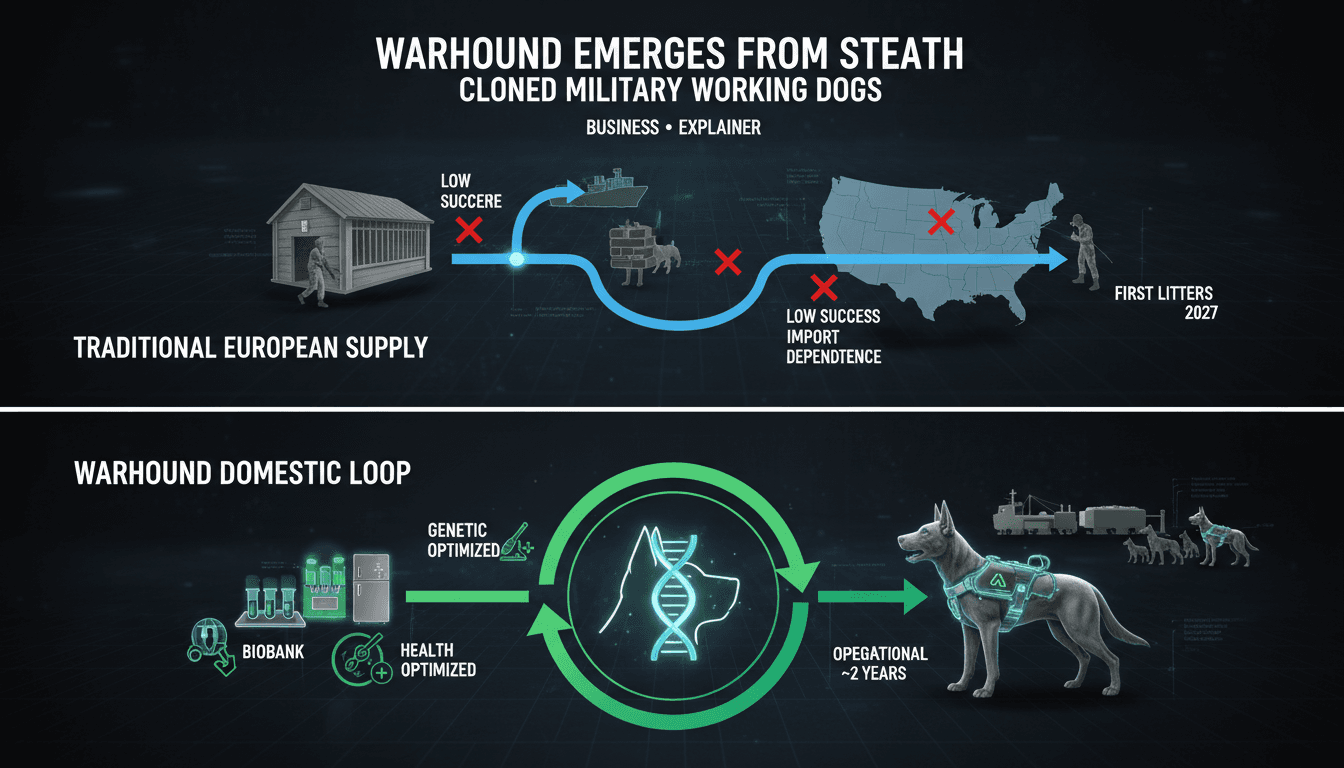
Why it matters
By substituting legacy European breeding networks with domestic biobanking and gene editing, defense contractors are treating biological assets as hard tech platforms with predictable production yields and integrated software suites.
What happened (in 30 seconds)
- A $200 million venture launched from stealth: Texas-based startup Warhound, co-founded by Palmer Luckey of Anduril Industries and Ben Lamm of Colossal Biosciences, emerged with a $1.2 billion valuation backed by investors including Sequoia Capital and ARK Invest.
- The company targets genetic cloning and editing: Warhound is biobanking tissue from elite Belgian Malinois, German Shepherds, and Labrador Retrievers to clone proven performers and edit out hereditary defects such as hip dysplasia.
- Tech integration will begin immediately: The startup plans to field its first modified litters in early 2027, pairing dogs with Anduril sensors, protective equipment, and situational awareness suites like Eagle Eye.
The context you actually need
- The U.S. faces an 80% foreign dependency: More than 80% of U.S. military working dogs are imported from Europe, leaving domestic operational readiness exposed to overseas market constraints and international competition.
- Selective breeding yields low qualification rates: Traditional canine reproduction produces variable physical and behavioral traits, resulting in high attrition rates during training pipelines before dogs ever reach active service.
- Defense hardware and synthetic biology are converging: Rather than treating service animals merely as support assets, the partnership fuses Colossal Biosciences’ gene-editing capabilities with Anduril’s sensor and computing ecosystem.
What's really happening
The formation of Warhound reflects a structural shift in how national defense programs manage operational dependencies. For decades, Western military and law enforcement agencies have relied on small-scale European breeders to supply working dogs capable of explosive detection, tracking, and perimeter defense. That procurement model presents two structural bottlenecks: an external supply vulnerability and an unpredictable qualification yield. When more than 80% of an operational capability relies on foreign breeders, procurement teams face currency exposure, shifting sovereign export rules, and rising procurement competition from third-party nations.
Warhound alters these economics by approaching canine biology as standardized infrastructure. Traditional selective breeding relies on genetic probability; litters regularly produce animals that fail behavioral tests or develop structural joint vulnerabilities such as hip dysplasia later in their working lifespans. By deploying biobanking and targeted gene editing, Warhound aims to eliminate known hereditary diseases while cloning specimens with field-tested performance markers. This shifts procurement from a low-yield screening model to an industrial batch-production model.
The enterprise valuation—$1.2 billion on a $200 million seed round—demonstrates strong venture demand for biological sovereignty in defense logistics. Investors like Sequoia Capital and ARK Invest are underwriting an asset class where biological organisms function as hardware platforms. Through Anduril Industries, Warhound plans to equip these animals with purpose-built protective armor and networked sensors that stream real-time environmental data directly into command interfaces like Eagle Eye.
This integration transforms the working dog into a biological edge sensor. Canines process olfactory data that synthetic chemical sensors cannot reliably replicate in unstructured environments. By reinforcing physical performance traits such as speed, endurance, and scent detection through biotechnology while outfitting the platform with communication hardware, the venture seeks to reduce operational failure rates. While the model bypasses overseas supply chains and reduces downstream medical retirements, it also pushes commercial defense contracting into unregulated bioethical territory.
Who feels it first (and how)
- Defense procurement officers: Military and homeland security buyers gain a domestic procurement alternative to unstable foreign canine pipelines, reducing logistical lead times.
- European working dog breeders: Traditional overseas kennels that supplied up to 80% of the American operational inventory face contract compression as domestic cloning scales.
- Biotech and defense venture capital: Funds targeting dual-use technologies face a precedent for underwriting commercial genetic engineering tied directly to battlefield hardware.
- First responder and canine training units: Handlers in tactical teams and disaster recovery will test standardized biological platforms integrated with sensor systems by 2028.
What to watch next
- Early 2027 litter viability: The birth of the first gene-edited puppies will confirm whether cellular cloning and editing techniques yield viable litters without unintended health anomalies.
- Federal regulatory classification: Watch how regulatory bodies define gene-edited operational animals, which dictates whether they face medical oversight or standard defense hardware approvals.
- Operational deployment timelines: Initial integration tests with Anduril hardware by 2028 will reveal whether engineered dogs outperform traditionally bred animals in operational scenarios.
Warhound raised $200 million at a $1.2 billion valuation to clone and genetically modify military working dogs, focusing on Belgian Malinois, German Shepherds, and Labradors.
Replacing overseas stock with engineered domestic lines will lower medical attrition rates and consolidate procurement contracts within the domestic defense-tech ecosystem.
Whether targeted gene editing can reliably enhance behavioral traits like drive and focus without triggering off-target biological complications or public regulatory friction.
Frequently Asked Questions
- Why it matters?
- By substituting legacy European breeding networks with domestic biobanking and gene editing, defense contractors are treating biological assets as hard tech platforms with predictable production yields and integrated software suites.
- What happened (in 30 seconds)?
- A $200 million venture launched from stealth: Texas-based startup Warhound, co-founded by Palmer Luckey of Anduril Industries and Ben Lamm of Colossal Biosciences, emerged with a $1.2 billion valuation backed by investors including Sequoia Capital and ARK Invest. The company targets genetic cloning and editing: Warhound is biobanking tissue from elite Belgian Malinois, German Shepherds, and Labrador Retrievers to clone proven performers and edit out hereditary defects such as hip dysplasia. Tech
- What's really happening?
- The formation of Warhound reflects a structural shift in how national defense programs manage operational dependencies. For decades, Western military and law enforcement agencies have relied on small-scale European breeders to supply working dogs capable of explosive detection, tracking, and perimeter defense. That procurement model presents two structural bottlenecks: an external supply vulnerability and an unpredictable qualification yield. When more than 80% of an operational capability relie
- Who feels it first (and how)?
- Defense procurement officers: Military and homeland security buyers gain a domestic procurement alternative to unstable foreign canine pipelines, reducing logistical lead times. European working dog breeders: Traditional overseas kennels that supplied up to 80% of the American operational inventory face contract compression as domestic cloning scales. Biotech and defense venture capital: Funds targeting dual-use technologies face a precedent for underwriting commercial genetic engineering tied d
- What to watch next?
- Early 2027 litter viability: The birth of the first gene-edited puppies will confirm whether cellular cloning and editing techniques yield viable litters without unintended health anomalies. Federal regulatory classification: Watch how regulatory bodies define gene-edited operational animals, which dictates whether they face medical oversight or standard defense hardware approvals. Operational deployment timelines: Initial integration tests with Anduril hardware by 2028 will reveal whether engin
Tech business coverage, major deals, product launches, and Silicon Valley trends.
"WSJ’s tech section offers authoritative reporting on the intersection of technology and business, including exclusive industry analysis."
— A47 Editor
The Plan to Put Super Dogs on the Battlefield of the Future
Anduril Industries is advancing its military technology initiatives by developing genetically engineered military dogs, designed to be faster and possess enhanced olfactory capabilities, to improve battlefield effectiveness. This project aims to leve...
U.S. business news, corporate developments, and economy.
"The Wall Street Journal is respected for deep financial and economic reporting with a center-right editorial perspective."
— A47 Editor
The Plan to Put Super Dogs on the Battlefield of the Future
Anduril Industries is spearheading an initiative to genetically engineer military dogs, aiming to enhance their speed and olfactory capabilities for battlefield applications. This venture, backed by co-founder Palmer Luckey and entrepreneur Ben Lamm,...
Conservative-leaning political and national coverage.
"The Washington Times is a conservative-leaning newspaper known for its political coverage and advocacy of right-of-center viewpoints."
— A47 Editor
New firm wants genetically enhanced working dogs for the military
Anduril Industries co-founder Palmer Luckey and Colossal Biosciences co-founder Ben Lamm are launching a new venture aimed at providing the military and law enforcement with genetically-enhanced working dogs. This initiative seeks to leverage advance...
Science and technology stories including AI.
"Longstanding science magazine with thoughtful AI coverage."
— A47 Editor
Warhound wants to engineer and clone military superdogs—can they do it?
Warhound, a startup co-founded by Ben Lamm and Palmer Luckey, has emerged from stealth mode with $200 million in funding aimed at developing genetically engineered dogs for military, law enforcement, and first responder applications. The initiative s...
Scientific research, technology, environment, and society.
"Scientific American is one of the oldest and most authoritative science magazines, known for deep dives into science, technology, and society."
— A47 Editor
Warhound wants to engineer and clone military superdogs—can they do it?
Warhound, a startup co-founded by Ben Lamm and Palmer Luckey, has emerged from stealth mode with $200 million in funding aimed at developing genetically engineered dogs for military, law enforcement, and first responder applications. The initiative s...
RT is a Russian state-funded network covering global events from a Russian perspective.
"RT is widely criticized for promoting pro-Kremlin narratives and is considered by many to be a state propaganda outlet."
— A47 Editor
Anduril’s Palmer Luckey launches genetically-engineered ‘war dogs’ startup
US billionaire Palmer Luckey has announced the launch of a startup focused on cloning genetically-engineered war dogs, which will be outfitted with advanced battlefield technology. This initiative aligns with Luckey's role as the founder of Anduril I...