
Audi CEO Faces German Backlash After Appearing at Trump Georgia Rally Announcing $4 Billion US Factory
Why it matters
The clash demonstrates how multinational manufacturing incentives are diverging from domestic labor pacts, forcing corporate leaders to balance local compliance against international market access.
What happened (in 30 seconds)
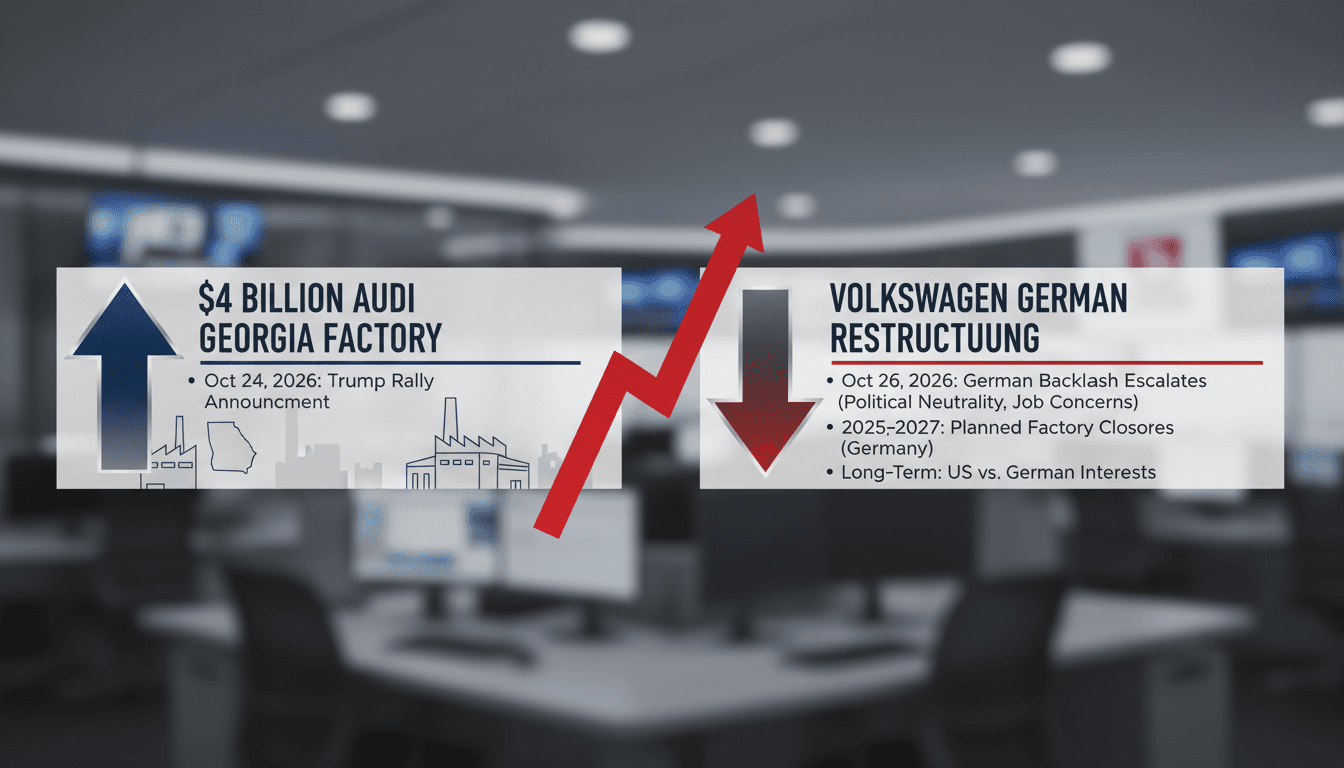
- The stage appearance: On October 24, 2026, Audi CEO Gernot Döllner joined U.S. President Donald Trump at a campaign rally in Georgia to announce a $4 billion investment in a new Macon manufacturing plant.
- The industrial footprint: The planned facility is engineered to produce 200,000 vehicles annually and create 4,500 jobs, marking Audi’s first dedicated manufacturing site in the United States.
- The domestic backlash: By October 26, 2026, German labor leaders and political officials publicly criticized Döllner, alleging a breach of internal political neutrality rules during an active restructuring period for parent group Volkswagen.
The context you actually need
- Domestic labor friction: Volkswagen Group entered late 2026 under restructuring pressures in Germany, marked by planned domestic factory closures and proposed job reductions.
- Strict neutrality guidelines: Internal corporate governance protocols mandate strict corporate political neutrality in the three months leading up to elections, establishing clear guardrails around executive public appearances.
- Trade tariff insulation: Audi prioritized direct expansion in North America to mitigate tariff exposure and capture regional volume ahead of the November 2026 U.S. midterm elections.
What's really happening
The conflict surrounding Gernot Döllner's appearance in Georgia exposes the structural tension between European labor codetermination and North American market protectionism. Volkswagen Group’s industrial model historically depended on a delicate domestic compromise: German labor unions, represented by IG Metall and the group works council, trade flexibility for long-term domestic investment guarantees and employment security.
That model faces structural friction when production economics shift abroad. Audi's decision to deploy $4 billion into Macon, Georgia, represents a capital-allocation calculation driven by trade barriers and supply-chain proximity. Producing 200,000 vehicles annually on American soil provides the brand with a hedge against prospective import tariffs. By localizing manufacturing, Audi positions its balance sheet inside the North American perimeter, securing localized subsidies, shorter logistics cycles, and regulatory insulation.
However, the execution of this strategy created immediate corporate governance fallout in Wolfsburg and Ingolstadt. For German labor representatives such as Daniela Cavallo and Christiane Benner, capital deployment abroad is viewed through the prism of domestic retrenchment. Volkswagen Group's parallel plans to close factories and eliminate positions in Germany made the timing of a $4 billion overseas commitment sensitive. Furthermore, joining an active campaign rally ran directly into the company’s internal policy mandating political neutrality in the three months prior to elections.
From an incentive standpoint, Döllner prioritized securing immediate political and operational goodwill for a multi-billion-dollar project in a critical market over adhering strictly to corporate governance optics at home. The trade-off is clear: by capturing long-term tariff protection and local assembly capacity in the world's second-largest automotive market, executive leadership accepted short-term institutional friction, parliamentary criticism, and internal works council reviews across Germany. As premium automakers compete for operating margins, the pressure to localize assembly near high-income consumer bases is outpacing traditional corporate neutrality standards.
Who feels it first (and how)
- European automotive labor forces: Workers at German assembly hubs face sustained uncertainty as capital expenditure shifts overseas while domestic plants evaluate footprint reductions.
- Georgia industrial contractors and labor: Regional economic operators in Macon capture 4,500 manufacturing jobs and the physical infrastructure development tied to the $4 billion facility.
- Global luxury vehicle buyers: International premium car buyers—including consumers in import-dependent hubs like Dubai—face reconfigured global supply chains that could alter vehicle sourcing, delivery timelines, and currency-driven retail pricing.
- Volkswagen Group governance committees: Executive boards and works council directors must navigate formal internal compliance reviews regarding code-of-conduct enforcement and executive public conduct.
What to watch next
- Works council review outcomes: Watch how Daniela Cavallo and the Volkswagen supervisory board handle internal neutrality inquiries, as this will determine the executive boundaries for global market announcements.
- Macon site development timelines: Monitor official permitting and groundbreaking schedules for the $4 billion Georgia plant to verify whether operational delivery matches announced timelines.
- Tariff adjustments post-midterms: Observe U.S. trade policy decisions following the November 2026 midterms, which will prove whether localized manufacturing shields Audi's operating margins relative to European-based peers.
Audi announced a $4 billion investment for an assembly site in Macon, Georgia, designed for 200,000 units annually and 4,500 jobs; German union leaders and political representatives formally condemned the rally appearance.
The works council will leverage the compliance dispute during domestic restructuring negotiations to secure employment guarantees or compensation for affected German plants.
Whether internal code-of-conduct reviews will lead to structural leadership changes or formal sanctions against Gernot Döllner.
Frequently Asked Questions
- Why it matters?
- The clash demonstrates how multinational manufacturing incentives are diverging from domestic labor pacts, forcing corporate leaders to balance local compliance against international market access.
- What happened (in 30 seconds)?
- The stage appearance: On October 24, 2026, Audi CEO Gernot Döllner joined U.S. President Donald Trump at a campaign rally in Georgia to announce a $4 billion investment in a new Macon manufacturing plant. The industrial footprint: The planned facility is engineered to produce 200,000 vehicles annually and create 4,500 jobs, marking Audi’s first dedicated manufacturing site in the United States. The domestic backlash: By October 26, 2026, German labor leaders and political officials publicly crit
- What's really happening?
- The conflict surrounding Gernot Döllner's appearance in Georgia exposes the structural tension between European labor codetermination and North American market protectionism. Volkswagen Group’s industrial model historically depended on a delicate domestic compromise: German labor unions, represented by IG Metall and the group works council, trade flexibility for long-term domestic investment guarantees and employment security. That model faces structural friction when production economics shift
- Who feels it first (and how)?
- European automotive labor forces: Workers at German assembly hubs face sustained uncertainty as capital expenditure shifts overseas while domestic plants evaluate footprint reductions. Georgia industrial contractors and labor: Regional economic operators in Macon capture 4,500 manufacturing jobs and the physical infrastructure development tied to the $4 billion facility. Global luxury vehicle buyers: International premium car buyers—including consumers in import-dependent hubs like Dubai—face re
- What to watch next?
- Works council review outcomes: Watch how Daniela Cavallo and the Volkswagen supervisory board handle internal neutrality inquiries, as this will determine the executive boundaries for global market announcements. Macon site development timelines: Monitor official permitting and groundbreaking schedules for the $4 billion Georgia plant to verify whether operational delivery matches announced timelines. Tariff adjustments post-midterms: Observe U.S. trade policy decisions following the November 20
Arabic-language political and world news coverage for UAE readers.
"Emarat Al Youm world coverage usually presents international developments through a UAE and Arab audience lens."
— A47 Editor
انتقادات في ألمانيا لظهور رئيس "أودي" مع ترامب في لقاء انتخابي للحزب الجمهوري الأميركي انتقادات في ألمانيا لظهور رئيس "أودي" مع ترامب في لقاء انتخابي للحزب الجمهوري الأميركي
Audi chief executive Gernot Döllner faced a wave of criticism in Germany on Monday after appearing alongside U.S. President Donald Trump at a Republican Party election event in the United States, according to Emarat Al Youm.
UK and international business news, economics, and corporate coverage.
"The Guardian’s business section covers finance and markets with a progressive editorial tone."
— A47 Editor
Audi boss under fire in Germany for Trump rally appearance
Audi CEO Gernot Döllner appeared on stage with US President Donald Trump at a Republican campaign rally in Georgia to announce a roughly $4 billion investment for Audi's first-ever US factory in Macon, expected to create about 4,500 jobs. The appeara...
Top international stories selected by The Guardian editors.
"The Guardian is known for its progressive editorial stance and in-depth analysis."
— A47 Editor
Audi boss under fire in Germany for Trump rally appearance
Audi chief executive Gernot Döllner joined US President Donald Trump on stage at a campaign rally in Georgia, days before the US midterm elections, to announce a $4bn investment in a new Audi SUV factory in Macon, which is expected to create about 4,...
Market-moving headlines impacting equities, bonds, and related risk assets.
"Real-time catalysts and volatility drivers across indices and sectors."
— A47 Editor
Audi CEO faces backlash after joining Trump at midterm campaign rally
Audi CEO Gernot Döllner appeared on stage with President Donald Trump at a Republican campaign rally in Georgia to announce that Audi will build its first-ever U.S. factory in Macon, a roughly $4 billion investment, while the announcement drew backla...
Coverage of national news and events from across the United States.
"HuffPost is known for its progressive editorial stance, offering opinionated yet comprehensive coverage on social, political, and cultural topics."
— A47 Editor
Audi Boss Accused Of Breaking Company Rules With Trump Rally Appearance
A German union leader has accused Audi CEO Gernot Döllner of breaking company guidelines by appearing on stage at a Trump campaign rally in Georgia, where the automaker's plan for a $4bn US factory in Macon was announced, creating about 4,500 jobs.