
Banks and Blackstone Commit $63 Billion Financing for Broadcom AI Chips Leased to Anthropic
Why it matters
The transaction establishes structured project finance as the primary mechanism for absorbing chip depreciation and hardware risk in the artificial intelligence sector.
What happened (in 30 seconds)
- A massive institutional consortium formed: Bank of America, Citigroup, Morgan Stanley, and Blackstone committed $63 billion to acquire Broadcom AI accelerators and networking equipment.
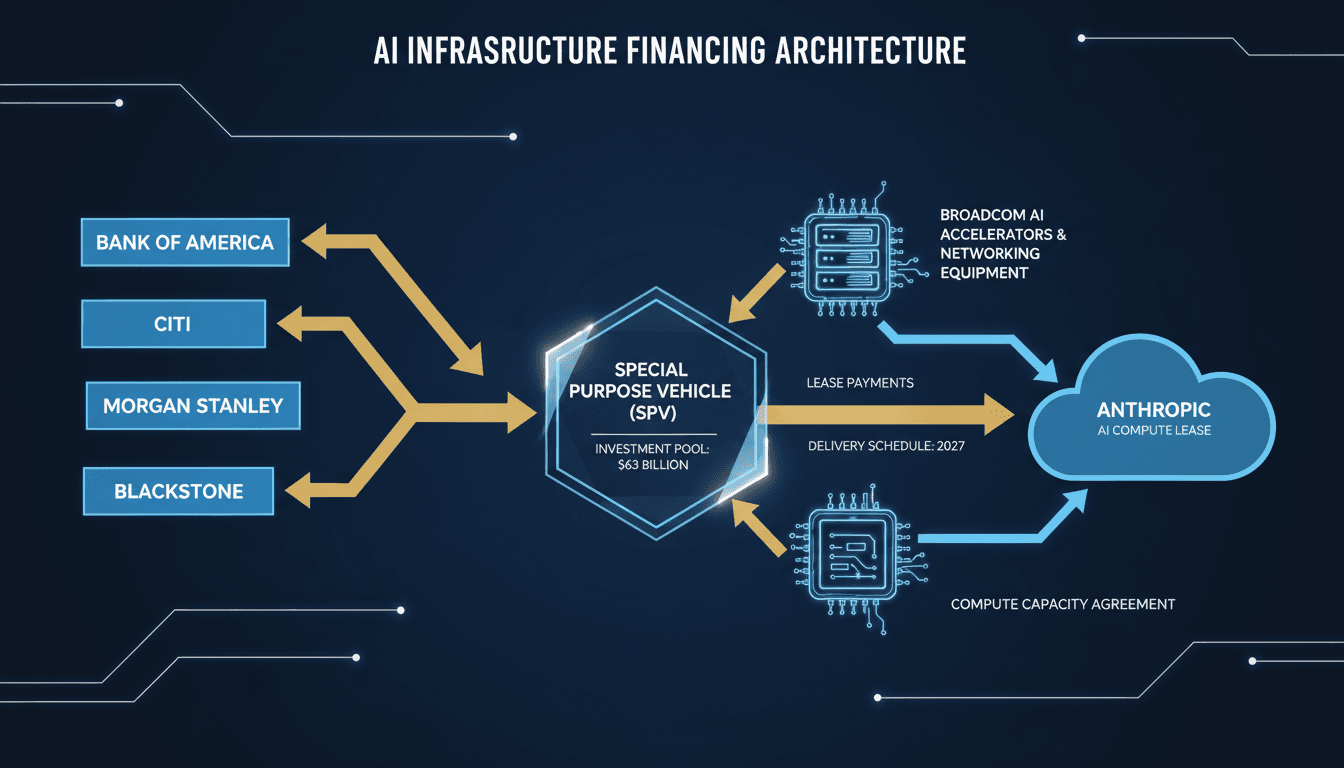
- The assets sit in a dedicated vehicle: The hardware will be purchased by a newly established special purpose vehicle (SPV) and leased directly to AI developer Anthropic.
- The capital stack is split into distinct risk tranches: The three investment banks arranged roughly $43.5 billion in first-lien senior debt, Blackstone provided the second-lien tranche, and Broadcom supplied residual value support matching the senior tier.
The context you actually need
- Precedent lease models are scaling rapidly: This transaction expands on earlier structured debt blueprints, including an earlier $35 billion Apollo-Blackstone package, which shifted physical compute asset ownership off technology balance sheets.
- Anthropic is securing compute ahead of public scrutiny: The arrangement coincides with Anthropic's public initial public offering (IPO) filing, allowing the company to guarantee long-term capacity starting in 2027 without absorbing tens of billions in direct capital expenditures.
- Broadcom secures locked-in demand through 2027: The deal finances Broadcom's custom XPU AI accelerators and networking systems under a prior compute capacity agreement, locking in multi-year hardware deliveries while mitigating lender default exposure.
What's really happening
The $63 billion package structured for Anthropic and Broadcom marks a functional turning point in how artificial intelligence infrastructure is capitalized. Rather than relying on venture equity or corporate balance-sheet reserves to purchase short-lived, power-dense silicon, the artificial intelligence sector is adopting structured project finance mechanisms traditionally reserved for energy utilities, commercial aircraft, and telecommunications networks.
At the core of this transaction is an off-balance-sheet special purpose vehicle. The SPV takes ownership of the Broadcom XPU AI accelerators and associated networking hardware, funding the purchase price through a bifurcated debt structure. Bank of America, Citigroup, and Morgan Stanley arranged $43.5 billion in senior first-lien debt. Blackstone provides the second-lien subordinate debt, absorbing junior credit risk in exchange for higher yields.
The mechanism resolves structural friction between model developers, chip suppliers, and debt markets:
First, it changes the financial geometry for Anthropic ahead of its initial public offering. If Anthropic were to purchase these accelerators outright, its balance sheet would be weighed down by rapid asset depreciation, high interest liabilities, and heavy cash consumption. By leasing the capacity via an SPV, the company converts high upfront capital spending into recurring operational compute lease expenses. This provides predictability for public market equity investors who value software margins over heavy industrial asset burdens.
Second, the structure redistributes rapid obsolescence risk. Modern compute chips face steep technological depreciation curves as newer architectures emerge. To satisfy lender caution during weeks of syndication, Broadcom provided residual value support equivalent to the $43.5 billion first-lien amount. This corporate backstop ensures that if Anthropic defaults, or if the hardware's market clearing value collapses before the debt matures, Broadcom absorbs the difference up to the senior threshold. In exchange, Broadcom guarantees tens of billions of dollars in enterprise sales for delivery cycles commencing in 2027.
Third, the transaction demonstrates how private credit and global investment banks are partnering to absorb capital requirements that exceed individual bank lending tolerances. By pairing senior investment-grade debt with private mezzanine capital, Wall Street has engineered a scalable financial pipeline that fuels AI hardware deployment without diluting tech equity.
Who feels it first (and how)
- Enterprise technology and cloud CFOs: Compute procurement teams face new competitive benchmarks, moving away from owned data center assets toward structured operational leasing frameworks.
- Private credit and leveraged finance desks: Debt syndication teams at global investment banks and private asset managers will see expanded mandates to structure specialized SPV tranches around enterprise AI hardware.
- Semiconductor supply-chain planners: Hardware manufacturers will increasingly evaluate customer agreements based on whether suppliers are willing to provide corporate residual-value guarantees to institutional lenders.
- Regional infrastructure investors: While direct impacts outside the United States are secondary, global capital reallocation toward multi-billion-dollar compute tranches accelerates international demand for co-located data center facilities and regional power grids.
What to watch next
- Syndication terms on subsequent tranches: Monitor the yields demanded by secondary institutional debt buyers on the $43.5 billion senior paper to measure broader bank appetite for hardware-backed credit.
- Anthropic's IPO registration filings: Review regulatory disclosures to inspect how credit rating agencies and auditors treat SPV lease obligations against the company's operating cash flows.
- 2027 Broadcom delivery benchmarks: Track early manufacturing and delivery timelines for Broadcom XPU deployments, which serve as the operational trigger for lease payments.
A $63 billion financing vehicle has been committed, led by $43.5 billion in senior debt from Bank of America, Citi, and Morgan Stanley, with Blackstone supplying second-lien financing and Broadcom providing residual value backing.
Competing foundation-model developers will follow Anthropic's lead, deploying similar off-balance-sheet structures to preserve capital margins and meet hardware commitments.
The exact cost of capital across the first- and second-lien tiers, as well as the specific physical salvage value of Broadcom XPUs at the end of their primary lease term.
Frequently Asked Questions
- Why it matters?
- The transaction establishes structured project finance as the primary mechanism for absorbing chip depreciation and hardware risk in the artificial intelligence sector.
- What happened (in 30 seconds)?
- A massive institutional consortium formed: Bank of America, Citigroup, Morgan Stanley, and Blackstone committed $63 billion to acquire Broadcom AI accelerators and networking equipment. The assets sit in a dedicated vehicle: The hardware will be purchased by a newly established special purpose vehicle (SPV) and leased directly to AI developer Anthropic. The capital stack is split into distinct risk tranches: The three investment banks arranged roughly $43.5 billion in first-lien senior debt, Bla
- What's really happening?
- The $63 billion package structured for Anthropic and Broadcom marks a functional turning point in how artificial intelligence infrastructure is capitalized. Rather than relying on venture equity or corporate balance-sheet reserves to purchase short-lived, power-dense silicon, the artificial intelligence sector is adopting structured project finance mechanisms traditionally reserved for energy utilities, commercial aircraft, and telecommunications networks. At the core of this transaction is an
- Who feels it first (and how)?
- Enterprise technology and cloud CFOs: Compute procurement teams face new competitive benchmarks, moving away from owned data center assets toward structured operational leasing frameworks. Private credit and leveraged finance desks: Debt syndication teams at global investment banks and private asset managers will see expanded mandates to structure specialized SPV tranches around enterprise AI hardware. Semiconductor supply-chain planners: Hardware manufacturers will increasingly evaluate custome
- What to watch next?
- Syndication terms on subsequent tranches: Monitor the yields demanded by secondary institutional debt buyers on the $43.5 billion senior paper to measure broader bank appetite for hardware-backed credit. Anthropic's IPO registration filings: Review regulatory disclosures to inspect how credit rating agencies and auditors treat SPV lease obligations against the company's operating cash flows. 2027 Broadcom delivery benchmarks: Track early manufacturing and delivery timelines for Broadcom XPU depl
Market-moving headlines impacting equities, bonds, and related risk assets.
"Real-time catalysts and volatility drivers across indices and sectors."
— A47 Editor
Wall Street banks, Blackstone line up $63 billion to finance Broadcom AI chips for Anthropic
Wall Street banks and Blackstone have lined up roughly $63 billion in financing to fund Broadcom AI chips for Anthropic, according to Investing.com. The deal builds on a record $60 billion syndication launched by Wall Street banks earlier in October,...
Curated tech headlines including AI stories.
"Influential aggregator surfacing the day’s top tech/AI links."
— A47 Editor
Broadcom arranges a $63B deal with BofA, Blackstone, Citi, and Morgan Stanley to finance the purchase of chips for Anthropic via a new special purpose vehicle (Lynn Doan/Bloomberg)
Broadcom has arranged a $63 billion financing package with Bank of America, Blackstone, Citigroup and Morgan Stanley to fund the purchase of chips for Anthropic, structured through a new special purpose vehicle, according to Bloomberg.
Tech business coverage, major deals, product launches, and Silicon Valley trends.
"WSJ’s tech section offers authoritative reporting on the intersection of technology and business, including exclusive industry analysis."
— A47 Editor
Banks, Blackstone Form $63 Billion Financing Vehicle for Broadcom AI Tech
Banks and Blackstone are lining up $63 billion in financing for a vehicle that will buy artificial-intelligence computing infrastructure from Broadcom and lease it to Anthropic, according to WSJ Tech reporting. The arrangement is described in neutral...
Markets desk coverage, trading insights, and investor updates.
"WSJ’s markets reporting provides in-depth analysis and context for investors."
— A47 Editor
Banks, Blackstone Form $63 Billion Financing Vehicle for Broadcom AI Tech
Banks and Blackstone are lining up roughly $63 billion in financing to purchase artificial-intelligence computing infrastructure from Broadcom and lease it to Anthropic, according to The Wall Street Journal and Investing.com, building on a record $60...
Technology business news, market impacts, and innovation trends.
"Bloomberg is a premier financial and tech news provider, respected for its in-depth reporting and analytical rigor."
— A47 Editor
Broadcom Arranges $63 Billion Deal to Finance Anthropic’s Chips
Broadcom has arranged a $63 billion financing package with Bank of America, Blackstone, Citigroup and Morgan Stanley to fund the purchase of chips by AI developer Anthropic PBC, according to Bloomberg Technology.
Technology business and AI-related headlines.
"Data-driven tech newsroom with global scope."
— A47 Editor
Broadcom Arranges $63 Billion Deal to Finance Anthropic’s Chips
Broadcom has arranged a $63 billion financing package with Bank of America, Blackstone, Citigroup and Morgan Stanley to fund the purchase of chips by AI developer Anthropic PBC, according to Bloomberg Technology.
Editor-curated FT homepage stories spanning markets, business, world, and opinion.
"The Financial Times is a globally respected business publication with a centrist/center-left tone and strong markets focus."
— A47 Editor
Meta plans $95bn stock offering to bankroll AI expansion
Meta has announced plans for a $95 billion stock offering to fund its artificial intelligence expansion, according to the Financial Times, with Nvidia, AMD and Broadcom named as cornerstone investors.