
AI Productivity Gains Confined to Magnificent Seven as S&P 493 Shows No Measurable Payoff
Why it matters
Capital expenditure on artificial intelligence is driving profit margins and revenue efficiency solely inside seven mega-cap tech balance sheets, leaving the remaining 98% of corporate America with zero measurable productivity dividend.
What happened (in 30 seconds)
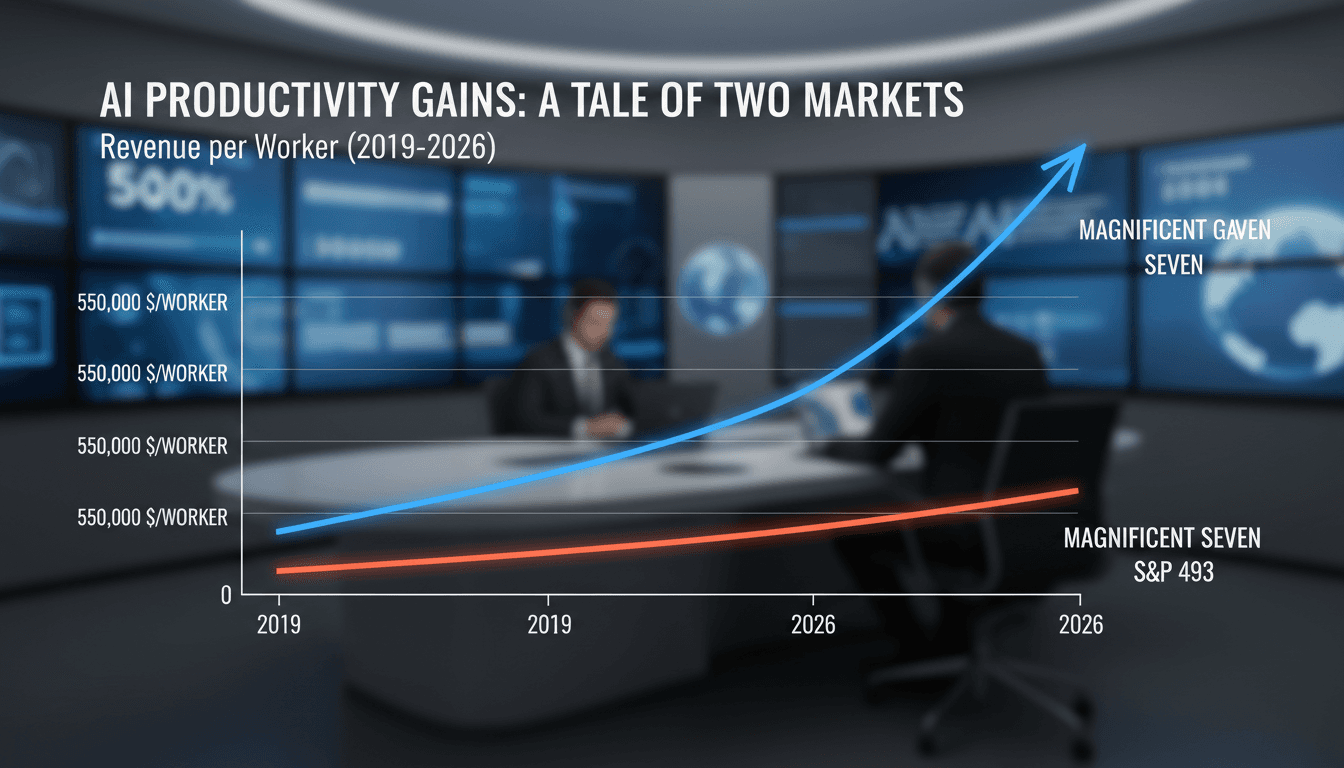
- A severe performance split emerged: Apollo Global Management analysis revealed that inflation-adjusted revenue per employee for the Magnificent Seven surged from roughly $550,000 in 2022 to nearly $800,000 in 2026.
- The broader market stalled: For the remaining 493 firms in the S&P 500, inflation-adjusted revenue per employee stayed entirely flat at approximately $550,000, failing to move above 2019 levels.
- Corporate budget behavior shifted: Non-tech enterprises began cutting back on discretionary AI deployments after internal audits categorized the software licenses and tokens as net cost centers rather than margin expansions.
The context you actually need
- Hyperscaler concentration captured the spend: Following the initial 2022–2023 rollout of large language models, enterprise America directed billions into compute capacity, token access, and experimental tools, which flowed directly to Nvidia, Tesla, Amazon, Microsoft, Alphabet, Apple, and Meta.
- Profit margins decoupled in late 2023: Since the third quarter of 2023, corporate net margin expansion across the S&P 500 has belonged exclusively to the Magnificent Seven, while the median corporate margin outside tech remained stagnant.
- Macroeconomic diffusion failed to register: Broad economic indicators across non-technology sectors show no aggregate uptick in labor output per hour worked, conflicting with earlier forecasts from institutions like Goldman Sachs that anticipated sweeping baseline efficiency.
What's really happening
The structural mechanics of the corporate AI boom have created a one-way financial pipeline rather than an economy-wide productivity engine.
When enterprise leaders rushed to procure generative AI tools between 2023 and 2025, they treated the technology as an operational efficiency layer designed to lift output per knowledge worker. Instead, the cost architecture of large language models reversed standard enterprise software dynamics. In traditional digital transformations, software licensing creates fixed operational costs that dilute over growing volume, unlocking wider profit margins. With enterprise AI, high inference costs, constant compute overhead, and subscription fees for external application programming interfaces turned deployments into compounding variable operating expenses.
Because the non-tech corporate sector—spanning retail, healthcare, manufacturing, finance, and logistics—struggles to monetize internal workflow automations directly, these tools simply added to baseline overhead. For the S&P 493, the inflation-adjusted revenue per worker remained frozen at $550,000 through late 2026, identical to where it sat seven years prior in 2019. The tools eliminated isolated task friction, but they did not generate incremental business volume, pricing power, or structural headcount reductions capable of moving aggregate balance sheets.
Conversely, the Magnificent Seven sit at the supply end of this capital cycle. They design the proprietary silicon, own the hyper-scale data centers, sell the enterprise cloud capacity, and license the foundational models. Every corporate trial, pilot project, and production deployment across the S&P 493 acts as direct top-line revenue for these seven infrastructure providers. As a result, the Magnificent Seven scaled their inflation-adjusted revenue per worker from roughly $550,000 in 2022 to nearly $800,000 by late 2026. Their profit margins expanded systematically from Q3 2023 onwards, funded largely by the capital budgets of the enterprises failing to see internal gains.
Faced with these balance sheet realities, non-tech corporate leadership teams are executing an incentive-driven retreat. Corporate procurement offices are moving away from widespread token consumption and experimental vendor contracts. Because enterprise AI failed to function as a self-funding growth driver, mainstream firms are actively classifying it as a traditional operational cost center, trimming pilot budgets and returning their focus to core unit economics.
Who feels it first (and how)
- Enterprise Chief Financial Officers: Non-tech financial leaders face immediate pressure to cut non-performing software subscriptions and justify three years of capital expenditures that delivered flat revenue per worker.
- Middle Management and Knowledge Workers: White-collar professionals who adopted AI productivity add-ons see enterprise access pulled or restricted as IT procurement departments classify specialized tools as unneeded overhead.
- Enterprise Software Vendors (Outside Mag 7): Mid-tier business-to-business software firms trying to charge enterprise premiums for AI-enabled features face direct vendor consolidation and budget clawbacks.
- Institutional Equity Allocators: Portfolio managers holding passive S&P 500 exposure remain tied to narrow index concentration risks, as market earnings power rests almost entirely on seven names.
What to watch next
- Non-Tech Corporate IT Budget Adjustments: Track whether mainstream S&P 500 capital allocations for software and technology flatten through upcoming quarterly earnings, signaling an entrenched retreat from external AI tools.
- Hyperscaler CapEx Guidance: Watch whether Magnificent Seven capital expenditure plans cool down if their enterprise customer base continues trimming peripheral AI usage fees.
- Rotation Across Equity Benchmarks: Monitor institutional trading volumes moving away from tech concentration into equal-weight S&P indices, testing whether broader market earnings can sustain valuations without tech-driven margin expansion.
The Magnificent Seven drove their revenue per worker to nearly $800,000 in 2026, while the S&P 493 saw zero inflation-adjusted worker productivity growth since 2019.
Corporate America outside of big tech will continue scaling back experimental AI deployments, restricting spend only to solutions with provable, near-term cost reductions.
Whether future iterations of enterprise models will lower inference and integration costs enough to finally generate measurable net profit margin gains for mainstream companies.
Frequently Asked Questions
- Why it matters?
- Capital expenditure on artificial intelligence is driving profit margins and revenue efficiency solely inside seven mega-cap tech balance sheets, leaving the remaining 98% of corporate America with zero measurable productivity dividend.
- What happened (in 30 seconds)?
- A severe performance split emerged: Apollo Global Management analysis revealed that inflation-adjusted revenue per employee for the Magnificent Seven surged from roughly $550,000 in 2022 to nearly $800,000 in 2026. The broader market stalled: For the remaining 493 firms in the S&P 500, inflation-adjusted revenue per employee stayed entirely flat at approximately $550,000, failing to move above 2019 levels. Corporate budget behavior shifted: Non-tech enterprises began cutting back on discretionar
- What's really happening?
- The structural mechanics of the corporate AI boom have created a one-way financial pipeline rather than an economy-wide productivity engine. When enterprise leaders rushed to procure generative AI tools between 2023 and 2025, they treated the technology as an operational efficiency layer designed to lift output per knowledge worker. Instead, the cost architecture of large language models reversed standard enterprise software dynamics. In traditional digital transformations, software licensing
- Who feels it first (and how)?
- Enterprise Chief Financial Officers: Non-tech financial leaders face immediate pressure to cut non-performing software subscriptions and justify three years of capital expenditures that delivered flat revenue per worker. Middle Management and Knowledge Workers: White-collar professionals who adopted AI productivity add-ons see enterprise access pulled or restricted as IT procurement departments classify specialized tools as unneeded overhead. Enterprise Software Vendors (Outside Mag 7): Mid-tier
- What to watch next?
- Non-Tech Corporate IT Budget Adjustments: Track whether mainstream S&P 500 capital allocations for software and technology flatten through upcoming quarterly earnings, signaling an entrenched retreat from external AI tools. Hyperscaler CapEx Guidance: Watch whether Magnificent Seven capital expenditure plans cool down if their enterprise customer base continues trimming peripheral AI usage fees. Rotation Across Equity Benchmarks: Monitor institutional trading volumes moving away from tech concen
Tech news, hardware, and AI tools coverage.
"PC/tech site increasingly covering AI hardware and apps."
— A47 Editor
The AI boom is happening at seven companies, the rest of the S&P 500 isn't seeing it
TechSpot reports, citing a Daily Spark note by Apollo Global Management Chief Economist Torsten Slok, that AI has so far delivered "zero financial payoff" to companies in corporate America outside the technology sector, despite heavy investment and h...
Curated insights and thought leadership in enterprise technology.
"Ciente.io delivers curated insights, thought leadership, and trends in B2B tech and innovation."
— A47 Editor
AI Delivers Zero Payoff to Enterprise America. Why Are We Even Surprised?
Apollo Global Management chief economist Torsten Slok has said that artificial intelligence delivers zero financial payoff to companies outside Big Tech, arguing that when the Magnificent Seven are removed from the S&P 500, profit margins and revenue...
AI news with an enterprise and cloud focus.
"Covers AI in the context of data infrastructure, cloud, and enterprise stacks."
— A47 Editor
Apollo analysis shows no one besides the biggest tech giants is seeing benefits from AI
Apollo Global Management published an analysis on Saturday finding that most of corporate America outside the largest technology firms has yet to see a financial payoff from the multimillion-dollar investments made in artificial intelligence.