
PIMCO Takes $4 Billion Stake in Apollo-Led $40 Billion SpaceX GPU Equipment Financing
Why it matters
The transaction establishes asset-backed hardware leasing as the primary institutional vehicle for funding multi-billion-dollar compute buildouts without diluting equity or tapping volatile public credit markets.
What happened (in 30 seconds)
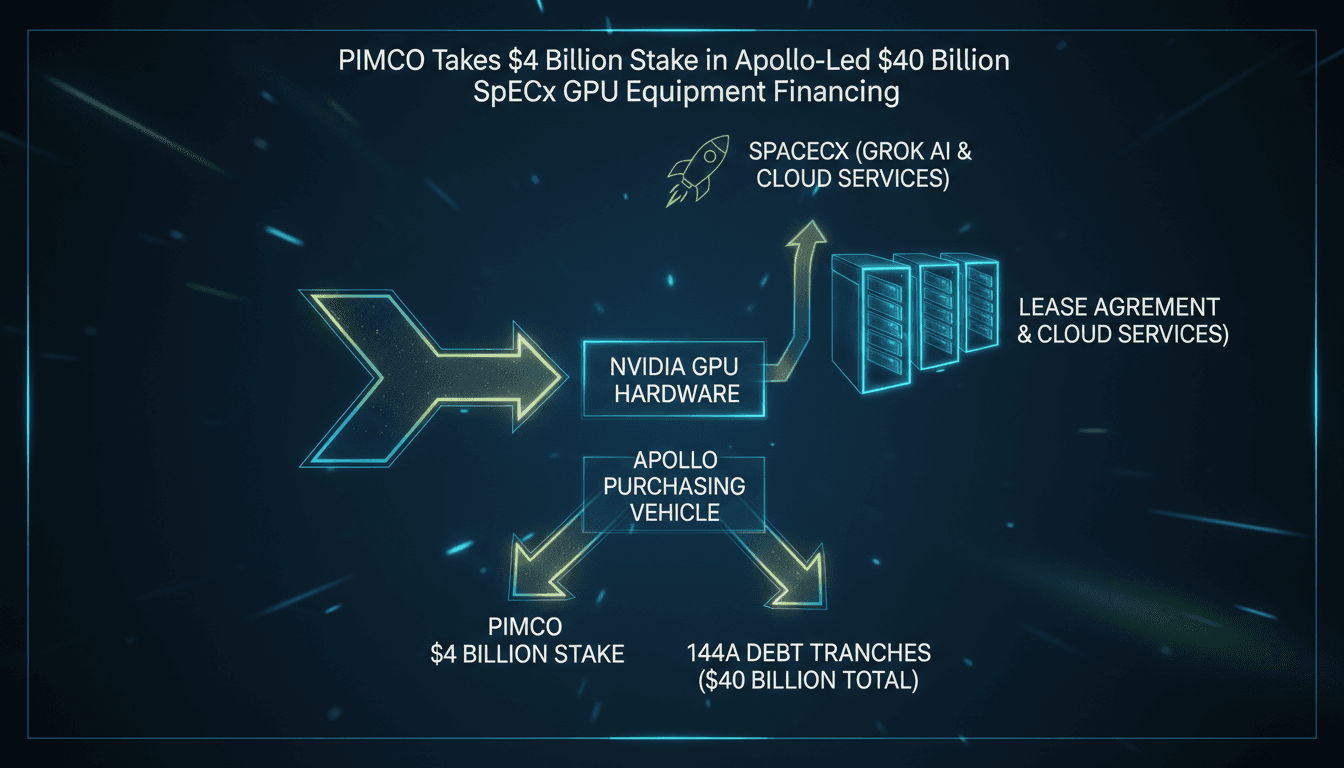
- A $40 billion financing vehicle was formed: SpaceX finalized a binding agreement for an equipment-financing facility arranged by Apollo Global Management to purchase Nvidia graphics processing units and server hardware.
- PIMCO took a direct tranche: Pacific Investment Management Co. bought a $4 billion slice of the A2 tranche, structured as privately placed 144a bonds sitting between senior and junior debt layers.
- Lease mechanics take effect in 2027: An Apollo-managed vehicle purchases the Nvidia hardware directly and leases it back to SpaceX for terms between 5 and 5.25 years, with deployments starting in the first half of 2027.
The context you actually need
- Compute demand is driving infrastructure debt: SpaceX is scaling its terrestrial infrastructure to support enterprise compute requirements, including cloud offerings and Grok models that generate recurring cash flow.
- Apollo established this leasing playbook earlier: Apollo Global Management previously engineered comparable hardware-leasing facilities for related Musk-led entities to avoid equity dilution.
- Private debt markets continue absorbing tech risk: The transaction proves institutional bondholders remain willing to absorb long-duration technology debt tranches despite recent volatility in tech-adjacent credit.
What's really happening
The structure of this $40 billion facility reflects a fundamental shift in how hyper-scale technology companies finance computing capacity. Rather than funding capital expenditures through corporate cash flow, straight corporate bonds, or equity sales, SpaceX is treating specialized computing hardware as depreciating physical equipment, structured through a lease arrangement.
Under this model, an Apollo-managed entity acts as the primary purchaser of Nvidia graphics processing units and associated enterprise server architecture. The purchasing vehicle then enters into an operating lease with SpaceX for a duration of five to five-and-a-quarter years. By structuring the capital outlay this way, SpaceX insulates its balance sheet from immediate single-event capital expenditures while securing access to critical computing infrastructure across multi-year cycles.
PIMCO’s acquisition of the $4 billion A2 tranche illustrates how mega-fund asset managers are pursuing yield in private credit. The A2 tranche represents a mezzanine position: it sits subordinate to senior debt holders but ranks ahead of junior, equity-adjacent risk layers. Issued as privately placed 144a notes, this debt allows fixed-income managers to capture structured yields backed by physical silicon hardware and SpaceX’s contractually obligated lease payments.
The transaction also alters the counterparty risk profile for hardware manufacturers. Nvidia sells hardware directly into an Apollo-managed special purpose structure backed by institutional credit from firms like PIMCO, rather than extending vendor financing or relying on the credit rating of a single operator. This ring-fences supplier liquidity while allowing the operating enterprise to pay for hardware as compute revenue materializes.
Furthermore, the five-year operational horizon reflects the expected productive economic lifespan of advanced AI accelerators. Because cutting-edge semiconductor architectures depreciate rapidly as newer chip iterations arrive, equity investors are hesitant to finance hardware with perpetual capital. Apollo’s lease structure ties repayment schedules directly to the hardware's functional service window. If the equipment remains productive across its five-year lease term starting in 2027, the lease payments cover principal and yield for tranche holders like PIMCO, establishing structured equipment leasing as a repeatable template for global compute expansion.
Who feels it first (and how)
- Enterprise fixed-income managers: Institutional portfolio teams face a growing supply of asset-backed technology paper competing directly with traditional corporate bonds.
- Enterprise infrastructure procurement officers: Technology leadership teams must evaluate structured hardware leasing versus direct balance-sheet ownership when purchasing AI silicon.
- Semiconductor supply chain strategists: Hardware manufacturers gain direct cash sales via intermediary institutional lease funds rather than managing customer credit lines.
What to watch next
- Execution of closing timelines by late 2026: Market absorption depends on whether Apollo successfully closes all remaining tranches before year-end.
- The start of 2027 hardware deliveries: Delivery schedules will determine whether Nvidia can deploy hardware on time to initiate the five-year lease agreements.
- Subsequent equipment-backed tech syndications: Other technology operators could replicate this 144a bond and leasing model to secure hardware tranches.
SpaceX disclosed a binding $40 billion financing deal led by Apollo, with PIMCO acquiring a $4 billion A2 tranche structured as 144a bonds for five to 5.25-year Nvidia GPU leases.
The transaction structure will establish a repeatable funding framework for other hyper-scale companies seeking private debt instead of equity dilution.
The residual market value of five-year-old Nvidia hardware when the leases terminate between 2031 and 2032 remains unknown.
Frequently Asked Questions
- Why it matters?
- The transaction establishes asset-backed hardware leasing as the primary institutional vehicle for funding multi-billion-dollar compute buildouts without diluting equity or tapping volatile public credit markets.
- What happened (in 30 seconds)?
- A $40 billion financing vehicle was formed: SpaceX finalized a binding agreement for an equipment-financing facility arranged by Apollo Global Management to purchase Nvidia graphics processing units and server hardware. PIMCO took a direct tranche: Pacific Investment Management Co. bought a $4 billion slice of the A2 tranche, structured as privately placed 144a bonds sitting between senior and junior debt layers. Lease mechanics take effect in 2027: An Apollo-managed vehicle purchases the Nvidia
- What's really happening?
- The structure of this $40 billion facility reflects a fundamental shift in how hyper-scale technology companies finance computing capacity. Rather than funding capital expenditures through corporate cash flow, straight corporate bonds, or equity sales, SpaceX is treating specialized computing hardware as depreciating physical equipment, structured through a lease arrangement. Under this model, an Apollo-managed entity acts as the primary purchaser of Nvidia graphics processing units and associa
- Who feels it first (and how)?
- Enterprise fixed-income managers: Institutional portfolio teams face a growing supply of asset-backed technology paper competing directly with traditional corporate bonds. Enterprise infrastructure procurement officers: Technology leadership teams must evaluate structured hardware leasing versus direct balance-sheet ownership when purchasing AI silicon. Semiconductor supply chain strategists: Hardware manufacturers gain direct cash sales via intermediary institutional lease funds rather than man
- What to watch next?
- Execution of closing timelines by late 2026: Market absorption depends on whether Apollo successfully closes all remaining tranches before year-end. The start of 2027 hardware deliveries: Delivery schedules will determine whether Nvidia can deploy hardware on time to initiate the five-year lease agreements. Subsequent equipment-backed tech syndications: Other technology operators could replicate this 144a bond and leasing model to secure hardware tranches.
Market-moving headlines impacting equities, bonds, and related risk assets.
"Real-time catalysts and volatility drivers across indices and sectors."
— A47 Editor
Pimco buys $4 billion of SpaceX AI debt package led by Apollo - Bloomberg
Pacific Investment Management Co. (Pimco) has bought a $4 billion slice of a large SpaceX financing package led by Apollo, according to reporting from Bloomberg and Investing.com, with proceeds expected to support SpaceX's artificial intelligence amb...
Global markets, investing, and macroeconomics from a premier financial newsroom.
"Bloomberg is respected for in-depth financial reporting and data-driven analysis."
— A47 Editor
Pimco Scoops Up $4 Billion of Massive SpaceX AI Debt Package
Pacific Investment Management Co. (Pimco) has bought a $4 billion slice of a massive SpaceX financing package, according to people familiar with the matter, with the proceeds expected to help expand SpaceX's artificial intelligence ambitions. The dea...
Technology business news, market impacts, and innovation trends.
"Bloomberg is a premier financial and tech news provider, respected for its in-depth reporting and analytical rigor."
— A47 Editor
SpaceX Agrees to $40 Billion Chip-Financing Deal With Apollo
SpaceX has signed a roughly $40 billion equipment-finance lease with Apollo Global Management Inc. to pay for the chips needed to fuel its artificial intelligence ambitions, according to Bloomberg Technology.